


Antidepressant Use and Its Association with 28-Day Mortality in Inpatients with SARS-CoV-2: Support for the FIASMA Model against COVID-19
- PMID: 36233753
- PMCID: PMC9572995
- DOI: 10.3390/jcm11195882
Antidepressant Use and Its Association with 28-Day Mortality in Inpatients with SARS-CoV-2: Support for the FIASMA Model against COVID-19
Abstract
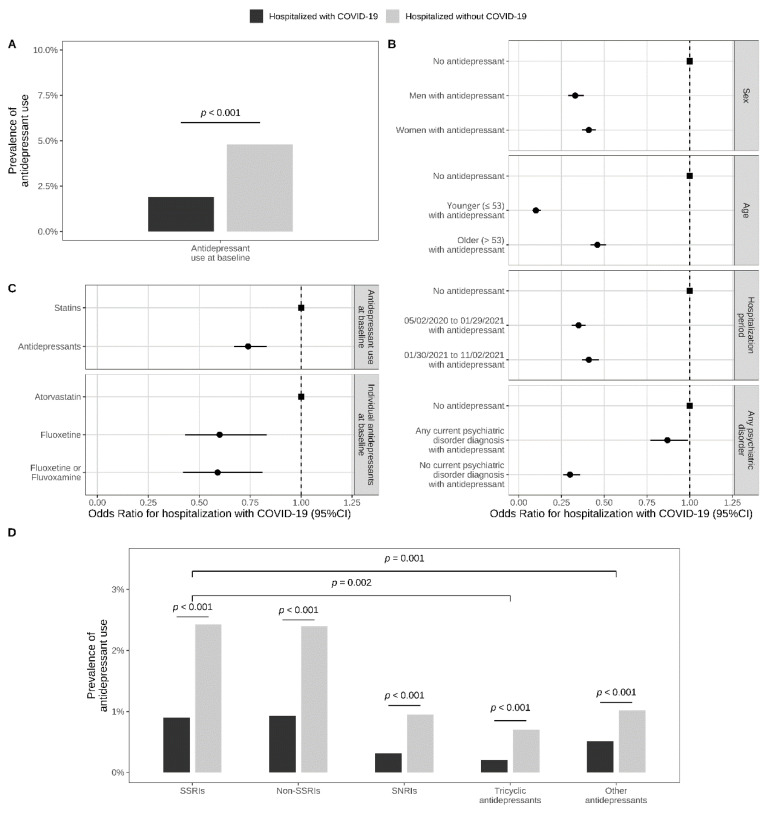
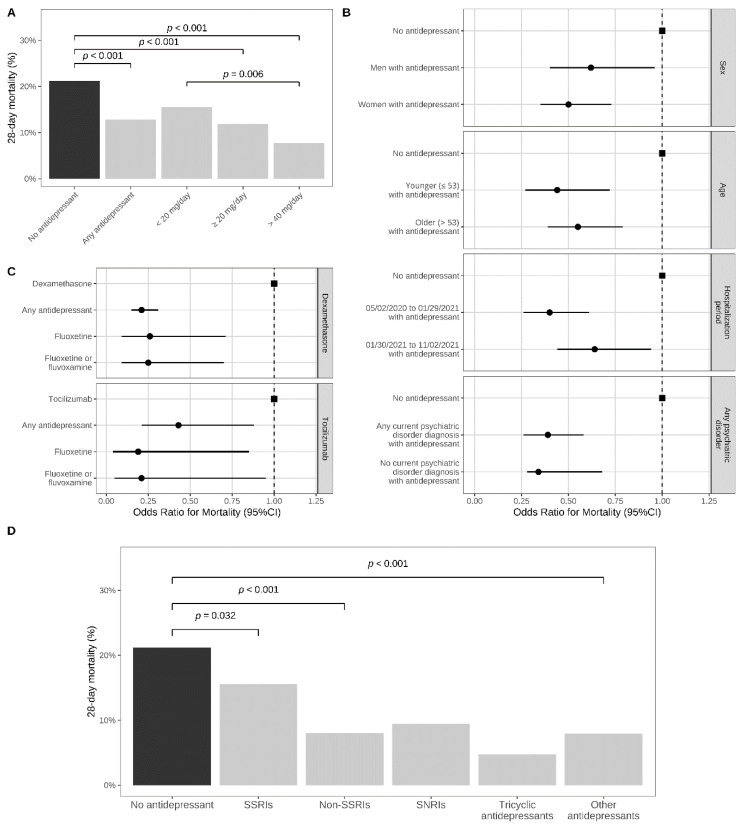
To reduce Coronavirus Disease 2019 (COVID-19)-related mortality and morbidity, widely available oral COVID-19 treatments are urgently needed. Certain antidepressants, such as fluvoxamine or fluoxetine, may be beneficial against COVID-19. We included 388,945 adult inpatients who tested positive for SARS-CoV-2 at 36 AP−HP (Assistance Publique−Hôpitaux de Paris) hospitals from 2 May 2020 to 2 November 2021. We compared the prevalence of antidepressant use at admission in a 1:1 ratio matched analytic sample with and without COVID-19 (N = 82,586), and assessed its association with 28-day all-cause mortality in a 1:1 ratio matched analytic sample of COVID-19 inpatients with and without antidepressant use at admission (N = 1482). Antidepressant use was significantly less prevalent in inpatients with COVID-19 than in a matched control group of inpatients without COVID-19 (1.9% versus 4.8%; Odds Ratio (OR) = 0.38; 95%CI = 0.35−0.41, p < 0.001). Antidepressant use was significantly associated with reduced 28-day mortality among COVID-19 inpatients (12.8% versus 21.2%; OR = 0.55; 95%CI = 0.41−0.72, p < 0.001), particularly at daily doses of at least 40 mg fluoxetine equivalents. Antidepressants with high FIASMA (Functional Inhibitors of Acid Sphingomyelinase) activity seem to drive both associations. These treatments may reduce SARS-CoV-2 infections and COVID-19-related mortality in inpatients, and may be appropriate for prophylaxis and/or COVID-19 therapy for outpatients or inpatients.
Keywords: COVID-19; FIASMA; SARS-CoV-2; antidepressant; ceramide; fluoxetine; fluvoxamine; mortality; sigma-1 receptor; sphingomyelinase.
Conflict of interest statement
N.H., M.S.R., J.K., E.G., A.C., C.M. and F.L. are inventors on a patent application related to methods of treating COVID-19, filled by Assistance Publique—Hopitaux de Paris in France. N.H. has received personal fees and non-financial support from Lundbeck, outside the submitted work. C.L. has received personal fees and non-financial support from Lundbeck and Otsuka Pharmaceutical, outside the submitted work. E.L. has received grant support (non-federal) from COVID Early Treatment Fund, Mercatus Center Emergent Ventures, the Skoll Foundation, the Taylor Family Institute for Innovative Psychiatric Research, the Center for Brain Research in Mood Disorders, the Patient-Centered Outcomes Research Institute, Janssen, and the Barnes Jewish Foundation, and has received consulting fees from Janssen and Jazz Pharmaceuticals. A.R. has received grant or research support from the McDonnell Center for Systems Neuroscience, the McDonnell Center for Cellular and Molecular Neurobiology, and the Taylor Family Institute for Innovative Psychiatric Research. A.R. and E.L. are inventors on a patent application related to methods of treating COVID-19, which was filed by Washington University in St. Louis. Other authors declare no conflict of interest related to this work.
Figures

References
-
- Matta J., Wiernik E., Robineau O., Carrat F., Touvier M., Severi G., de Lamballerie X., Blanché H., Deleuze J.-F., Gouraud C., et al. Association of Self-Reported COVID-19 Infection and SARS-CoV-2 Serology Test Results With Persistent Physical Symptoms Among French Adults During the COVID-19 Pandemic. JAMA Intern. Med. 2021;2021:6454. doi: 10.1001/jamainternmed.2021.6454. - DOI - PMC - PubMed
-
- Chevance A., Gourion D., Hoertel N., Llorca P.-M., Thomas P., Bocher R., Moro M.-R., Laprévote V., Benyamina A., Fossati P., et al. Ensuring mental health care during the SARS-CoV-2 epidemic in France: A narrative review. L’Encephale. 2020;46:193–201. doi: 10.1016/j.encep.2020.04.005. - DOI - PMC - PubMed
Grants and funding
LinkOut - more resources
Full Text Sources
Miscellaneous
