


Novel Alumina Matrix Composites Reinforced with MAX Phases-Microstructure Analysis and Mechanical Properties
- PMID: 36234250
- PMCID: PMC9571909
- DOI: 10.3390/ma15196909
Novel Alumina Matrix Composites Reinforced with MAX Phases-Microstructure Analysis and Mechanical Properties
Abstract
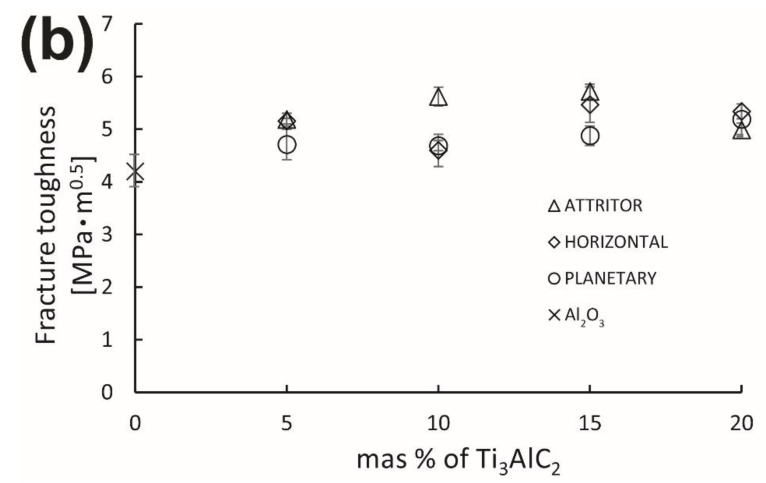
This article describes the manufacturing of alumina composites with the addition of titanium aluminum carbide Ti3AlC2, known as MAX phases. The composites were obtained by the powder metallurgy technique with three types of mill (horizontal mill, attritor mill, and planetary mill), and were consolidated with the use of the Spark Plasma Sintering method at 1400 °C, with dwelling time 10 min. The influence of the Ti3AlC2 MAX phase addition on the microstructure and mechanical properties of the obtained composites was analyzed. The structure of the MAX phase after the sintering process was also investigated. The chemical composition and phase composition analysis showed that the Ti3AlC2 addition preserved its structure after the sintering process. The increase in fracture toughness for all series of composites has been noted (over 20% compared to reference samples). Detailed stereological analysis of the obtained microstructures also could determine the influence of the applied mill on the homogeneity of the final microstructure and the properties of obtained composites.
Keywords: Al2O3; MAX phases; composites; mechanical properties; sintering.
Conflict of interest statement
The authors declare no conflict of interest.
Figures
References
-
- Koli D.K., Agnihotri G., Purohit R. A Review on Properties, Behaviour and Processing Methods for Al-Nano Al2O3 Composites. Procedia Mater. Sci. 2014;6:567–589. doi: 10.1016/j.mspro.2014.07.072. - DOI
-
- Munro M. Evaluated Material Properties for a Sintered alpha-Alumina. J. Am. Ceram. Soc. 1997;80:1919–1928. doi: 10.1111/j.1151-2916.1997.tb03074.x. - DOI
-
- Sternitzke M. Structural ceramic nanocomposites. J. Eur. Ceram. Soc. 1997;17:1061–1082. doi: 10.1016/S0955-2219(96)00222-1. - DOI
-
- Niihara K. New Design Concept of Structural Ceramics. J. Ceram. Soc. Jpn. 1991;99:974–982. doi: 10.2109/jcersj.99.974. - DOI
-
- Petrus M., Wozniak J., Cygan T., Kostecki M., Cygan S., Jaworska L., Teklińska D., Olszyna A. Comprehensive study on graphene-based reinforcements in Al2O3–ZrO2 and Al2O3–Ti(C,N) systems and their effect on mechanical and tribological properties. Ceram. Int. 2019;45:21742–21750. doi: 10.1016/j.ceramint.2019.07.175. - DOI
LinkOut - more resources
Full Text Sources
