


Long-term effect of childhood trauma: Role of inflammation and white matter in mood disorders
- PMID: 36237478
- PMCID: PMC9550612
- DOI: 10.1016/j.bbih.2022.100529
Long-term effect of childhood trauma: Role of inflammation and white matter in mood disorders
Abstract
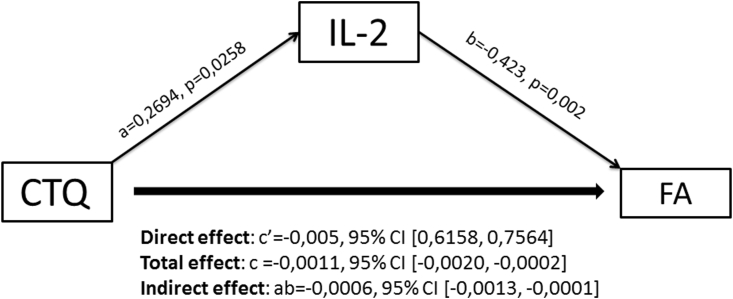
Bipolar disorder (BD) and major depressive disorder (MDD) are severe psychiatric illnesses that share among their environmental risk factors the exposure to adverse childhood experiences (ACE). Exposure to ACE has been associated with long-term changes in brain structure and the immune response. In the lasts decades, brain abnormalities including alterations of white matter (WM) microstructure and higher levels of peripheral immune/inflammatory markers have been reported in BD and MDD and an association between inflammation and WM microstructure has been shown. However, differences in these measures have been reported by comparing the two diagnostic groups. The aim of the present study was to investigate the interplay between ACE, inflammation, and WM in BD and MDD. We hypothesize that inflammation will mediate the association between ACE and WM and that this will be different in the two groups. A sample of 200 patients (100 BD, 100 MDD) underwent 3T MRI scan and ACE assessment through Childhood Trauma Questionnaire. A subgroup of 130 patients (75 MDD and 55 BD) underwent blood sampling for the assessment of immune/inflammatory markers. We observed that ACE associated with higher peripheral levels of IL-2, IL-17, bFGF, IFN-γ, TNF-α, CCL3, CCL4, CCL5, and PDGF-BB only in the BD group. Further, higher levels of CCL3 and IL-2 associated with lower FA in BD. ACE were found to differently affect WM microstructure in the two diagnostic groups and to be negatively associated with FA and AD in BD patients. Mediation analyses showed a significant indirect effect of ACE on WM microstructure mediated by IL-2. Our findings suggest that inflammation may mediate the detrimental effect of early experiences on brain structure and different mechanisms underlying brain alterations in BD and MDD.
Keywords: Bipolar disorder; Early stress; Interleukin 2; White matter.
© 2022 The Authors.
Conflict of interest statement
None.
Figures
References
-
- Agnew-Blais J., Danese A. Childhood maltreatment and unfavourable clinical outcomes in bipolar disorder: a systematic review and meta-analysis. Lancet Psychiatr. 2016;3:342–349. - PubMed
-
- Ascoli B.M., Gea L.P., Colombo R., Barbe-Tuana F.M., Kapczinski F., Rosa A.R. The role of macrophage polarization on bipolar disorder: identifying new therapeutic targets. Aust. N. Z. J. Psychiatr. 2016;50:618–630. - PubMed
-
- Bai Y.M., Su T.P., Li C.T., Tsai S.J., Chen M.H., Tu P.C., Chiou W.F. Comparison of pro-inflammatory cytokines among patients with bipolar disorder and unipolar depression and normal controls. Bipolar Disord. 2015;17:269–277. - PubMed
-
- Bateson P., Barker D., Clutton-Brock T., Deb D., D'Udine B., Foley R.A., Gluckman P., Godfrey K., Kirkwood T., Lahr M.M., McNamara J., Metcalfe N.B., Monaghan P., Spencer H.G., Sultan S.E. Developmental plasticity and human health. Nature. 2004;430:419–421. - PubMed
LinkOut - more resources
Full Text Sources
Miscellaneous
