


Editorial
doi: 10.7554/eLife.83076.
More than just an inert dense region
Affiliations
- PMID: 36239700
- PMCID: PMC9566848
- DOI: 10.7554/eLife.83076
Item in Clipboard
Editorial
More than just an inert dense region
Elife.
.
Abstract
A newly discovered protein helps define a subset of heterochromatin regions that can silence harmful mobile genetic elements in the genome of fruit flies.
Keywords: D. melanogaster; HP1 proteins; chromosomes; gene expression; genetics; genomics; germline biology; heterochromatin formation; piRNA pathway; transposon biology; zinc finger proteins.
© 2022, Akkouche and Brasset.
Conflict of interest statement
AA, EB No competing interests declared
Figures
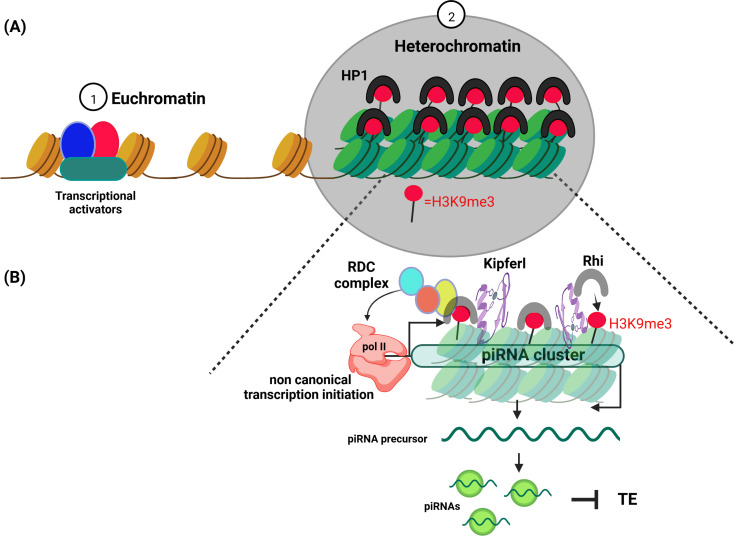
(A) Euchromatin (left) is involved in the transcription of DNA into mRNA. It is usually only lightly packed, with the histone proteins it is wrapped around (brown cylinders) spaced far apart so that the DNA can be easily accessed by the cell’s transcription machinery (red, blue and green shapes). Heterochromatin (right) on the other hand, is more densely packed with histone proteins (green cylinders) closely crammed together, making the DNA less accessible. Proteins belonging to the HP1 (Heterochromatin Protein 1) family promote the formation of a condensed chromatin structure by binding to the histone mark H3K9me3 (red circle). (B) Heterochromatin has long been thought to be without purpose. However, it has been shown to play an important role in identifying and silencing mobile genetic elements which can disrupt the integrity of the genome. One of the ways cells protect themselves is to transcribe parts of heterochromatin (known as piRNA clusters) that contain these harmful genetic elements. In fruit flies, the DNA-binding protein Kipferl (purple swirl) guides an HP1 protein expressed in germline cells called Rhino (grey horseshoe) to a subset of heterochromatin regions that are enriched in H3K9me3. Rhino then recruits three other proteins to form the RDC complex (made up of Rhino, Deadlock, Cutoff). This complex initiates the transcription of these specific loci with the help of the enzyme RNA polymerase II (peach coloured shape). The resulting transcripts are then processed into piRNAs that guide proteins to silence the mobile genetic elements also called Transposable element (TE).
Comment on
-
The Drosophila ZAD zinc finger protein Kipferl guides Rhino to piRNA clusters.Elife. 2022 Oct 4;11:e80067. doi: 10.7554/eLife.80067. Elife. 2022. PMID: 36193674 Free PMC article.
References
-
- Akkouche A, Mugat B, Barckmann B, Varela-Chavez C, Li B, Raffel R, Pélisson A, Chambeyron S. Piwi is required during Drosophila embryogenesis to license dual-strand pirna clusters for transposon repression in adult ovaries. Molecular Cell. 2017;66:411–419. doi: 10.1016/j.molcel.2017.03.017. - DOI - PubMed
Publication types
MeSH terms
Substances
LinkOut - more resources
Full Text Sources
Molecular Biology Databases
