


A critical review of front-loading: A maladaptive drinking pattern driven by alcohol's rewarding effects
- PMID: 36239713
- PMCID: PMC9588658
- DOI: 10.1111/acer.14924
A critical review of front-loading: A maladaptive drinking pattern driven by alcohol's rewarding effects
Abstract
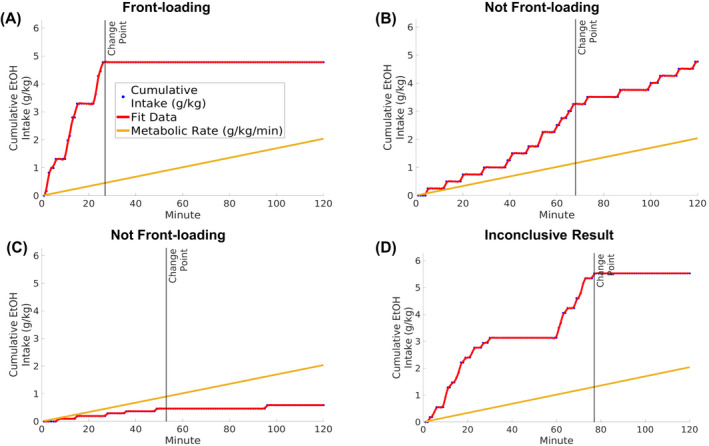
Front-loading is a drinking pattern in which alcohol intake is skewed toward the onset of reward access. This phenomenon has been reported across several different alcohol self-administration protocols in a wide variety of species, including humans. The hypothesis of the current review is that front-loading emerges in response to the rewarding effects of alcohol and can be used to measure the motivation to consume alcohol. Alternative or additional hypotheses that we consider and contrast with the main hypothesis are that: (1) front-loading is directed at overcoming behavioral and/or metabolic tolerance and (2) front-loading is driven by negative reinforcement. Evidence for each of these explanations is reviewed. We also consider how front-loading has been evaluated statistically in previous research and make recommendations for defining this intake pattern in future studies. Because front-loading may predict long-term maladaptive alcohol drinking patterns leading to the development of alcohol use disorder (AUD), several future directions are proposed to elucidate the relationship between front-loading and AUD.
Keywords: alcohol; alcohol use disorder; drinking patterns; front-loading; high-intensity drinking; motivation; tolerance.
© 2022 The Authors. Alcoholism: Clinical & Experimental Research published by Wiley Periodicals LLC on behalf of Research Society on Alcoholism.
Conflict of interest statement
The authors declare no conflict of interest.
Figures
References
-
- Agabio, R. , Pisanu, C. , Gessa, G.L. & Franconi, F. (2017) Sex differences in alcohol use disorder. Current Medicinal Chemistry, 24, 2661–2670. - PubMed
-
- Becker, H.C. & Lopez, M.F. (2004) Increased ethanol drinking after repeated chronic ethanol exposure and withdrawal experience in C57BL/6 mice. Alcoholism: Clinical and Experimental Research, 28, 1829–1838. - PubMed
Publication types
MeSH terms
Substances
Grants and funding
LinkOut - more resources
Full Text Sources
Medical
