. 2022 Dec;31(6):661-676.
doi: 10.1007/s11248-022-00328-4. Epub 2022 Oct 14.

An Agrobacterium strain auxotrophic for methionine is useful for switchgrass transformation

Affiliations

An Agrobacterium strain auxotrophic for methionine is useful for switchgrass transformation

Mónica Prías-Blanco et al. Transgenic Res. 2022 Dec.

Abstract

Auxotrophic strains of Agrobacterium tumefaciens can contribute to the development of more efficient transformation systems, especially for crops historically considered recalcitrant. Homologous recombination was used to derive methionine auxotrophs of two common A. tumefaciens strains, LBA4404 and EHA105. The EHA105 strains were more efficient for switchgrass transformation, while both the EHA105 and LBA4404 strains worked equally well for the rice control. Event quality, as measured by transgene copy number, was not affected by auxotrophy, but was higher for the LBA4404 strains than the EHA105 strains. Ultimately, the use of auxotrophs reduced bacterial overgrowth during co-cultivation and decreased the need for antibiotics.

Keywords: Agrobacterium tumefaciens; Auxotrophy; Rice; Switchgrass; Transformation.


Conflict of interest statement

The authors declare that they have no conflict of interest.

Figures
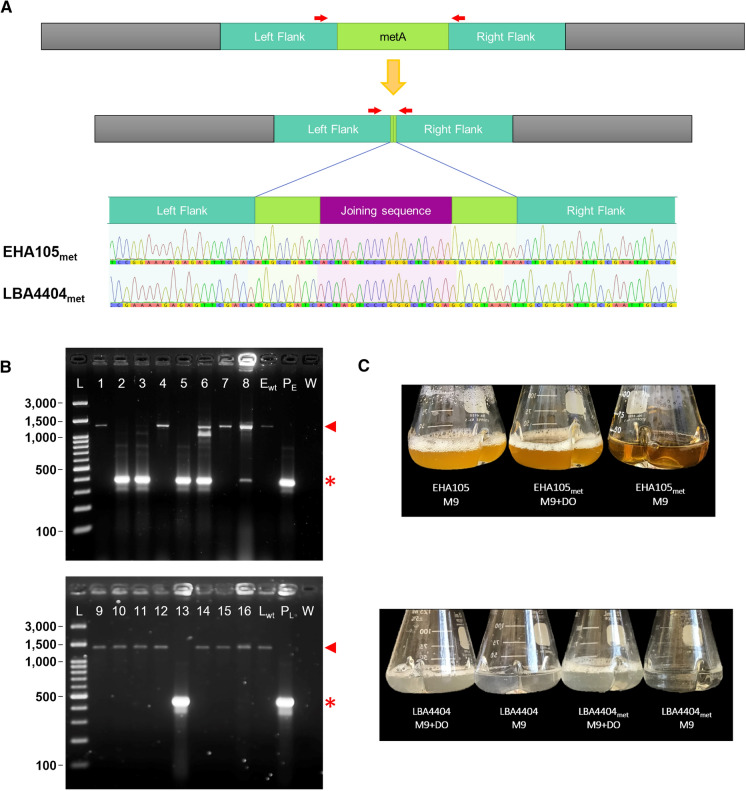
Fig. 1
Fig. 1
Generation of homologous recombination-mediated methionine auxotrophic mutants in Agrobacterium. a To make an auxotrophic Agrobacterium mutant we deleted the homoserine O-succinyltransferase (metA) gene—leaving the first three codons followed by the joining sequence CTCGAGCCCGGGACTAGT and the last two/three codons, including the stop codon of metA gene. Red arrows indicate the relative positions of the PCR primers used to validate the metA deletion. b Screening for Agrobacterium metA knockout mutants. Lanes 1 to 8: EHA105 background colony screening; Ewt: EHA105 wild-type DNA control; PE: pDONR1K18-EHAmetA plasmid; W: water; Lanes 9 to 16 LBA4404 background colony screening; Lwt: LBA4404 wild-type DNA control; PL: pDONR1K18-LBAmetA plasmid; L: 100-bp DNA ladder. *: mutant allele at metA locus (381 and 455-bp for EHA105met and LBA4404met, respectively). : wild-type allele (1271 and 1349-bp for EHA105 and LBA4404, respectively). c Methionine dependent growth of auxotrophic strains after 24-h incubation at 28 °C in minimal medium (M9) or M9 supplemented with DO
Fig. 2
Fig. 2
Embryogenic callus induction from basal culms of in vitro switchgrass plantlets
Fig. 3
Fig. 3
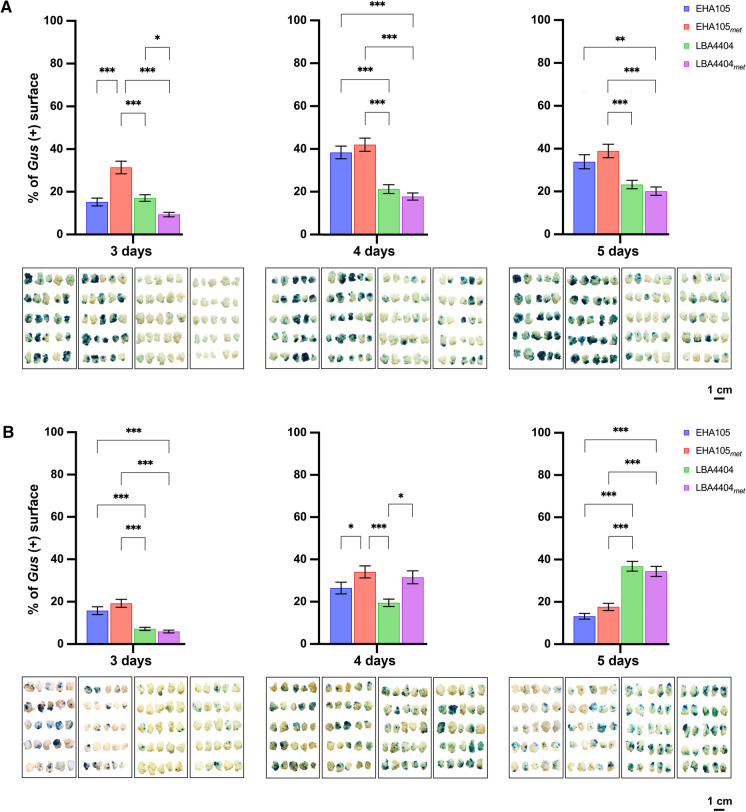
GUS staining in a switchgrass Performer 7 callus and b rice TP309 after three, four, and five days of co-cultivation. GUS-staining was conducted 8 days after the end of co-cultivation. Photos from one representative replicate are shown. Plot and error bars represent the mean value ± SEM of percent GUS staining from three biological replicates (n = 25). Because experimental data did not fit the normal distribution, data were normalized as described in the material and methods section and subjected to a two-way ANOVA and Tukey test. Only significant pairwise comparisons are shown. Significance levels P-value according to Tukey test are shown as < 0.05 (*), < 0.01 (**), or < 0.001 (***)
Fig. 4
Fig. 4
Agrobacterium growth in co-cultivation with switchgrass tissue. Co-cultivation was for three, four and five days. The plant tissue may produce enough methionine to support limited growth of the bacteria
Fig. 5
Fig. 5
Number of hygromycin-resistant calli and GUS-positive regenerated events after transformation of switchgrass and rice with EHA105 and EHA105met, and LBA4404 and LBA4404met. a Switchgrass Performer 7; b Rice TP309. Bars represent the mean ± SEM from two biological replicates after eight weeks of selection. Significance levels P-value according to Tukey’s test are shown as > 0.05 (ns), ≤ 0.05 (*), ≤ 0.01 (**), or ≤ 0.001 (***)
Fig. 6
Fig. 6
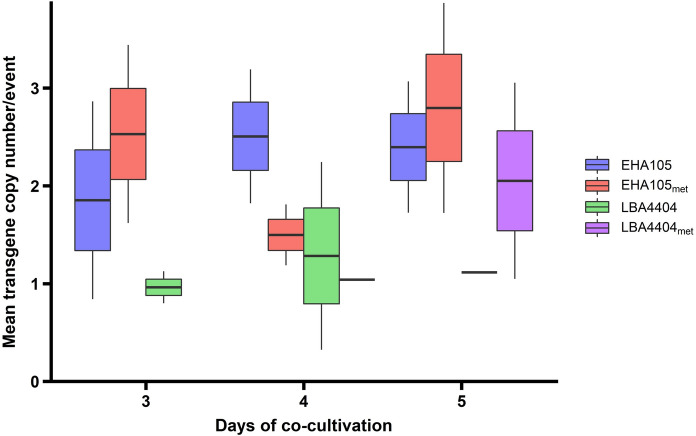
Evaluation of transgene copy number among switchgrass transgenic T0 lines transformed with pCAMBIA-1305.2. Box plots depict the mean ± SEM of GusPlus™ copies inserted by the different Agrobacterium strains, with whiskers showing the 95%-confidence interval. Each Agrobacterium strain is colored as indicated in the key. The low mean value at 4-days of co-cultivation for EHA105met was because 9 of the 15 events analyzed (60%) presented one single T-DNA insertion

References

    1. Alexandrova KS, Denchev PD, Conger BV. In vitro development of inflorescences from switchgrass nodal segments. Crop Sci. 1996;36:175–178. doi: 10.2135/cropsci1996.0011183X003600010031x. - DOI - PubMed
    1. Aliu E, Azanu MK, Wang K, Lee K (2020) Generation of thymidine auxotrophic Agrobacterium tumefaciens strains for plant transformation. bioRxiv. 10.1101/2020.08.21.261941
    1. Anand A, Bass SH, Wu E, Wang N, McBride KE, Annaluru N, Miller M, Hua M, Jones TJ. An improved ternary vector system for Agrobacterium-mediated rapid maize transformation. Plant Mol Biol. 2018;97:187–200. doi: 10.1007/s11103-018-0732-y. - DOI - PMC - PubMed
    1. Bellido AM, Souza Canadá ED, Permingeat HR, Echenique V. Genetic transformation of apomictic grasses: progress and constraints. Front Plant Sci. 2021;12:768393. doi: 10.3389/fpls.2021.768393. - DOI - PMC - PubMed
    1. Burris JN, Mann DGJ, Joyce BL, Stewart CN. An improved tissue culture system for embryogenic callus production and plant regeneration in switchgrass (Panicum virgatum L.) Bioenerg Res. 2009;2:267–274. doi: 10.1007/s12155-009-9048-8. - DOI

Publication types

MeSH terms

LinkOut - more resources