. 2023 Jan 5;25(1):4-25.
doi: 10.1093/neuonc/noac207.

Isocitrate dehydrogenase (IDH) mutant gliomas: A Society for Neuro-Oncology (SNO) consensus review on diagnosis, management, and future directions

Affiliations

Isocitrate dehydrogenase (IDH) mutant gliomas: A Society for Neuro-Oncology (SNO) consensus review on diagnosis, management, and future directions

Julie J Miller et al. Neuro Oncol. .

Abstract

Isocitrate dehydrogenase (IDH) mutant gliomas are the most common adult, malignant primary brain tumors diagnosed in patients younger than 50, constituting an important cause of morbidity and mortality. In recent years, there has been significant progress in understanding the molecular pathogenesis and biology of these tumors, sparking multiple efforts to improve their diagnosis and treatment. In this consensus review from the Society for Neuro-Oncology (SNO), the current diagnosis and management of IDH-mutant gliomas will be discussed. In addition, novel therapies, such as targeted molecular therapies and immunotherapies, will be reviewed. Current challenges and future directions for research will be discussed.

Keywords: D-2HG; Isocitrate dehydrogenase (IDH); glioma.


Figures

Figure 1.
Figure 1.
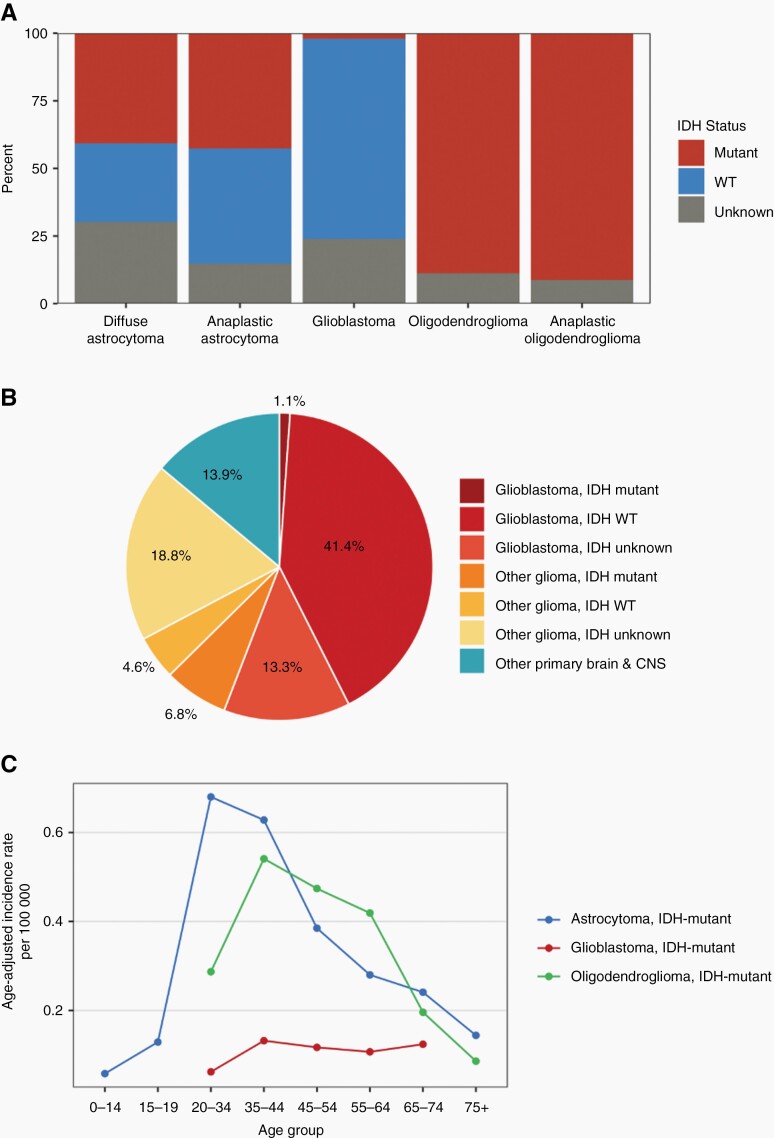
(A) Distribution of IDH status among pathologically-confirmed diffuse astrocytoma, grade 2 (ICD-O-3: 9400/3), astrocytoma, grade 3 (ICD-O-3: 9401/3), astrocytoma, grade 4/glioblastoma (ICD-O-3: 9440/3, 9441/3, 9442/3, 9445/3), oligodendroglioma, grade 2 (ICD-O-3: 9450/3), and oligodendroglioma, grade 3 (ICD-O-3: 9451/3) using the 2016 WHO classification system. IDH status determined by NAACCR Item #3816: Brain Molecular Markers, where applicable. (CBTRUS: Data provided by CDC’s National Program of Cancer Registries and NCI’s Surveillance, Epidemiology and End Results Program, 2018). *Oligodendroglioma, IDH-mutant, grade 2–3 is additionally 1p/19q codeleted. (B) Relative frequency of IDH-mutant gliomas among all pathologically-confirmed primary malignant gliomas. (CBTRUS: data provided by CDC’s National Program of Cancer Registries and NCI’s Surveillance, Epidemiology and End Results Program, 2018). (C) Age-adjusted incidence per 100,000 for pathologically-confirmed astrocytoma, IDH-mutant, grade 2–4 (ICD-O-3: 9400/3, 9401/3, 9445/3), and oligodendroglioma, IDH-mutant, 1p/19q codeleted, grade 2–3 (ICD-O-3: 9450/3, 9451/3) by age group. IDH status determined by NAACCR Item #3816: Brain Molecular Markers, where applicable. Rates are not presented when fewer than 16 cases were reported for a specific age group. (CBTRUS: Data provided by CDC’s National Program of Cancer Registries and NCI’s Surveillance, Epidemiology and End Results Program, 2018). Note: These data are based on tumors classified using CNS WHO 2016 diagnostic criteria, therefore the legacy terminiology is used within this figure.
Figure 2.
Figure 2.
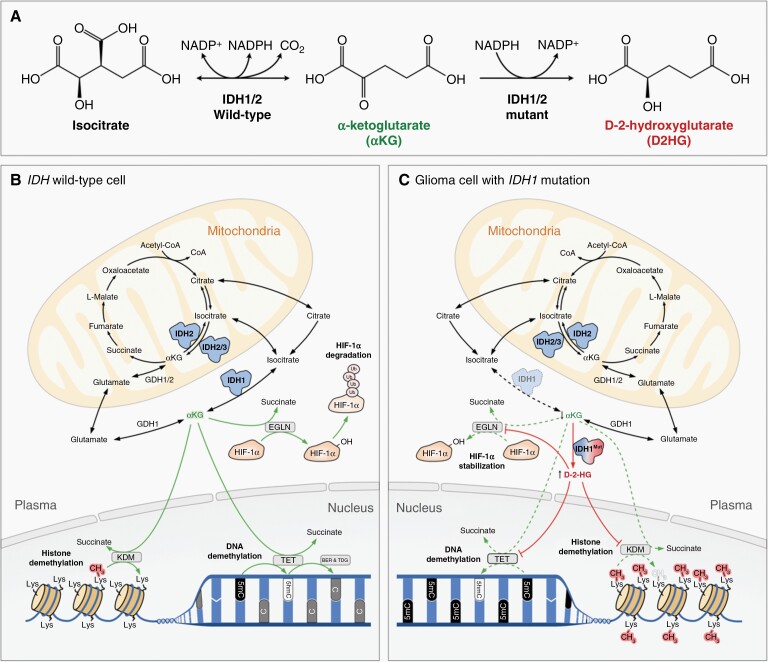
Functions of normal and mutated IDH enzymes. (A) Normal IDH1 and IDH2 proteins use NADP + as an electron acceptor to catalyze the oxidative decarboxylation of isocitrate, producing α-ketoglutarate (αKG) and CO2. However, mutant IDH1 and IDH2 produce D-2-hydroxyglutarate (D-2-HG) from α-KG using NADPH as an electron donor. (B) The normal isoforms IDH1 and IDH2 catalyze αKG production in the cytoplasm and mitochondria, respectively. As a critical intermediate in the Krebs cycle, αKG is involved in many biological metabolic processes. A superfamily of enzymes called αKG-dependent dioxygenases (αKGDs), including TET, KDM, and EglN, can decarboxylate αKG to succinate while hydroxylating different substrates for various further changes, such as DNA demethylation, histone demethylation, and ubiquitination of transcription factor HIF-1α. (C) Mutant IDH1 produces high level D-2-HG. As a structural analog of αKG, excessive D-2-HG competitively inhibits the catalytic efficiency of the TETs and KDMs while paradoxically stimulating EglN activity. Decreased TET and KDM activity causes DNA and histone hypermethylation, respectively, while increased EglN activity lowers HIF. Collectively, these changes affect gene expression, cell division and differentiation.
Figure 3.
Figure 3.
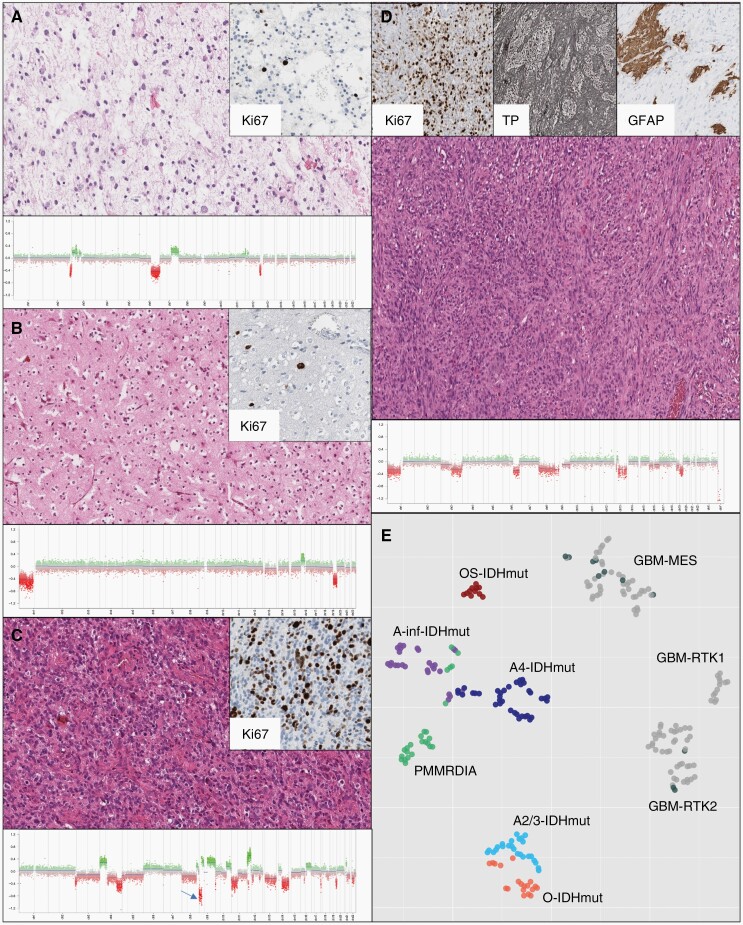
Morphologic and molecular aspects in IDH-mutant glioma: (A) Astrocytoma IDH-mut grade 2 with few Ki67 positive nuclei and little copy number variations lacking homozygous CDKN2A/B deletion. (B) Oligodendroglioma IDH-mutant 1p/19q codeleted grade 2 with fried egg pattern. Copy number variation plot (CNVP) shows the defining 1p/19q codeletion (C) Astrocytoma IDH-mut grade 4 with high Ki67 count and CNVP demonstrating presence of homozygous CDKN2A/B deletion (arrow). (D) Oligosarcoma-IDH-mut, high Ki67 count, abundance of agyrophilic fibers (TP stain) and focal GFAP binding. CNVP shows multiple alterations. (E) tSNE analysis of methylation data separating IDH-mutant glioma. Glioblastomas-IDH wild-type of the methylation classes RTK1, RTK2 and MES are coanalyzed. Gliosarcoma (black) colocalize with glioblastomas and are separate from oligosarcoma-IDH-mut.
Figure 4.
Figure 4.
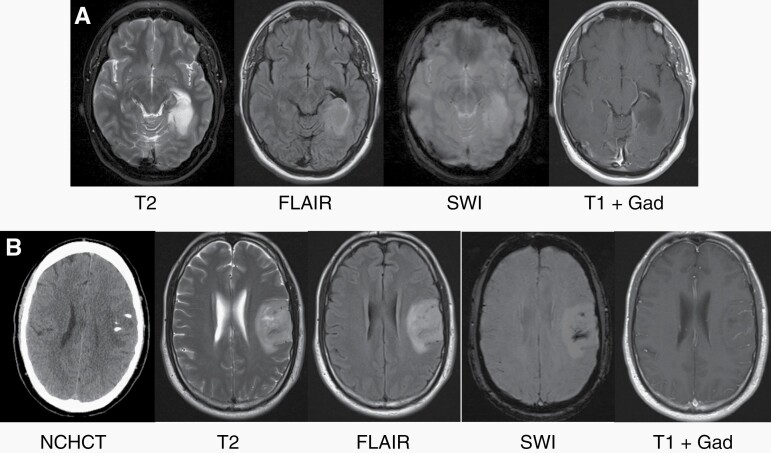
Imaging characteristics of IDH-mutant gliomas. (A) MRI features of astrocytoma, IDH-mutant, grade 2. This left posterior temporal lobe tumor demonstrates hyperintensity on T2-weighted and fluid-attenuated inverted recovery (FLAIR) sequences. Note the decreased signal within the core of the tumor on FLAIR compared to T2 (T2/FLAIR mismatch). The tumor does not demonstrate decreased signal on susceptibility-weighted imaging (SWI) or contrast enhancement after administration of Gadolinium (Gad). (B) MRI features of oligodendroglioma, IDH-mutant, 1p/19q codeleted, grade 2. This left frontal tumor demonstrates hyperdensities on non-contrast head CT (NHCHT), consistent with calcifications (also seen on SWI). The tumor is hyperintense on T2 and FLAIR and does not demonstrate contrast enhancement after administration of Gad.
Figure 5.
Figure 5.
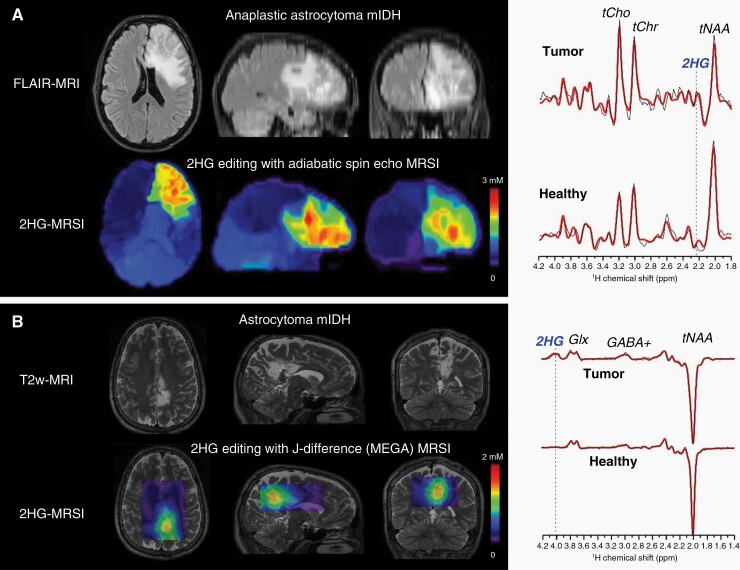
D -2-hydroxyglutarate (2-HG) imaging at 3T in IDH-mutant glioma (IDHm) patients: (A) 2-HG edited whole-brain magnetic resonance spectroscopic imaging (MRSI) using adiabatic spin echo with long echo time modulation, TE = 97 ms (TE1/TE2 = 32/65 ms). (B) 2-HG edited 3D MRSI using J-difference (MEGA-LASER editing, TE = 68 ms) technique. Metabolic heterogeneity can be seen in 2-HG images of large tumors (A). Spectra shown on the right indicate the positions of 2-HG signals edited by the two imaging methods.
Figure 6.
Figure 6.
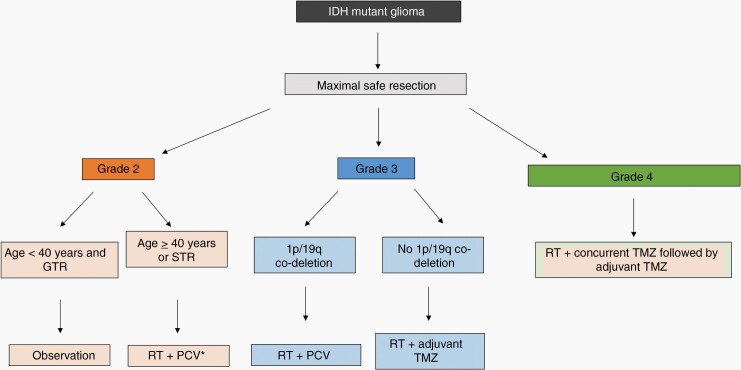
Suggested management algorithm for patients with newly diagnosed IDH-mutant glioma, based on histopathological grade and 1p/19q codeletion status.
Figure 7.
Figure 7.
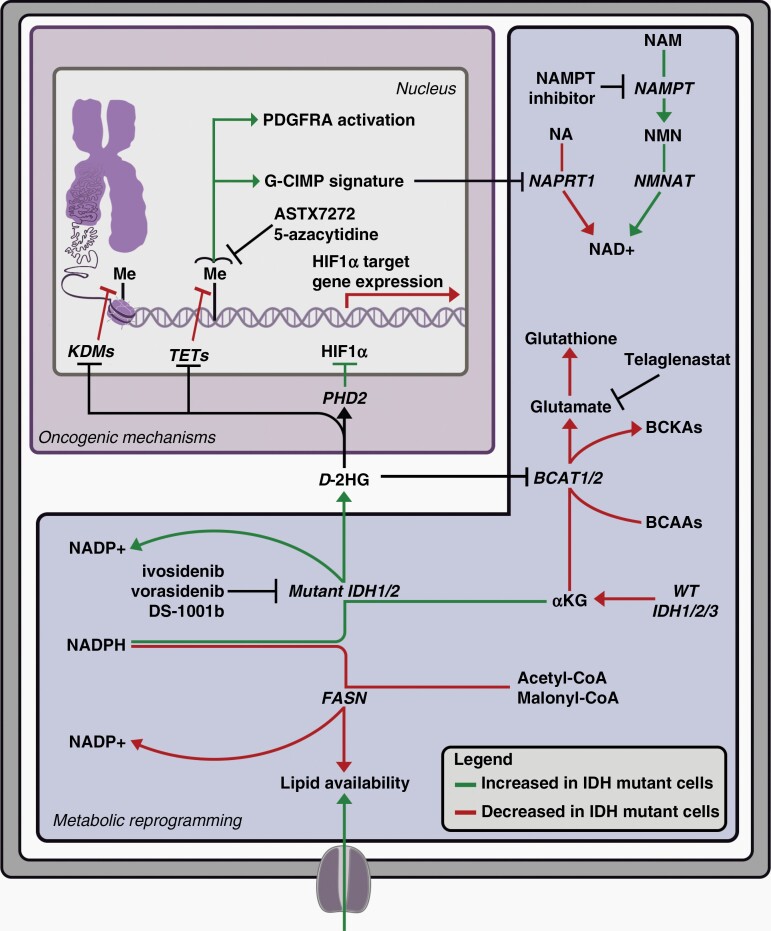
Targeted therapies for IDH-mutant gliomas. Oncogenic mechanisms and metabolic reprogramming caused by mutant IDH and excess D-2-hydroxyglutarate (D-2-HG). Targeting strategies under investigation are noted at relevant points.

Comment in

References

    1. Bailey P, Cushing H.. A Classification of the Tumors of the Glioma Group on a Histogenetic Basis with a Correlated Study of Prognosis. Philadelphia, London and Montreal: Lippincott; 1926.
    1. Parsons DW, Jones S, Zhang X, et al. An integrated genomic analysis of human glioblastoma multiforme. Science. 2008; 321(5897):1807–1812. - PMC - PubMed
    1. Louis DN, Perry A, Reifenberger G, et al. The 2016 World Health Organization Classification of tumors of the central nervous system: a summary. Acta Neuropathol. 2016; 131(6):803–820. - PubMed

    1. Louis DN, Perry A, Wesseling P, et al. The 2021 WHO Classification of tumors of the central nervous system: a summary. Neuro Oncol. 2021; 23(8):1231–1251. - PMC - PubMed
    1. Brat DJ, Aldape K, Colman H, et al. cIMPACT-NOW update 5: recommended grading criteria and terminologies for IDH-mutant astrocytomas. Acta Neuropathol. 2020; 139(3):603–608. - PMC - PubMed

Substances