


Functional immune responses against SARS-CoV-2 variants of concern after fourth COVID-19 vaccine dose or infection in patients with blood cancer
- PMID: 36240755
- PMCID: PMC9513326
- DOI: 10.1016/j.xcrm.2022.100781
Functional immune responses against SARS-CoV-2 variants of concern after fourth COVID-19 vaccine dose or infection in patients with blood cancer
Abstract
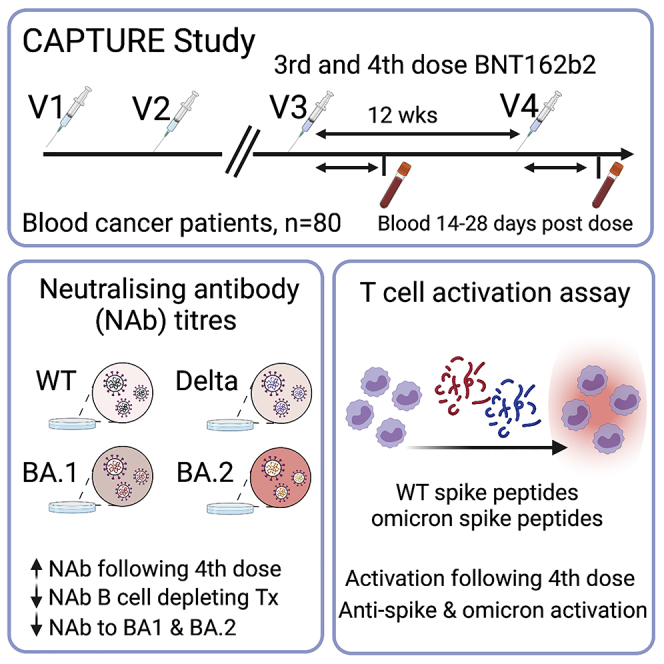
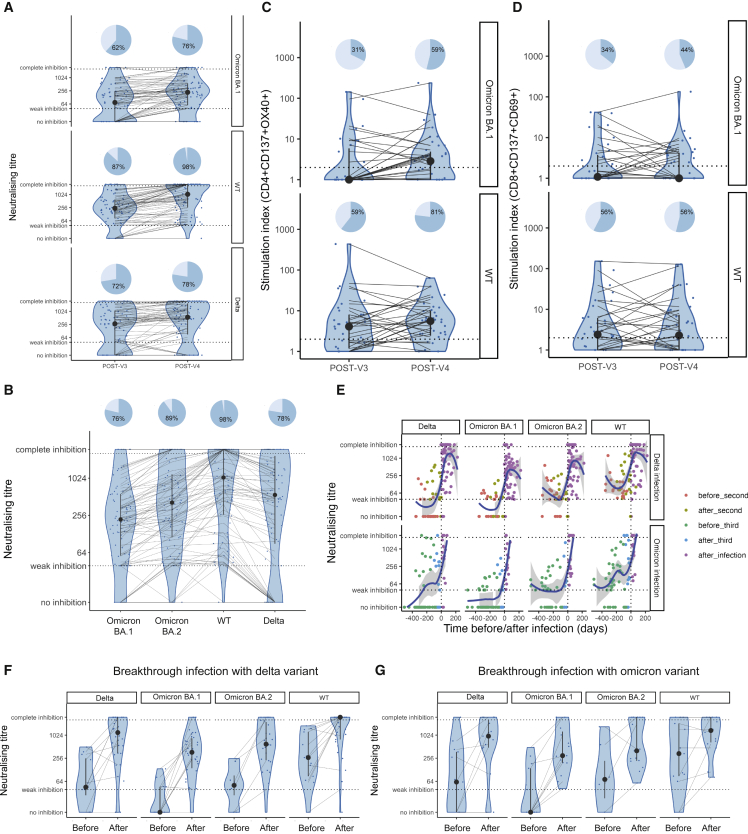
Patients with blood cancer continue to have a greater risk of inadequate immune responses following three COVID-19 vaccine doses and risk of severe COVID-19 disease. In the context of the CAPTURE study (NCT03226886), we report immune responses in 80 patients with blood cancer who received a fourth dose of BNT162b2. We measured neutralizing antibody titers (NAbTs) using a live virus microneutralization assay against wild-type (WT), Delta, and Omicron BA.1 and BA.2 and T cell responses against WT and Omicron BA.1 using an activation-induced marker (AIM) assay. The proportion of patients with detectable NAb titers and T cell responses after the fourth vaccine dose increased compared with that after the third vaccine dose. Patients who received B cell-depleting therapies within the 12 months before vaccination have the greatest risk of not having detectable NAbT. In addition, we report immune responses in 57 patients with breakthrough infections after vaccination.
Keywords: COVID-19; SARS-CoV-2; T cells; blood cancer; neutralizing antibodies; variants of concern.
Copyright © 2022 The Author(s). Published by Elsevier Inc. All rights reserved.
Conflict of interest statement
Declaration of interests The authors declare no competing interest.
Figures
References
-
- Fendler A., Shepherd S.T.C., Au L., Wilkinson K.A., Wu M., Schmitt A.M., Tippu Z., Farag S., Rogiers A., Harvey R., et al. Immune responses following third COVID-19 vaccination are reduced in patients with hematologic malignancies compared to patients with solid cancer. Cancer Cell. 2022;40:114–116. doi: 10.1016/j.ccell.2021.12.013. - DOI - PMC - PubMed
-
- Shapiro L.C., Thakkar A., Campbell S.T., Forest S.K., Pradhan K., Gonzalez-Lugo J.D., Quinn R., Bhagat T.D., Choudhary G.S., McCort M., et al. Efficacy of booster doses in augmenting waning immune responses to COVID-19 vaccine in patients with cancer. Cancer Cell. 2022;40:3–5. doi: 10.1016/j.ccell.2021.11.006. - DOI - PMC - PubMed
-
- Aleman A., Van Oekelen O., Upadhyaya B., Beach K., Kogan Zajdman A., Alshammary H., Serebryakova K., Agte S., Kappes K., Gleason C.R., et al. Augmentation of humoral and cellular immune responses after third-dose SARS-CoV-2 vaccination and viral neutralization in myeloma patients. Cancer Cell. 2022;40:441–443. doi: 10.1016/j.ccell.2022.03.013. - DOI - PMC - PubMed
Publication types
MeSH terms
Substances
Supplementary concepts
Associated data
Grants and funding
- MR/W005611/1/MRC_/Medical Research Council/United Kingdom
- 18176/CRUK_/Cancer Research UK/United Kingdom
- DH_/Department of Health/United Kingdom
- 29911/CRUK_/Cancer Research UK/United Kingdom
- FC001002/WT_/Wellcome Trust/United Kingdom
- FC001169/WT_/Wellcome Trust/United Kingdom
- FC001099/WT_/Wellcome Trust/United Kingdom
- FC001218/WT_/Wellcome Trust/United Kingdom
- FC001988/WT_/Wellcome Trust/United Kingdom
- FC001030/WT_/Wellcome Trust/United Kingdom
- FC001078/WT_/Wellcome Trust/United Kingdom
- FC011104/WT_/Wellcome Trust/United Kingdom
- C50947/A18176/CRUK_/Cancer Research UK/United Kingdom
LinkOut - more resources
Full Text Sources
Medical
Miscellaneous
