


Microvascular complications identify a specific coronary atherosclerotic phenotype in patients with type 2 diabetes mellitus
- PMID: 36243750
- PMCID: PMC9571474
- DOI: 10.1186/s12933-022-01637-y
Microvascular complications identify a specific coronary atherosclerotic phenotype in patients with type 2 diabetes mellitus
Abstract
Background: Patients with type 2 diabetes mellitus (T2DM) are considered as a homogeneous cohort of patients. However, the specific role of diabetic microvascular complications (DMC), in determining the features of coronary plaques is poorly known. We investigated whether the presence of DMC may identify a different phenotype of patients associated to specific clinical, angiographic, optical coherence tomography (OCT) features and different prognosis.
Methods: We prospectively enrolled consecutive T2DM patients with obstructive coronary artery disease (CAD) at their first coronary event. Patients were stratified according to the presence or absence of DMC, including diabetic retinopathy, diabetic neuropathy, and diabetic nephropathy. OCT assessment of the culprit vessel was performed in a subgroup of patients. The incidence of major adverse cardiac events (MACEs) was assessed at follow-up.
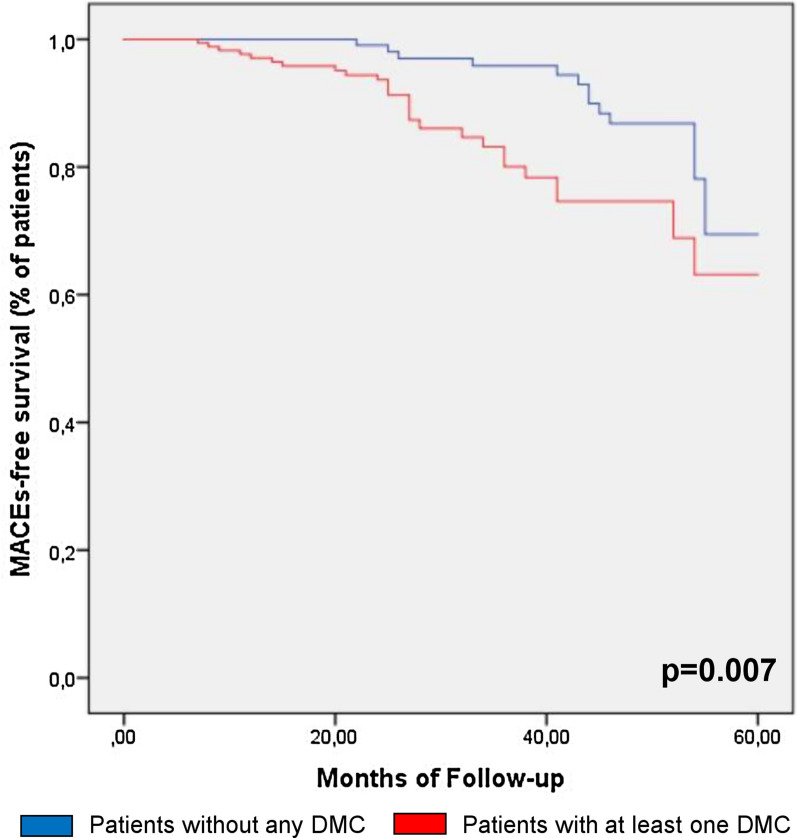
Results: We enrolled 320 T2DM patients (mean age 70.3 ± 8.8 years; 234 [73.1%] men, 40% acute coronary syndrome, 60% chronic coronary syndrome). Patients with DMC (172 [53.75%]) presented a different clinical and biochemical profile and, of importance, a higher prevalence of multivessel CAD (109 [63.4%] vs. 68 [45.9%], p = 0.002). At OCT analysis, DMC was associated to a higher prevalence of large calcifications and healed plaques and to a lower prevalence of lipid plaques. Finally, MACEs rate was significantly higher (25 [14.5%] vs. 12 [8.1%], p = 0.007) in DMC patients, mainly driven by a higher rate of planned revascularizations, and DMC predicted the occurrence of MACEs (mean follow-up 33.4 ± 15.6 months).
Conclusions: The presence of DMC identifies a distinct diabetic population with more severe CAD but with a more stable pattern of coronary atherosclerosis.
Keywords: Coronary artery disease; Diabetes mellitus; Diabetic microvascular complications; Optical coherence tomography; Prognosis.
© 2022. The Author(s).
Conflict of interest statement
The authors declare no competing interests.
Figures


References
-
- Low Wang CC, Hess CN, Hiatt WR, Goldfine AB. Clinical update: cardiovascular disease in diabetes mellitus: atherosclerotic cardiovascular disease and heart failure in type 2 diabetes mellitus—mechanisms, management, and clinical considerations. Circulation. 2016;133:2459–2502. doi: 10.1161/CIRCULATIONAHA.116.022194. - DOI - PMC - PubMed
-
- Marso SP, Bain SC, Consoli A, Eliaschewitz FG, Jódar E, Leiter LA, Lingvay I, Rosenstock J, Seufert J, Warren ML, Woo V, Hansen O, Holst AG, Pettersson J, Vilsbøll T, SUSTAIN-6 Investigators Semaglutide and cardiovascular outcomes in patients with type 2 diabetes. N Engl J Med. 2016;375:1834–1844. doi: 10.1056/NEJMoa1607141. - DOI - PubMed
-
- Brownrigg JR, Hughes CO, Burleigh D, Karthikesalingam A, Patterson BO, Holt PJ, Thompson MM, de Lusignan S, Ray KK, Hinchliffe RJ. Microvascular disease and risk of cardiovascular events among individuals with type 2 diabetes: a population-level cohort study. Lancet Diabetes Endocrinol. 2016;4:588–597. doi: 10.1016/S2213-8587(16)30057-2. - DOI - PubMed
MeSH terms
Substances
LinkOut - more resources
Full Text Sources
Medical
Miscellaneous
