


Psychological distress, depression, anxiety, and life satisfaction following COVID-19 infection: evidence from 11 UK longitudinal population studies
- PMID: 36244359
- PMCID: PMC9560745
- DOI: 10.1016/S2215-0366(22)00307-8
Psychological distress, depression, anxiety, and life satisfaction following COVID-19 infection: evidence from 11 UK longitudinal population studies
Abstract
Background: Evidence on associations between COVID-19 illness and mental health is mixed. We aimed to examine whether COVID-19 is associated with deterioration in mental health while considering pre-pandemic mental health, time since infection, subgroup differences, and confirmation of infection via self-reported test and serology data.
Methods: We obtained data from 11 UK longitudinal studies with repeated measures of mental health (psychological distress, depression, anxiety, and life satisfaction; mental health scales were standardised within each study across time) and COVID-19 status between April, 2020, and April, 2021. We included participants with information available on at least one mental health outcome measure and self-reported COVID-19 status (suspected or test-confirmed) during the pandemic, and a subset with serology-confirmed COVID-19. Furthermore, only participants who had available data on a minimum set of covariates, including age, sex, and pre-pandemic mental health were included. We investigated associations between having ever had COVID-19 and mental health outcomes using generalised estimating equations. We examined whether associations varied by age, sex, ethnicity, education, and pre-pandemic mental health, whether the strength of the association varied according to time since infection, and whether associations differed between self-reported versus confirmed (by test or serology) infection.
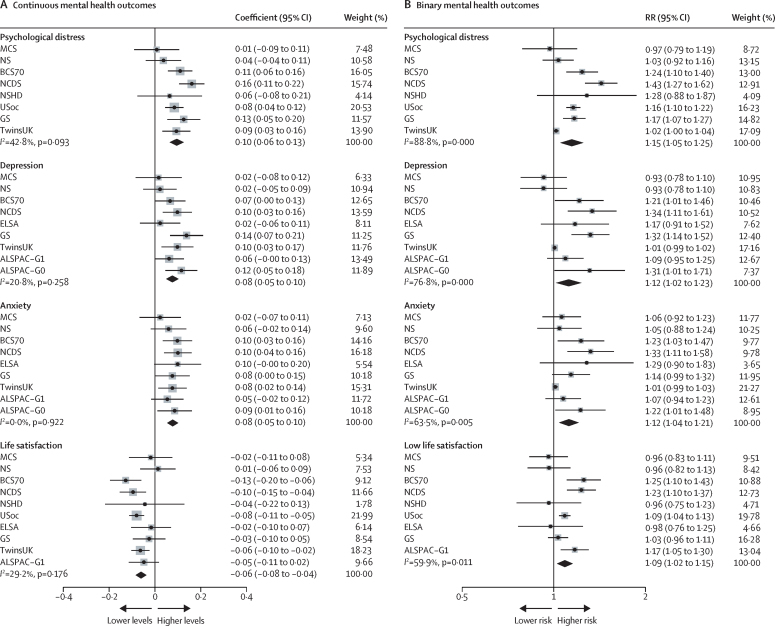
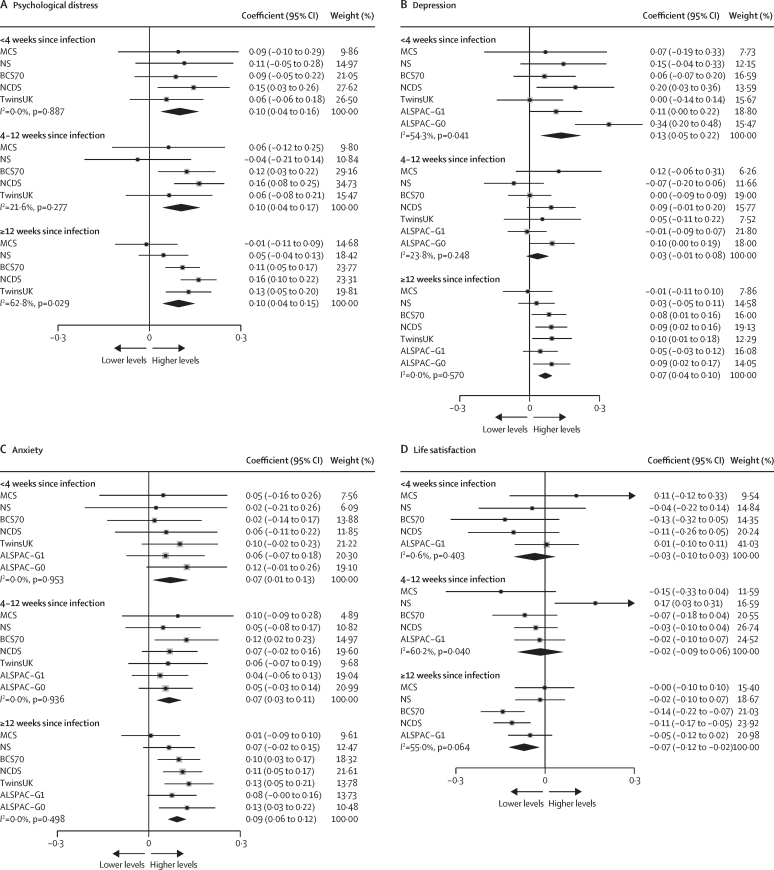
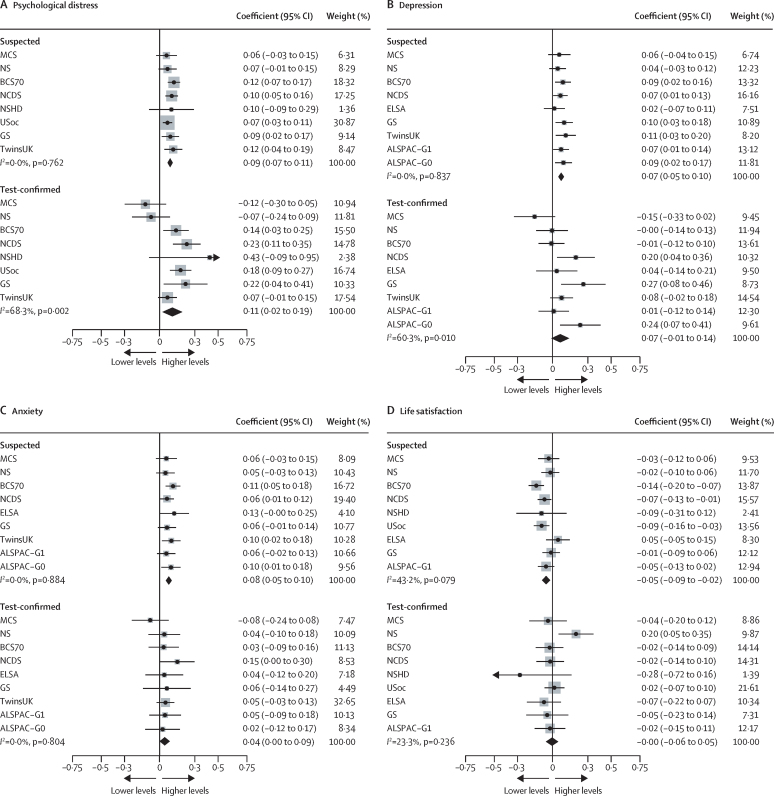
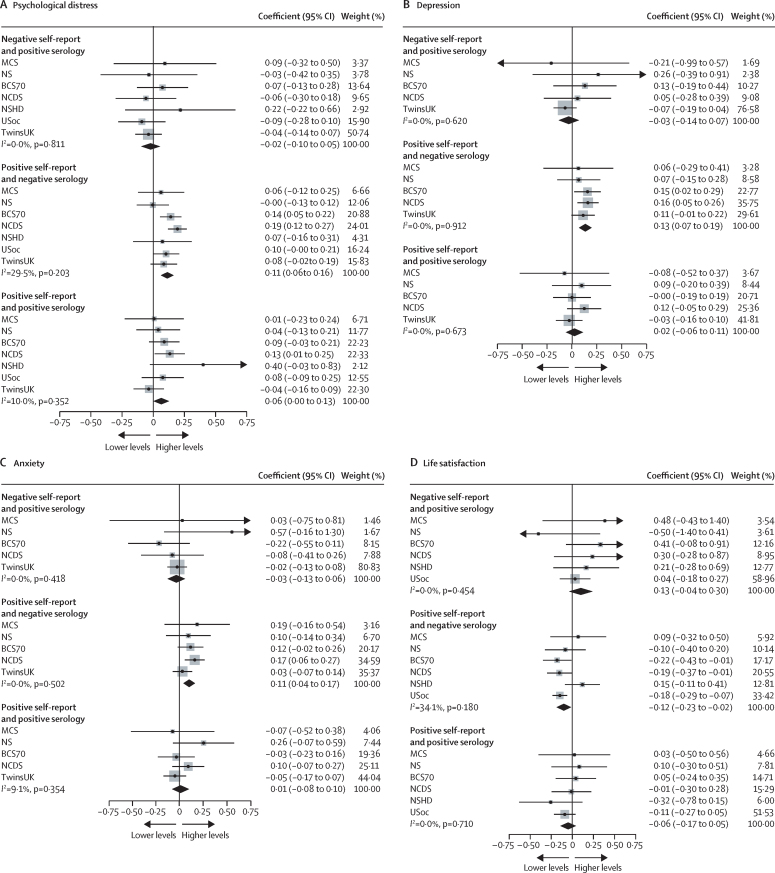
Findings: Between 21 Dec, 2021, and July 11, 2022, we analysed data from 54 442 participants (ranging from a minimum age of 16 years in one study to a maximum category of 90 years and older in another; including 33 200 [61·0%] women and 21 242 [39·0%] men) from 11 longitudinal UK studies. Of 40 819 participants with available ethnicity data, 36 802 (90·2%) were White. Pooled estimates of standardised differences in outcomes suggested associations between COVID-19 and subsequent psychological distress (0·10 [95% CI 0·06 to 0·13], I2=42·8%), depression (0·08 [0·05 to 0·10], I2=20·8%), anxiety (0·08 [0·05 to 0·10], I2=0·0%), and lower life satisfaction (-0·06 [-0·08 to -0·04], I2=29·2%). We found no evidence of interactions between COVID-19 and sex, education, ethnicity, or pre-pandemic mental health. Associations did not vary substantially between time since infection of less than 4 weeks, 4-12 weeks, and more than 12 weeks, and were present in all age groups, with some evidence of stronger effects in those aged 50 years and older. Participants who self-reported COVID-19 but had negative serology had worse mental health outcomes for all measures than those without COVID-19 based on serology and self-report. Participants who had positive serology but did not self-report COVID-19 did not show association with mental health outcomes.
Interpretation: Self-reporting COVID-19 was longitudinally associated with deterioration in mental health and life satisfaction. Our findings emphasise the need for greater post-infection mental health service provision, given the substantial prevalence of COVID-19 in the UK and worldwide.
Funding: UK Medical Research Council and UK National Institute for Health and Care Research.
Copyright © 2022 The Author(s). Published by Elsevier Ltd. This is an Open Access article under the CC BY 4.0 license. Published by Elsevier Ltd.. All rights reserved.
Conflict of interest statement
Declaration of interests SVK is a member of the Scientific Advisory Group on Emergencies subgroup on ethnicity and COVID-19 and is co-chair of the Scottish Government's Ethnicity Reference Group on COVID-19. NC serves on a data safety monitoring board for trials sponsored by AstraZeneca. CJS is an academic lead on KCL Zoe Global COVID symptoms study. KT has been a paid consultant for the CHDI Foundation (member of Statistical Advisory Group) and is a member of the steering group for Living With COVID Recovery study at UCL (unpaid). All other authors declare no competing interests.
Figures
References
-
- Rogers JP, Watson CJ, Badenoch J, et al. Neurology and neuropsychiatry of COVID-19: a systematic review and meta-analysis of the early literature reveals frequent CNS manifestations and key emerging narratives. J Neurol Neurosurg Psychiatry. 2021;92:932–941. - PubMed
Publication types
MeSH terms
Grants and funding
LinkOut - more resources
Full Text Sources
Medical
Research Materials
Miscellaneous
