


Pre-clinical validation of a turbine-based ventilator for invasive ventilation-The ACUTE-19 ventilator
- PMID: 36244956
- PMCID: PMC9639442
- DOI: 10.1016/j.redare.2021.09.006
Pre-clinical validation of a turbine-based ventilator for invasive ventilation-The ACUTE-19 ventilator
Abstract
Background: The Severe Acute Respiratory Syndrome (SARS)-Coronavirus 2 (CoV-2) pandemic pressure on healthcare systems can exhaust ventilator resources, especially where resources are restricted. Our objective was a rapid preclinical evaluation of a newly developed turbine-based ventilator, named the ACUTE-19, for invasive ventilation.
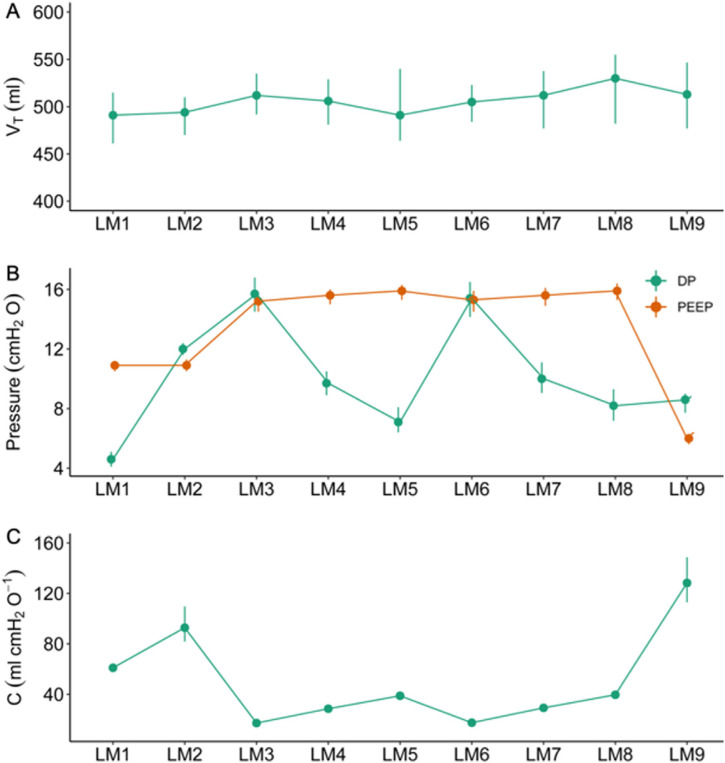
Methods: Validation consisted of (a) testing tidal volume (VT) delivery in 11 simulated models, with various resistances and compliances; (b) comparison with a commercial ventilator (VIVO-50) adapting the United Kingdom Medicines and Healthcare products Regulatory Agency-recommendations for rapidly manufactured ventilators; and (c) in vivo testing in a sheep before and after inducing acute respiratory distress syndrome (ARDS) by saline lavage.
Results: Differences in VT in the simulated models were marginally different (largest difference 33ml [95%-confidence interval (CI) 31-36]; P<.001ml). Plateau pressure (Pplat) was not different (-0.3cmH2O [95%-CI -0.9 to 0.3]; P=.409), and positive end-expiratory pressure (PEEP) was marginally different (0.3 cmH2O [95%-CI 0.2 to 0.3]; P<.001) between the ACUTE-19 and the commercial ventilator. Bland-Altman analyses showed good agreement (mean bias, -0.29, [limits of agreement, 0.82 to -1.42], and mean bias 0.56 [limits of agreement, 1.94 to -0.81], at a Pplat of 15 and 30cmH2O, respectively). The ACUTE-19 achieved optimal oxygenation and ventilation before and after ARDS induction.
Conclusions: The ACUTE-19 performed accurately in simulated and animal models yielding a comparable performance with a VIVO-50 commercial device. The acute 19 can provide the basis for the development of a future affordable commercial ventilator.
Antecedentes: La pandemia producida por el Síndrome Respiratorio Agudo Severo (SARS) por Coronavirus 2 (CoV-2) puede agotar los recursos sanitarios, especialmente de respiradores, en situaciones de escasez de recursos sanitarios. Nuestro objetivo fue realizar una evaluación preclínica rápida de un prototipo de respirador de turbina para la ventilación invasiva denominado ACUTE-19.
Métodos: La validación consistió en (a) evaluación de la administración de un volumen corriente (VT) en 11 modelos pulmonares simulados, con diversas resistencias y compliancias; (b) comparación con un ventilador comercial (VIVO-50) adaptando las recomendaciones de la Agencia Reguladora de Medicamentos y Productos Sanitarios del Reino Unido para ventiladores de fabricación rápida; y (c) realización pruebas in vivo en una oveja antes y después de inducir el síndrome de distrés respiratorio agudo (SDRA) mediante lavado salino.
Resultados: Las diferencias de VT en los modelos simulados fueron mínimamente diferentes (la mayor diferencia fue de 33 ml [intervalo de confianza (IC) del 95%: 31 a 36]; P < ,001 ml). La presión de meseta (Pplat) no fue diferente (−0,3 cmH2O [IC del 95%: −0,9 a 0,3]; P = ,409), y la presión positiva al final de la espiración (PEEP) fue levemente diferente (0,3 cmH2O [IC del 95%: 0,2 a 0,3]; P < ,001) comparando el ACUTE-19 y el ventilador comercial. El análisis de Bland-Altman mostró una buena concordancia (bias medio, −0,29, [límites de concordancia, 0,82 a −1,42], y bias medio 0,56 [límites de concordancia, 1,94 a −0,81], a una Pplat de 15 y 30 cmH2O, respectivamente). El ACUTE-19 consiguió una oxigenación y ventilación óptimas antes y después de la inducción del SDRA en el modelo animal.
Conclusiones: El ACUTE-19 se comportó con precisión en los modelos simulados y animales, con un rendimiento comparable al del dispositivo comercial VIVO-50. El ACUTE-19 puede servir de base para el desarrollo de un futuro ventilador comercial asequible.
Keywords: Aumento de la capacidad médica; Bench study; COVID-19; Estudio de banco; Mechanical ventilation; Medical capacity surge; Rendimiento del ventilador; SARS-CoV-2; Ventilación mecánica; Ventilator performance.
Copyright © 2021 Sociedad Española de Anestesiología, Reanimación y Terapéutica del Dolor. Publicado por Elsevier España, S.L.U. All rights reserved.
Figures




References
-
- Wu Z., McGoogan J.M. Characteristics of and important lessons from the coronavirus disease 2019 (COVID-19) outbreak in China: summary of a report of 72314 cases from the Chinese Center for Disease Control and Prevention. JAMA. 2020;323:1239–1242. - PubMed
-
- Richardson S., Hirsch J.S., Narasimhan M., Crawford J.M., McGinn T., Davidson K.W., et al. The Northwell COVID-19 Research Consortium. Presenting characteristics, comorbidities, and outcomes among 5700 patients hospitalised with COVID-19 in the New York City area. JAMA. 2020;10022:E1–8. - PMC - PubMed
-
- Rascado P, Ballesteros MA, Bodí MA, Carrasco LF, Castañedos Á. Plan de contingencia para los servicios de Medicina Intensiva frente a la pandemia COVID-19. Madrid: SEMICYUC; 2020. p. 73 [accessed 13 Sep 2020]. Available from: https://www.semicyuc.org/covid19_files/Plan_de_Contingencia_COVID-19.pdf.
MeSH terms
LinkOut - more resources
Full Text Sources
Medical
Miscellaneous
