Review
. 2023;21(1):97-152.
doi: 10.1007/s10311-022-01520-y. Epub 2022 Oct 8.

Seaweed for climate mitigation, wastewater treatment, bioenergy, bioplastic, biochar, food, pharmaceuticals, and cosmetics: a review

Affiliations
Review

Seaweed for climate mitigation, wastewater treatment, bioenergy, bioplastic, biochar, food, pharmaceuticals, and cosmetics: a review

Mohamed Farghali et al. Environ Chem Lett. 2023.

Abstract

The development and recycling of biomass production can partly solve issues of energy, climate change, population growth, food and feed shortages, and environmental pollution. For instance, the use of seaweeds as feedstocks can reduce our reliance on fossil fuel resources, ensure the synthesis of cost-effective and eco-friendly products and biofuels, and develop sustainable biorefinery processes. Nonetheless, seaweeds use in several biorefineries is still in the infancy stage compared to terrestrial plants-based lignocellulosic biomass. Therefore, here we review seaweed biorefineries with focus on seaweed production, economical benefits, and seaweed use as feedstock for anaerobic digestion, biochar, bioplastics, crop health, food, livestock feed, pharmaceuticals and cosmetics. Globally, seaweeds could sequester between 61 and 268 megatonnes of carbon per year, with an average of 173 megatonnes. Nearly 90% of carbon is sequestered by exporting biomass to deep water, while the remaining 10% is buried in coastal sediments. 500 gigatonnes of seaweeds could replace nearly 40% of the current soy protein production. Seaweeds contain valuable bioactive molecules that could be applied as antimicrobial, antioxidant, antiviral, antifungal, anticancer, contraceptive, anti-inflammatory, anti-coagulants, and in other cosmetics and skincare products.

Keywords: Biorefineries; Climate change mitigations; Seaweed biochar; Seaweed biogas; Seaweed food; Seaweeds; Seaweeds cosmetics; Seaweeds pharmaceuticals.


Conflict of interest statement

Conflict of interestThe authors have not disclosed any competing interests.

Figures

Fig. 1
Fig. 1
Seaweed biorefineries. Seaweeds can be harvested either through cultivation or from a natural source. Cultivated seaweeds use carbon dioxides from other refinery sources and the sun to sequester carbon within their biomass and are therefore regarded as a carbon sequestration tool when converted into a stable form of carbon such as biochar. In addition, wild seaweeds can float and descend deeper into the ocean, where they can be buried and act as a carbon sink. On the other hand, seaweeds can be extracted to obtain bioactive molecules that can be used in various biorefineries, such as antimicrobials, antioxidants, food supplements, plant growth promoters, anti-inflammatory, anticancer, contraceptives, cosmetics, and skin care agents. As a climate change mitigation strategy, seaweed residues or biomass can be used as feedstocks for anaerobic digestion to produce biomethane, which can be used to replace fossil fuels as a bioenergy source. Bioplastic derived from seaweed is an innovative method to replace synthetic, non-biodegradable plastics and protect the environment. Conversion of seaweed biomass to biochar is another method for mitigating climate change
Fig. 2
Fig. 2
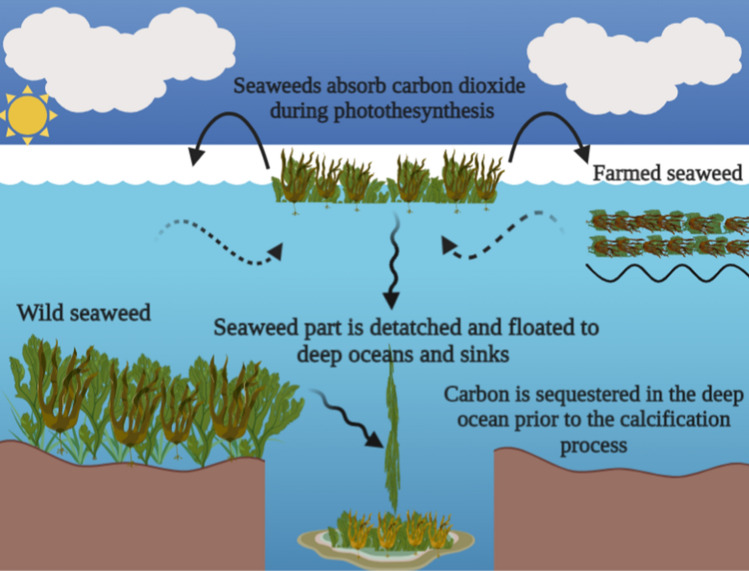
Seaweed’s role in deep ocean carbon sequestration, which is an effective carbon sequestration strategy. Seaweeds have the capacity to remove carbon dioxide from the atmosphere. Then, there are two modes for transporting seaweeds to the sediment and depths of the ocean: the drift of seaweed particles through marine canyons and the sinking of negatively floating seaweed detritus. Overall, seaweeds can store 173 teragrams of carbon per year on average
Fig. 3
Fig. 3
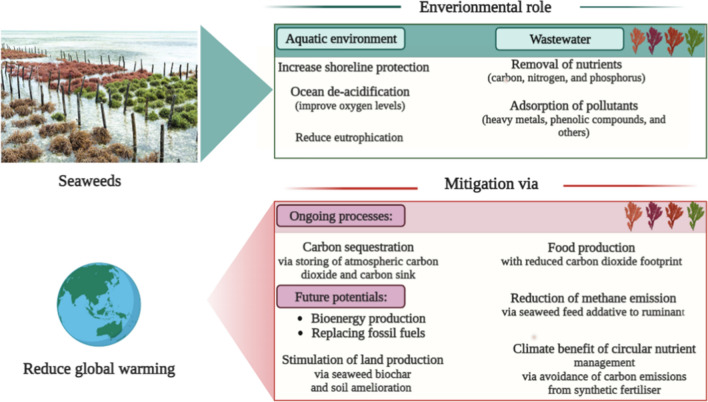
Beneficial functions of seaweeds in environmental restoration and climate change mitigation. Therefore, seaweeds can be viewed as carbon sequestration tools due to their ability to reduce carbon footprint. Seaweeds have the capacity to restore water pH, oxygen levels, and shoreline protection against wave energy dissipation. In addition, using seaweed biomass as feedstocks for biogas production is a promising area of research that can be utilised to replace fossil fuels. Utilising seaweeds for biochar production is also a promising area of research for the environmental sequestration of carbon and the benefit of plants
Fig. 4
Fig. 4
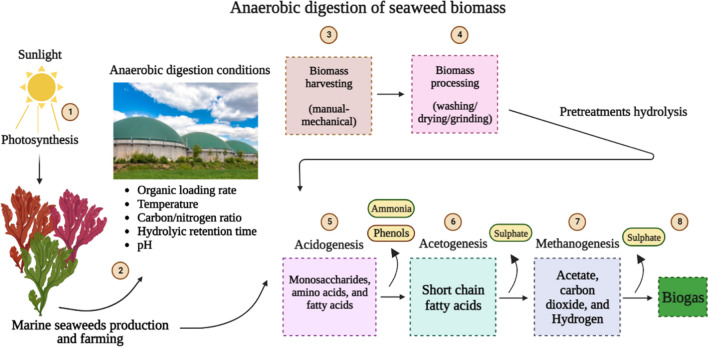
Biogas production from seaweed resources: the mass of wild seaweed grown in aquatic water or farmed seaweed can be gathered manually or mechanically. After assembly, the seaweeds are managed, including rinsing with water, and then the dried or wet biomass is utilised for methane production. In the biogas digester, biomass undergoes four phases of anaerobic digestion, namely hydrolysis, acetogenesis, acidogenesis, and methanogenesis, in order to produce methane and carbon dioxides as end products. Diverse inhibitors and process parameters, such as ammonia, sulphates, phenols, organic loading rates, hydraulic retention time, and other factors, may affect the biogas yields from seaweed feedstocks
Fig. 5
Fig. 5
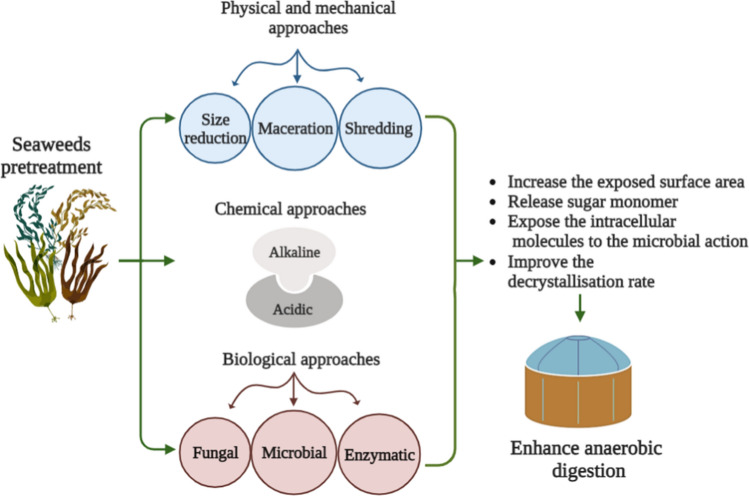
Methods of pretreatment for seaweeds. Various pretreatment methods can be applied to seaweeds, including physical (mechanical), chemical, biological, thermal, and integrated methods. The applied pretreatment increases the exposed surface area, degrades the cell wall, releases sugar monomer, exposes the intracellular molecules to microbial and enzymatic action, and improves the decrystallisation rate, which would be better utilised for methane production, thereby enhancing anaerobic digestion. A method that is both environmentally friendly and cost-effective is still required. Biological pretreatment is an effective and environmentally friendly process
Fig. 6
Fig. 6
Bioplastic products made from seaweed. In the food industry, seaweed polysaccharides can be purified and used to make a variety of bioplastic products. The resulting bioplastics are safe, non-toxic, and have superior durability and mechanical performance. In addition, bioplastics are biodegradable and recyclable, providing the environment with sustainable, green, and eco-friendly plastics
Fig. 7
Fig. 7
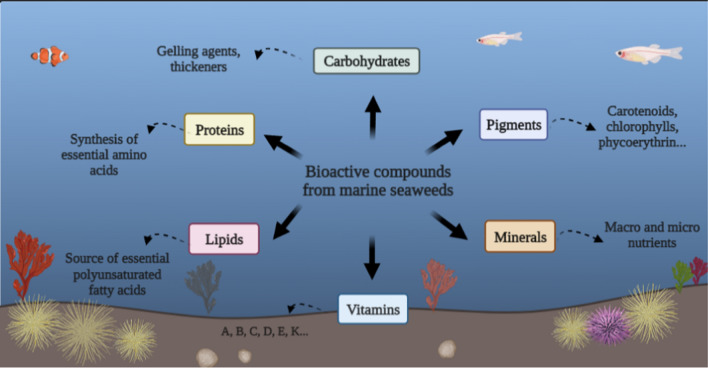
Phytonutrients and bioactive compounds found in marine algae. Approximately 40% of the biomass of seaweed is comprised of carbohydrates. Protein content in seaweeds varies by geographic region, species, season, and growth conditions. In brown, green, and red seaweeds, protein concentrations range from 4 to 10%, 1525%, and 840%, respectively. Lipid is of great interest because lipid contains essential fatty acids, such as omega 3. Comparatively, fewer lipids are present in seaweed than in other terrestrial plants. Typically, the lipid content of brown seaweed ranges between 1 and 4.5 grams per 100 grams of dry seaweed. The amount of algal ash varies between 8.7 and 66.07% of the dry matter. Minerals such as potassium, sodium, magnesium, phosphorus, and calcium are abundant in seaweeds, as are trace elements such as copper, iron, zinc, chlorine, iodine, and manganese. Pigments, such as water-soluble phycobiliproteins harvested from red seaweed, fucoxanthin, a xanthophyll pigment in brown seaweed, and chlorophyll-a are also found in seaweeds
Fig. 8
Fig. 8
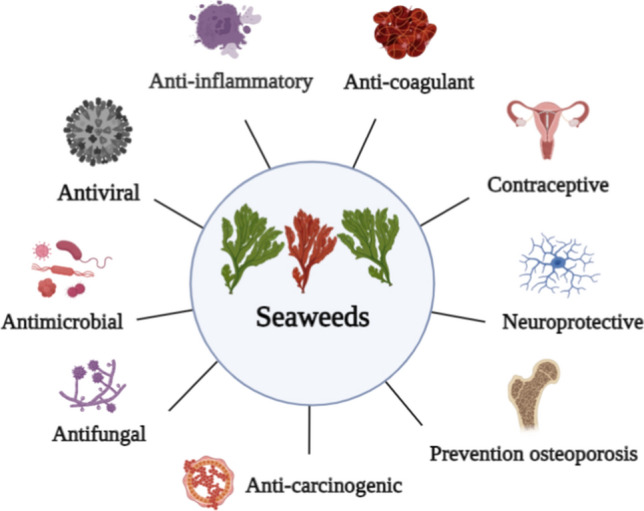
Biological activities of seaweed. Antimicrobial, antifungal, antioxidant, anticoagulant, anti-inflammatory, and mosquitocidal agents are among the biological processes in which seaweed extracts can be utilised. Secondary metabolites derived from seaweed, such as polysaccharide fucoidan, sulfoquinovosildiacyl-glycerols, and caulerpin, exhibit a broad range of biological activities

References

    1. Abu Hafsa SH, et al. Effect of dietary supplementation with green and brown seaweeds on laying performance, egg quality, blood lipid profile and antioxidant capacity in Japanese quail. Poult Sci. 2019;39:41–59. doi: 10.21608/epsj.2019.28828. - DOI
    1. Additives EPO, et al. Guidance on the assessment of the safety of feed additives for the environment. EFSA J. 2019;17:e05648. doi: 10.2903/j.efsa.2019.5648. - DOI - PMC - PubMed
    1. Afonso NC, et al. Brown macroalgae as valuable food ingredients. Antioxidants. 2019;8(9):365. doi: 10.3390/antiox8090365. - DOI - PMC - PubMed
    1. Ajisaka K, et al. Structural characteristics and antioxidant activities of fucoidans from five brown seaweeds. J Appl Glycosci (1999) 2016;63:31–37. doi: 10.5458/jag.jag.JAG-2015_024. - DOI - PMC - PubMed
    1. Akila V, et al. Biogas and biofertilizer production of marine macroalgae: an effective anaerobic digestion of Ulva sp. Biocatal Agric Biotechnol. 2019;18:101035. doi: 10.1016/j.bcab.2019.101035. - DOI

LinkOut - more resources