


Increase in peak oxygen uptake and Andersen test performance in children from age six to ten: The Health Oriented Pedagogical Project (HOPP)
- PMID: 36246119
- PMCID: PMC9557051
- DOI: 10.3389/fphys.2022.976505
Increase in peak oxygen uptake and Andersen test performance in children from age six to ten: The Health Oriented Pedagogical Project (HOPP)
Abstract
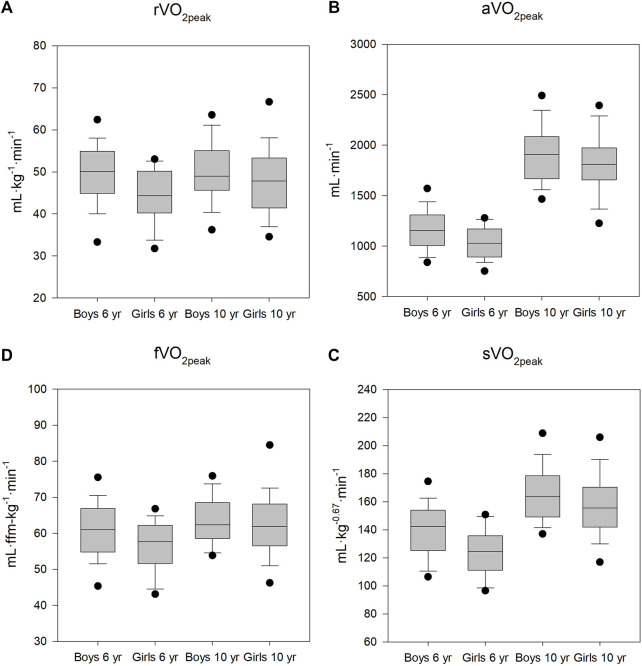
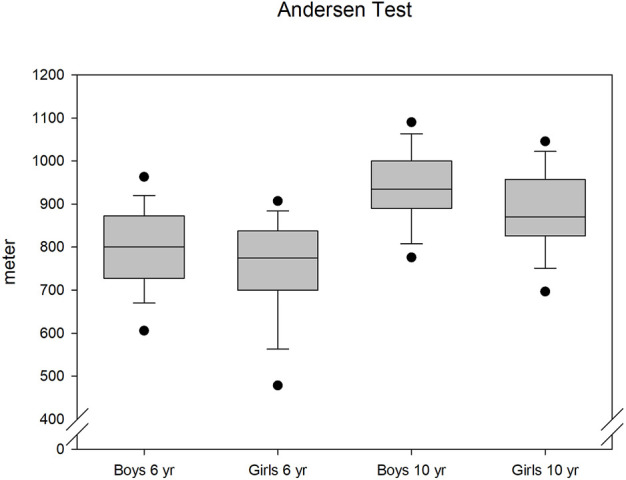
The increased prevalence of non-communicable disease risk factors among children because of lack of physical activity is concerning. The Health Oriented Pedagogical Project was set up to combine learning activities and physical activity, thus reducing sedentariness during school time. The current study aimed to measure and describe the longitudinal and cross-sectional development of oxygen uptake and running performance in children at ages six and ten. The validity of the Andersen Test in predicting V̇O2peak in these age groups was also evaluated. Eighty-six children (53 boys, 33 girls) with complete datasets at ages 6 and 10 years were included in the longitudinal study, while 192 children (106 boys, 86 girls) were included in the cross-sectional analysis because they missed data from 1 year. Oxygen uptake was measured using a metabolic analyser and maximal treadmill running, while the distance covered during the AT determined running performance. Body mass, height, and waist-to-height ratios were recorded. Multiple regression analysis was used to assess the association between oxygen uptake and running performance. The cross-sectional results did not differ from the longitudinal data for anthropometrical data, oxygen uptake and running performance. Height, body mass and waist-to-height ratio did not differ between the sexes at ages six or ten. Boys had significantly higher peak oxygen uptake than girls at 6 years of age, irrespective of how oxygen uptake was expressed. Allometric scaling of oxygen uptake revealed differences between sexes at both ages. Longitudinal running performance increased in both sexes from 6 to 10 years. Boys ran significantly longer only at age ten. The association between oxygen uptake and running performance varied according to how the oxygen uptake was expressed and with sex and age. Ten-year-old girls had the highest correlations in the longitudinal investigation, from r 2 = 0.48 (fV̇O2peak) to 0.65 (rV̇O2peak) between AT and V̇O2peak. The AT was found to be as valid as the 20-m shuttle run test in estimating peak oxygen uptake, with a random measurement error of approximately 11% of mean values.
Keywords: Andersen test longitudinal; children; cross-sectional; longitudinal; oxygen uptake; running.
Copyright © 2022 Mamen, Lindberg and Fredriksen.
Conflict of interest statement
The authors declare that the research was conducted in the absence of any commercial or financial relationships that could be construed as a potential conflict of interest.
Figures
Similar articles
-
Factors affecting running performance in 6-12-year-olds: The Health Oriented Pedagogical Project (HOPP).Scand J Public Health. 2018 May;46(21_suppl):61-67. doi: 10.1177/1403494818767816. Scand J Public Health. 2018. PMID: 29754572
-
The correlation between peak oxygen uptake (VO2peak) and running performance in children and adolescents. aspects of different units.Scand J Med Sci Sports. 2001 Aug;11(4):223-8. doi: 10.1034/j.1600-0838.2001.110405.x. Scand J Med Sci Sports. 2001. PMID: 11476427 Clinical Trial.
-
The Andersen aerobic fitness test: reliability and validity in 10-year-old children.PLoS One. 2014 Oct 17;9(10):e110492. doi: 10.1371/journal.pone.0110492. eCollection 2014. PLoS One. 2014. PMID: 25330388 Free PMC article.
-
Aerobic fitness and metabolic health in children: A clinical validation of directly measured maximal oxygen consumption versus performance measures as markers of health.Prev Med Rep. 2017 May 18;7:74-76. doi: 10.1016/j.pmedr.2017.05.001. eCollection 2017 Sep. Prev Med Rep. 2017. PMID: 28593126 Free PMC article.
-
Criterion-Related Validity of the 20-M Shuttle Run Test for Estimating Cardiorespiratory Fitness: A Meta-Analysis.J Sports Sci Med. 2015 Aug 11;14(3):536-47. eCollection 2015 Sep. J Sports Sci Med. 2015. PMID: 26336340 Free PMC article. Review.
References
-
- Andersen L. B., Andersen T. E., Andersen E., Anderssen S. A. (2008). An intermittent running test to estimate maximal oxygen uptake: The andersen test. J. Sports Med. Phys. Fit. 48, 434–437. - PubMed
LinkOut - more resources
Full Text Sources
Miscellaneous
