


Nasopharyngeal Wash with Normal Saline Decreases SARS-CoV-2 Viral Load: A Randomized Pilot Controlled Trial
- PMID: 36247079
- PMCID: PMC9556252
- DOI: 10.1155/2022/8794127
Nasopharyngeal Wash with Normal Saline Decreases SARS-CoV-2 Viral Load: A Randomized Pilot Controlled Trial
Abstract
Background: Although great progress has been made over the past 2 years in the scientific understanding of the biology, epidemiology, and pathogenesis of severe acute respiratory syndrome coronavirus 2 (SARS-CoV-2), case morbidity and fatality rates remain a great concern and continue to challenge the healthcare resources worldwide as novel variants emerge. There is therefore an urgent need for affordable and readily available strategies to reduce viral transmission. Previous studies in non-COVID-19 patients have demonstrated that administration of low-salt (isotonic but 0.0375% Na) and isotonic saline (0.9% Na) solutions has been associated with an immediate, significant reduction in the microbial antigens and a related decline of microbial burden. The aim of the present study was to determine the effect of nasal washes with normal saline 0.9% on nasopharyngeal viral load and outcome in hospitalized patients with COVID-19 pneumonia.
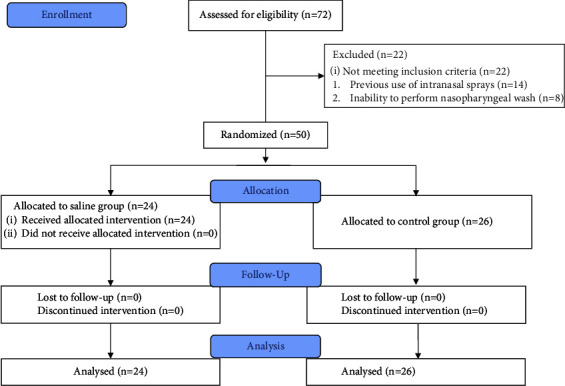
Methods: We performed a prospective, randomized, pilot, controlled trial in 50 patients with confirmed COVID-19 disease. Patients were randomized into two groups, the normal saline group (received normal saline 0.9% solution for nasopharyngeal wash) and the control group (no treatment). In the normal saline group, nasopharyngeal wash was performed every 4 hours for a 16-hour period. Twenty-four hours after the baseline nasopharyngeal swab (and 8 hours after the last wash in the normal saline group), a second nasopharyngeal swab was collected for the semiquantitative estimation of the SARS-CoV-2 viral load as determined by cycle threshold (Ct) values.
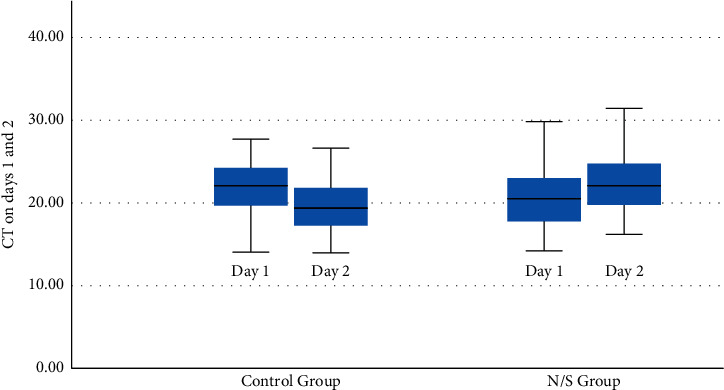
Results: In the normal saline group, mean N gene Ct values increased significantly 24 hours after the baseline measurement [ΔCtday2-day1 = 1.87 ± 3.11 cycles, p = 0.007 (95% CI: 0.55 to 3.18)], indicating a decline in SARS-CoV-2 nasopharyngeal viral load by 8.9%. A significant decrease in mean N gene Ct values was observed in the control group, indicating an increase in viral load [ΔCtday2-day1 = -2.12 ± 2.66, p < 0.001 (95% CI: -3.20 to -1.05)] by 9.7%. The difference between the two groups 24 hours after admission and nasopharyngeal wash was 3.09 cycles (p = 0.005, 95% CI: 0.97 to 5.20).
Conclusion: Nasal washes with normal saline effectively decreased the viral load during hospitalization and at follow-up.
Copyright © 2022 I. Pantazopoulos et al.
Conflict of interest statement
The authors declare that they have no conflicts of interest.
Figures
References
-
- Petersen E., Ntoumi F., Hui D. S., et al. Emergence of new SARS-CoV-2 variant of concern omicron (B.1.1.529)—highlights Africa’s research capabilities, but exposes major knowledge gaps, inequities of vaccine distribution, inadequacies in global COVID-19 response and control efforts. International Journal of Infectious Diseases . 2021;114(21):268–272. - PMC - PubMed
-
- Jajou R., Mutsaers-van Oudheusden A., Verweij J. J., Rietveld A., Murk J. L. SARS-CoV-2 transmitters have more than three times higher viral loads than non-transmitters—practical use of viral load for disease control. Journal of Clinical Virology . 2022;150–151 doi: 10.1016/j.jcv.2022.105131.105131 - DOI - PMC - PubMed
Publication types
MeSH terms
Substances
LinkOut - more resources
Full Text Sources
Medical
Miscellaneous
