. 2022 May 18;45(3):521-557.
doi: 10.1007/s40614-022-00338-x. eCollection 2022 Sep.

Applied Behavior Analysis in Children and Youth with Autism Spectrum Disorders: A Scoping Review

Affiliations

Applied Behavior Analysis in Children and Youth with Autism Spectrum Disorders: A Scoping Review

Mojgan Gitimoghaddam et al. Perspect Behav Sci. .

Abstract

This manuscript provides a comprehensive overview of the impact of applied behavior analysis (ABA) on children and youth with autism spectrum disorders (ASD). Seven online databases and identified systematic reviews were searched for published, peer-reviewed, English-language studies examining the impact of ABA on health outcomes. Measured outcomes were classified into eight categories: cognitive, language, social/communication, problem behavior, adaptive behavior, emotional, autism symptoms, and quality of life (QoL) outcomes. Improvements were observed across seven of the eight outcome measures. There were no included studies that measured subject QoL. Moreover, of 770 included study records, only 32 (4%) assessed ABA impact, had a comparison to a control or other intervention, and did not rely on mastery of specific skills to mark improvement. Results reinforce the need for large-scale prospective studies that compare ABA with other non-ABA interventions and include measurements of subject QoL to provide policy makers with valuable information on the impacts of ABA and other existing and emerging interventions.

Supplementary information: The online version contains supplementary material available at 10.1007/s40614-022-00338-x.

Keywords: applied behavior analysis; autism spectrum disorder; children and youth; neurodevelopmental disabilities and disorders.


Conflict of interest statement

Conflicts of Interest/Competing InterestsThe authors have no conflicts of interest to declare that are relevant to the content of this article.

Figures
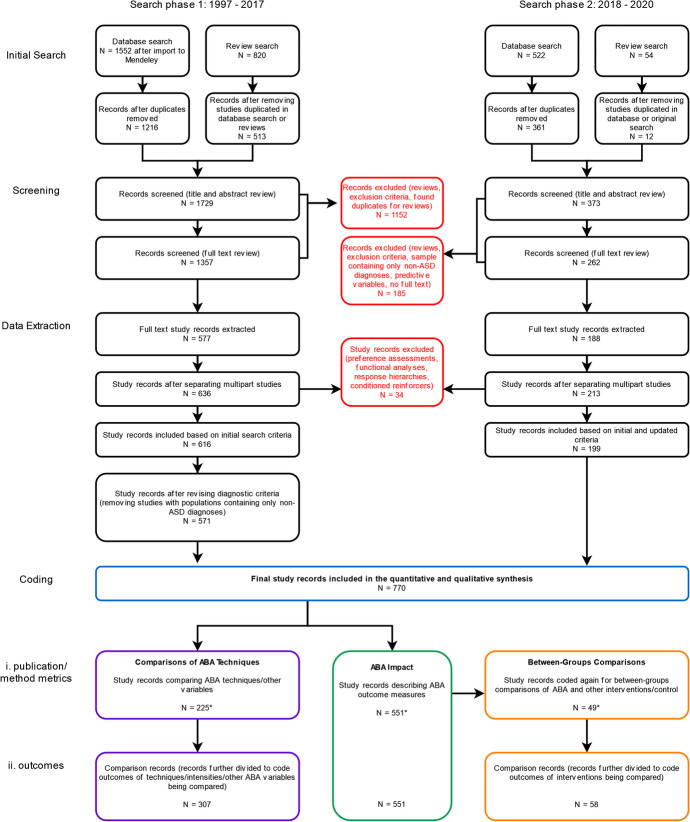
Fig. 1
Fig. 1
Flowchart Describing the Process of the Current Scoping Review Search, Screening, Data Extraction, and Coding. Note. From an initial search comprising 2,948 records, after screening studies and subdividing multipart studies, a total of 770 study records remained. These were coded in three categories: Comparisons of ABA Techniques, ABA Impact, and Between-Groups Comparisons. Designed with reference to Tricco et al. (2016) and created using diagrams.net™/draw.io® from JGraph Ltd. Note that three study records were included in both the ABA Impact section and the Comparisons of ABA Techniques section (Mello et al., ; Rad et al., ; Vietze & Lax, 2020), and three study records were included in all three coding sections (Dugan, ; Kalgotra et al., ; Kovshoff et al., 2011).
Fig. 2
Fig. 2
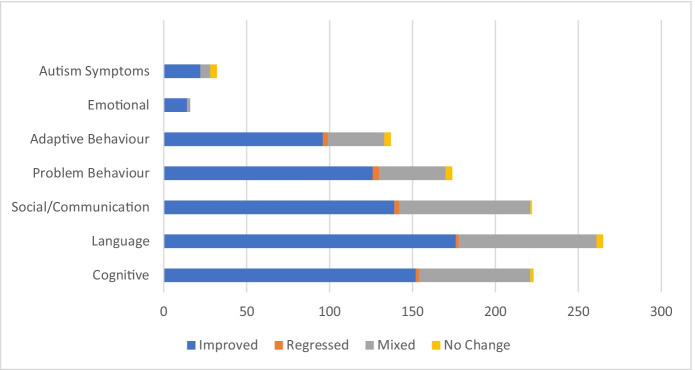
Distribution of Improved, Regressed, Mixed, and Unchanged Results in the ABA Impact Section across the Measured Outcomes (N = 551 study records)
Fig. 3
Fig. 3
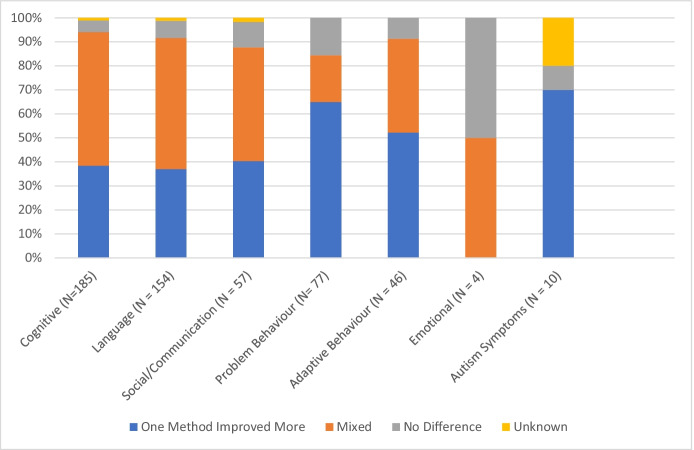
Percentage Distribution of Results Where One Method Improved More, Results were Mixed, Results had No Change, or Results were Unknown (had No Quantifiable Measure) in Comparisons of ABA Techniques Group across the Measured Outcomes (N = 225 comparison records)
Fig 4
Fig 4
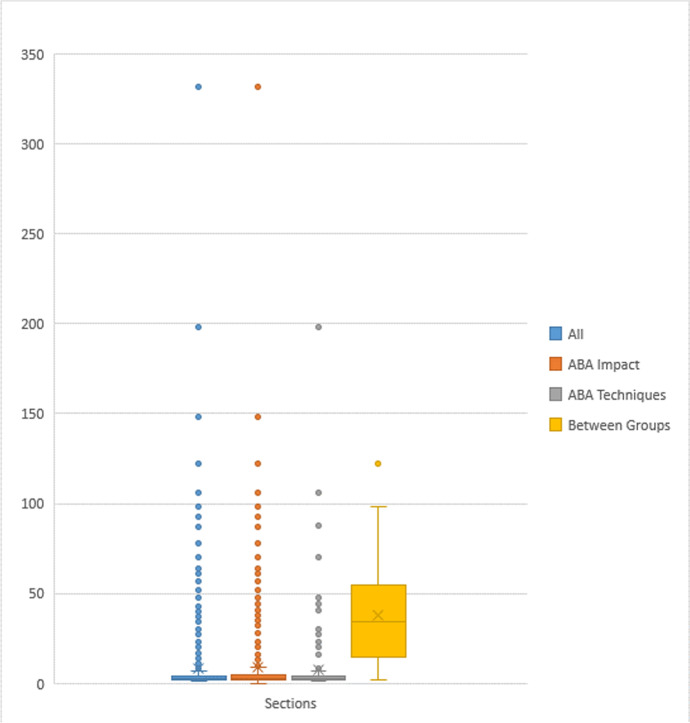
Distribution of the Number of Participants in the Entire Cohort, ABA Impact, Comparisons of ABA Techniques, and Between-Groups Comparisons sections. Note. The entire cohort, ABA Impact section, and Comparisons of ABA Techniques section each had a median of 3 participants and an IQR of 1, whereas the Between-Groups Comparisons section had a median of 34 participants and an IQR of 37
Fig. 5
Fig. 5
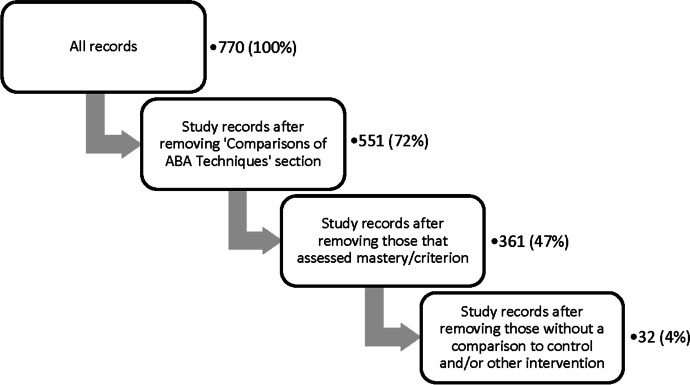
Filter Flow Sheet Representing Study Records after the Subsequent Removal of Various Factors. Note. The first filter removed study records that compared various ABA techniques, where 551 of 770 (72%) of records remained. Next, study records that assessed mastery/criterion were removed, leaving 361 of 770 (47%) of records. Next, study records without any comparison group were removed, leaving 32 of 770 (4% records)

References

    1. Allison J, Wilder DA, Chong I, Lugo A, Pike J, Rudy N. A comparison of differential reinforcement and noncontingent reinforcement to treat food selectivity in a child with autism. Journal of Applied Behavior Analysis. 2012;45(3):613–617. doi: 10.1901/jaba.2012.45-613. - DOI - PMC - PubMed
    1. American Psychiatric Association. (2013). Diagnostic and statistical manual of mental disorders (5th ed.). 10.1176/appi.books.9780890425596
    1. Arim RG, Miller AR, Guèvremont A, Lach LM, Brehaut JC, Kohen DE. Children with neurodevelopmental disorders and disabilities: a population-based study of healthcare service utilization using administrative data. Developmental Medicine & Child Neurology. 2017;59(12):1284–1290. doi: 10.1111/dmcn.13557. - DOI - PubMed
    1. Arksey H, O’Malley L. Scoping studies: Towards a methodological framework. International Journal of Social Research Methodology: Theory & Practice. 2005;8(1):19–32. doi: 10.1080/1364557032000119616. - DOI
    1. Arntzen E, Almås IK. Effects of mand-tact versus tact-only training on the acquisition of tacts. Journal of Applied Behavior Analysis. 2002;35(4):419–422. doi: 10.1901/jaba.2002.35-419. - DOI - PMC - PubMed

Publication types

LinkOut - more resources