


Deep Learning-Based Cataract Detection and Grading from Slit-Lamp and Retro-Illumination Photographs: Model Development and Validation Study
- PMID: 36249697
- PMCID: PMC9559082
- DOI: 10.1016/j.xops.2022.100147
Deep Learning-Based Cataract Detection and Grading from Slit-Lamp and Retro-Illumination Photographs: Model Development and Validation Study
Abstract
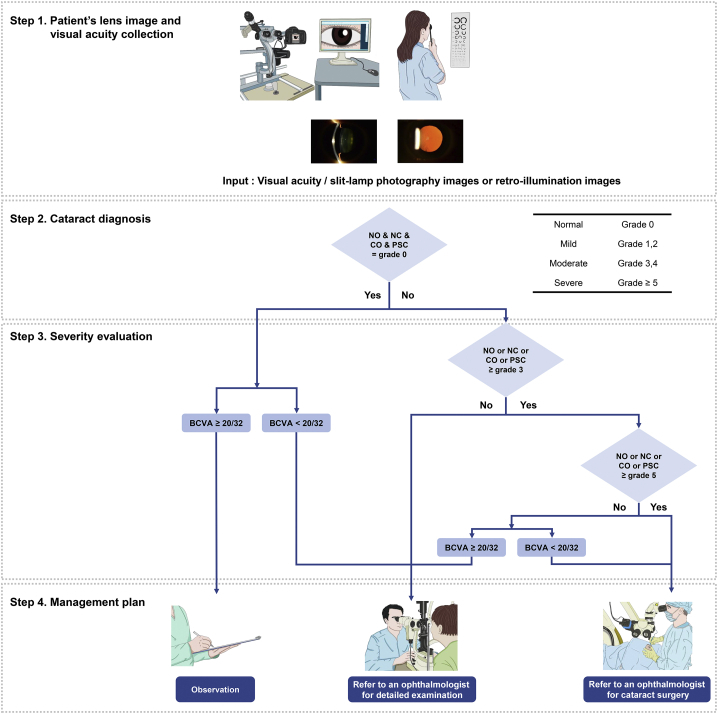
Purpose: To develop and validate an automated deep learning (DL)-based artificial intelligence (AI) platform for diagnosing and grading cataracts using slit-lamp and retroillumination lens photographs based on the Lens Opacities Classification System (LOCS) III.
Design: Cross-sectional study in which a convolutional neural network was trained and tested using photographs of slit-lamp and retroillumination lens photographs.
Participants: One thousand three hundred thirty-five slit-lamp images and 637 retroillumination lens images from 596 patients.
Methods: Slit-lamp and retroillumination lens photographs were graded by 2 trained graders using LOCS III. Image datasets were labeled and divided into training, validation, and test datasets. We trained and validated AI platforms with 4 key strategies in the AI domain: (1) region detection network for redundant information inside data, (2) data augmentation and transfer learning for the small dataset size problem, (3) generalized cross-entropy loss for dataset bias, and (4) class balanced loss for class imbalance problems. The performance of the AI platform was reinforced with an ensemble of 3 AI algorithms: ResNet18, WideResNet50-2, and ResNext50.
Main outcome measures: Diagnostic and LOCS III-based grading prediction performance of AI platforms.
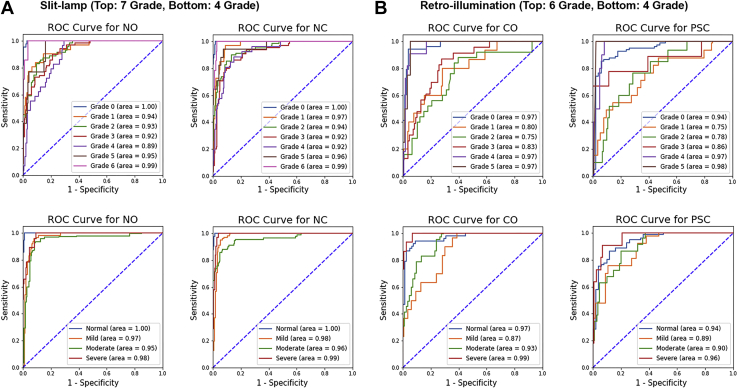
Results: The AI platform showed robust diagnostic performance (area under the receiver operating characteristic curve [AUC], 0.9992 [95% confidence interval (CI), 0.9986-0.9998] and 0.9994 [95% CI, 0.9989-0.9998]; accuracy, 98.82% [95% CI, 97.7%-99.9%] and 98.51% [95% CI, 97.4%-99.6%]) and LOCS III-based grading prediction performance (AUC, 0.9567 [95% CI, 0.9501-0.9633] and 0.9650 [95% CI, 0.9509-0.9792]; accuracy, 91.22% [95% CI, 89.4%-93.0%] and 90.26% [95% CI, 88.6%-91.9%]) for nuclear opalescence (NO) and nuclear color (NC) using slit-lamp photographs, respectively. For cortical opacity (CO) and posterior subcapsular opacity (PSC), the system achieved high diagnostic performance (AUC, 0.9680 [95% CI, 0.9579-0.9781] and 0.9465 [95% CI, 0.9348-0.9582]; accuracy, 96.21% [95% CI, 94.4%-98.0%] and 92.17% [95% CI, 88.6%-95.8%]) and good LOCS III-based grading prediction performance (AUC, 0.9044 [95% CI, 0.8958-0.9129] and 0.9174 [95% CI, 0.9055-0.9295]; accuracy, 91.33% [95% CI, 89.7%-93.0%] and 87.89% [95% CI, 85.6%-90.2%]) using retroillumination images.
Conclusions: Our DL-based AI platform successfully yielded accurate and precise detection and grading of NO and NC in 7-level classification and CO and PSC in 6-level classification, overcoming the limitations of medical databases such as few training data or biased label distribution.
Keywords: AI, artificial intelligence; AUC, area under the receiver operating characteristic curve; Artificial intelligence; BCVA, best-corrected visual acuity; CB, class-balanced; CI, confidence interval; CNN, convolutional neural network; CO, cortical opacity; Cataract; DL, deep learning; Deep learning; FN, false negative; FP, false positive; GCE, generalized cross-entropy; Grad-CAM, gradient-weighted class activation mapping; LOCS, Lens Opacities Classification System; Lens Opacities Classification System III; NC, nuclear color; NO, nuclear opalescence; PSC, posterior subcapsular opacity; RDN, region detection network; TN, true negative; TP, true positive.
© 2022 by the American Academy of Ophthalmology.
Figures
References
-
- Flaxman S.R., Bourne R.R.A., Resnikoff S., et al. Global causes of blindness and distance vision impairment 1990–2020: a systematic review and meta-analysis. Lancet Glob Health. 2017;5(12):e1221–e1234. - PubMed
-
- Liu Y.C., Wilkins M., Kim T., et al. Cataracts. Lancet. 2017;390(10094):600–612. - PubMed
-
- Chylack L.T., Jr., Leske M.C., Sperduto R., et al. Lens Opacities Classification System. Arch Ophthalmol. 1988;106(3):330–334. - PubMed
-
- Chylack L.T., Jr., Wolfe J.K., Singer D.M., et al. The Lens Opacities Classification System III. The Longitudinal Study of Cataract Study Group. Arch Ophthalmol. 1993;111(6):831–836. - PubMed
-
- Hall A.B., Thompson J.R., Deane J.S., Rosenthal A.R. LOCS III versus the Oxford Clinical Cataract Classification and Grading System for the assessment of nuclear, cortical and posterior subcapsular cataract. Ophthalmic Epidemiol. 1997;4(4):179–194. - PubMed
LinkOut - more resources
Full Text Sources
Other Literature Sources
Miscellaneous
