


Image-Based Differentiation of Bacterial and Fungal Keratitis Using Deep Convolutional Neural Networks
- PMID: 36249698
- PMCID: PMC9560557
- DOI: 10.1016/j.xops.2022.100119
Image-Based Differentiation of Bacterial and Fungal Keratitis Using Deep Convolutional Neural Networks
Abstract
Purpose: Develop computer vision models for image-based differentiation of bacterial and fungal corneal ulcers and compare their performance against human experts.
Design: Cross-sectional comparison of diagnostic performance.
Participants: Patients with acute, culture-proven bacterial or fungal keratitis from 4 centers in South India.
Methods: Five convolutional neural networks (CNNs) were trained using images from handheld cameras collected from patients with culture-proven corneal ulcers in South India recruited as part of clinical trials conducted between 2006 and 2015. Their performance was evaluated on 2 hold-out test sets (1 single center and 1 multicenter) from South India. Twelve local expert cornea specialists performed remote interpretation of the images in the multicenter test set to enable direct comparison against CNN performance.
Main outcome measures: Area under the receiver operating characteristic curve (AUC) individually and for each group collectively (i.e., CNN ensemble and human ensemble).
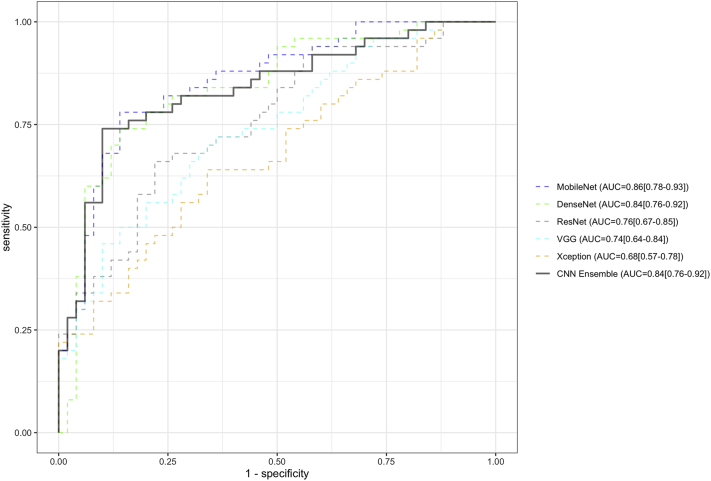
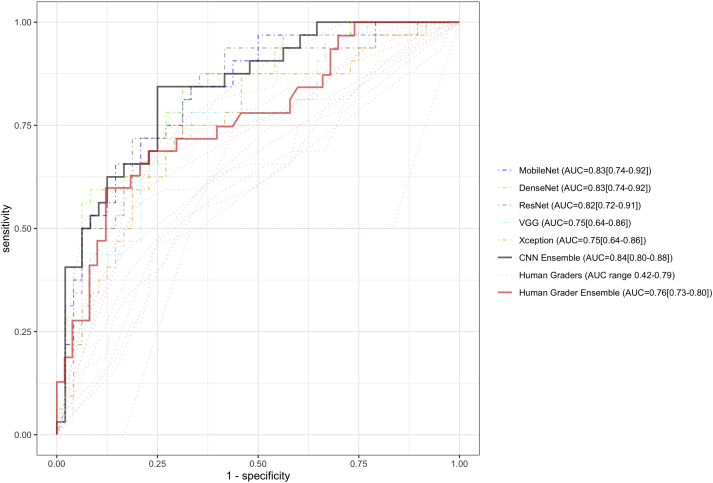
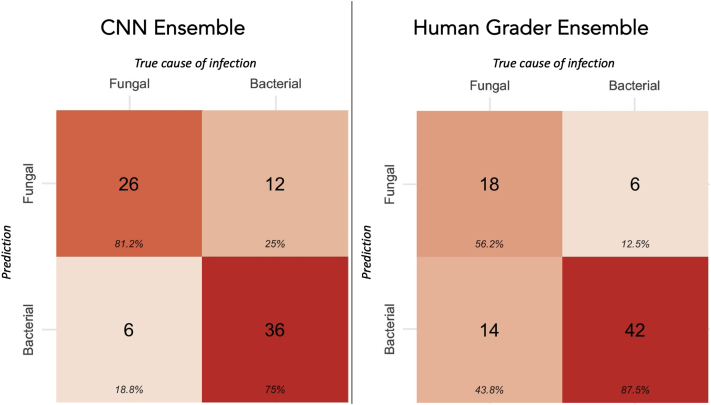
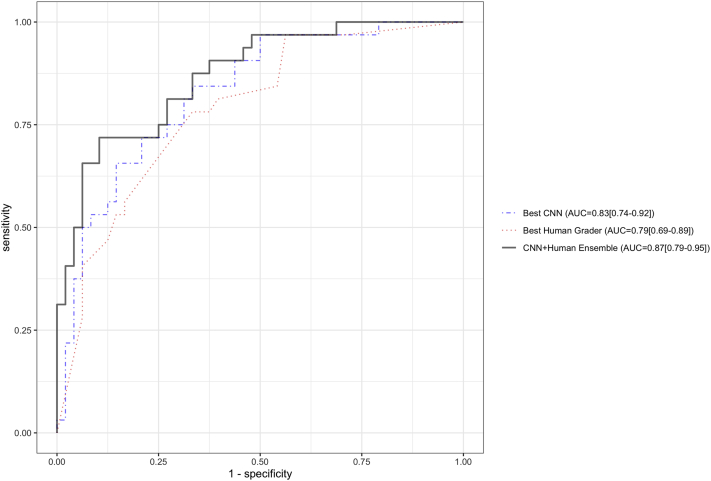
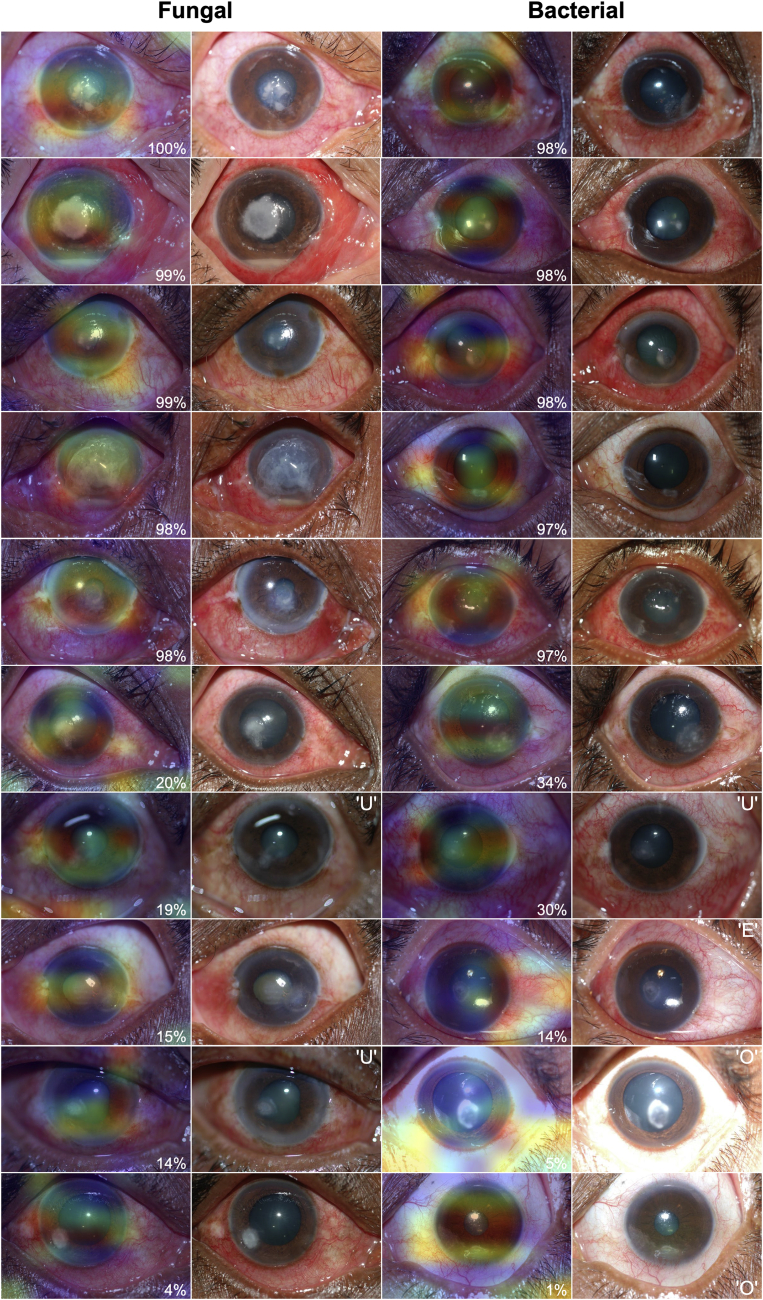
Results: The best-performing CNN architecture was MobileNet, which attained an AUC of 0.86 on the single-center test set (other CNNs range, 0.68-0.84) and 0.83 on the multicenter test set (other CNNs range, 0.75-0.83). Expert human AUCs on the multicenter test set ranged from 0.42 to 0.79. The CNN ensemble achieved a statistically significantly higher AUC (0.84) than the human ensemble (0.76; P < 0.01). CNNs showed relatively higher accuracy for fungal (81%) versus bacterial (75%) ulcers, whereas humans showed relatively higher accuracy for bacterial (88%) versus fungal (56%) ulcers. An ensemble of the best-performing CNN and best-performing human achieved the highest AUC of 0.87, although this was not statistically significantly higher than the best CNN (0.83; P = 0.17) or best human (0.79; P = 0.09).
Conclusions: Computer vision models achieved superhuman performance in identifying the underlying infectious cause of corneal ulcers compared with cornea specialists. The best-performing model, MobileNet, attained an AUC of 0.83 to 0.86 without any additional clinical or historical information. These findings suggest the potential for future implementation of these models to enable earlier directed antimicrobial therapy in the management of infectious keratitis, which may improve visual outcomes. Additional studies are ongoing to incorporate clinical history and expert opinion into predictive models.
Keywords: AUC, area under the receiver operating characteristic curve; Artificial intelligence; Bacterial keratitis; CI, confidence interval; CNN, convolutional neural network; Computer vision; Convolutional neural networks; Corneal ulcer; Deep learning; Fungal keratitis; Infectious keratitis; MUTT, Mycotic Ulcer Treatment Trials; SCUT, Steroids for Corneal Ulcers Trial.
© 2022 by the American Academy of Ophthalmology.
Figures
References
-
- Flaxman S.R., Bourne R.R.A., Resnikoff S., et al. Global causes of blindness and distance vision impairment 1990–2020: a systematic review and meta-analysis. Lancet Global Health. 2017;5(12):e1221–e1234. - PubMed
-
- Pascolini D., Mariotti S.P. Global estimates of visual impairment: 2010. Br J Ophthalmol. 2012;96(5):614–618. - PubMed
-
- Varaprasathan G., Miller K., Lietman T., et al. Trends in the etiology of infectious corneal ulcers at the F. I. Proctor Foundation. Cornea. 2004;23(4):360–364. - PubMed
