


Wettability-based ultrasensitive detection of amphiphiles through directed concentration at disordered regions in self-assembled monolayers
- PMID: 36252006
- PMCID: PMC9618133
- DOI: 10.1073/pnas.2211042119
Wettability-based ultrasensitive detection of amphiphiles through directed concentration at disordered regions in self-assembled monolayers
Abstract
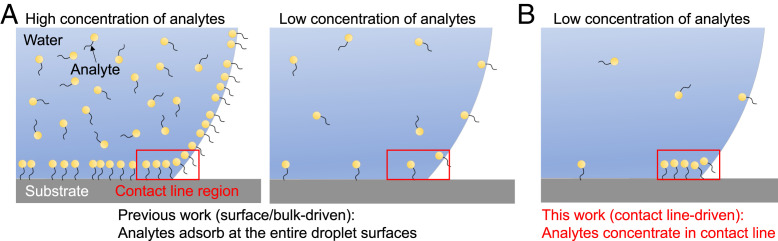
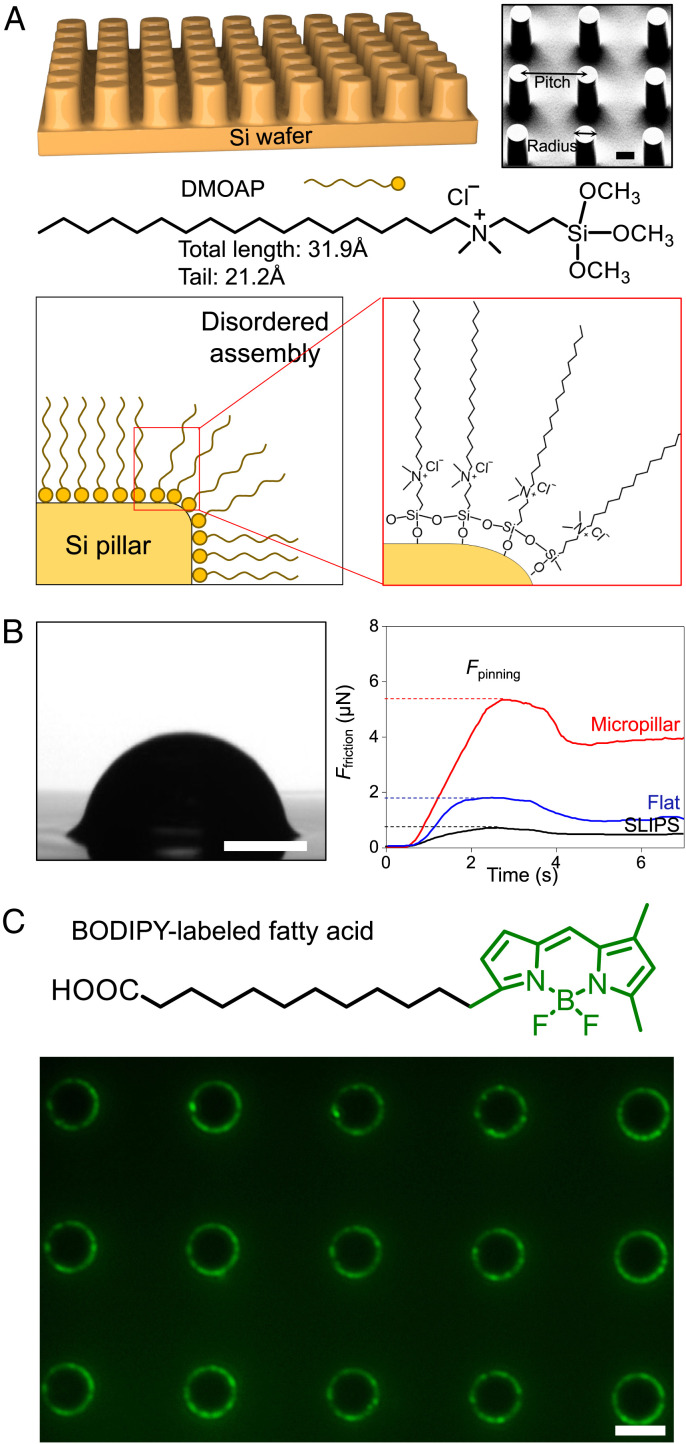
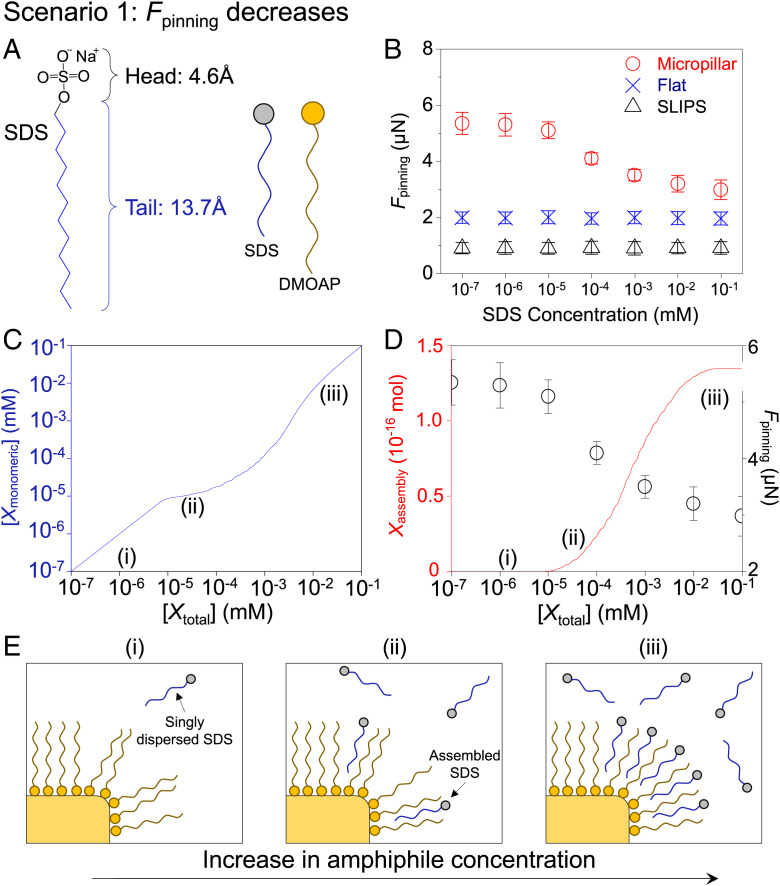
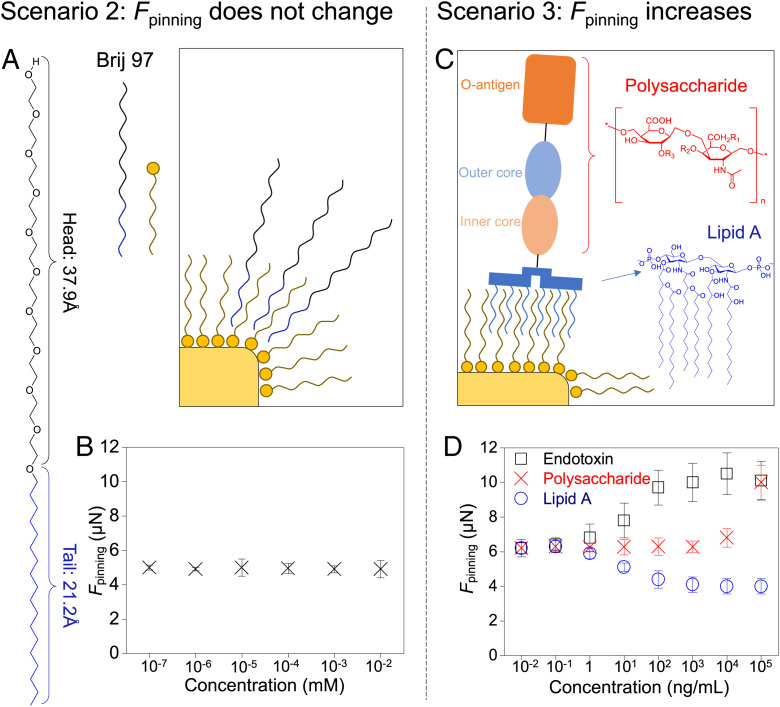
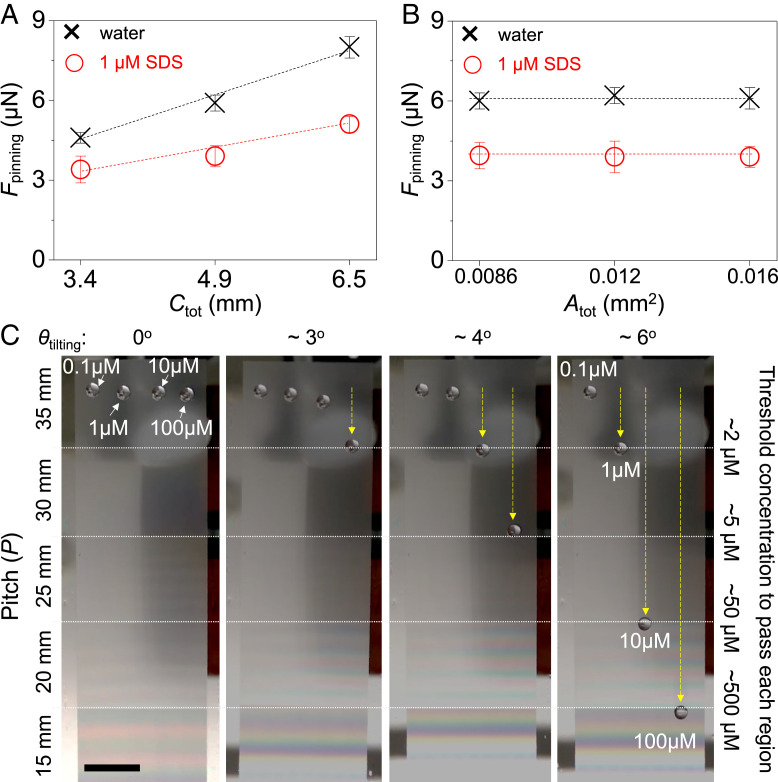
Various forms of ecological monitoring and disease diagnosis rely upon the detection of amphiphiles, including lipids, lipopolysaccharides, and lipoproteins, at ultralow concentrations in small droplets. Although assays based on droplets' wettability provide promising options in some cases, their reliance on the measurements of surface and bulk properties of whole droplets (e.g., contact angles, surface tensions) makes it difficult to monitor trace amounts of these amphiphiles within small-volume samples. Here, we report a design principle in which self-assembled monolayer-functionalized microstructured surfaces coated with silicone oil create locally disordered regions within a droplet's contact lines to effectively concentrate amphiphiles within the areas that dominate the droplet static friction. Remarkably, such surfaces enable the ultrasensitive, naked-eye detection of amphiphiles through changes in the droplets' sliding angles, even when the concentration is four to five orders of magnitude below their critical micelle concentration. We develop a thermodynamic model to explain the partitioning of amphiphiles at the contact line by their cooperative association within the disordered, loosely packed regions of the self-assembled monolayer. Based on this local analyte concentrating effect, we showcase laboratory-on-a-chip surfaces with positionally dependent pinning forces capable of both detecting industrially and biologically relevant amphiphiles (e.g., bacterial endotoxins), as well as sorting aqueous droplets into discrete groups based on their amphiphile concentrations. Furthermore, we demonstrate that the sliding behavior of amphiphile-laden aqueous droplets provides insight into the amphiphile's effective length, thereby allowing these surfaces to discriminate between analytes with highly disparate molecular sizes.
Keywords: amphiphiles; lubricated surfaces; self-assembly; sensors; wettability.
Conflict of interest statement
The authors declare no competing interest.
Figures
References
-
- Yushmanov V. E., Perussi J. R., Imasato H., Tabak M., Interaction of papaverine with micelles of surfactants with different charge studied by 1H-NMR. Biochim. Biophys. Acta 1189, 74–80 (1994). - PubMed
-
- Olkowska E., Polkowska Ż., Namieśnik J., Analytics of surfactants in the environment: Problems and challenges. Chem. Rev. 111, 5667–5700 (2011). - PubMed
-
- Cserháti T., Forgács E., Oros G., Biological activity and environmental impact of anionic surfactants. Environ. Int. 28, 337–348 (2002). - PubMed
-
- Lechuga M., Fernández-Serrano M., Jurado E., Núñez-Olea J., Ríos F., Acute toxicity of anionic and non-ionic surfactants to aquatic organisms. Ecotoxicol. Environ. Saf. 125, 1–8 (2016). - PubMed
Publication types
MeSH terms
Substances
LinkOut - more resources
Full Text Sources
