


Generalizability of treatment outcome prediction in major depressive disorder using structural MRI: A NeuroPharm study
- PMID: 36252556
- PMCID: PMC9668596
- DOI: 10.1016/j.nicl.2022.103224
Generalizability of treatment outcome prediction in major depressive disorder using structural MRI: A NeuroPharm study
Abstract
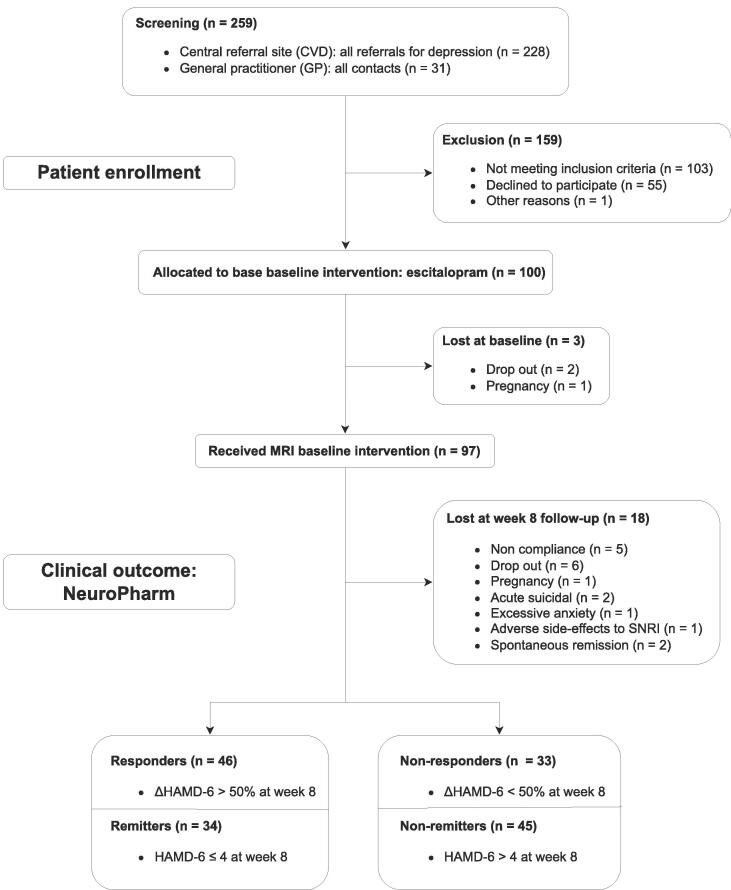
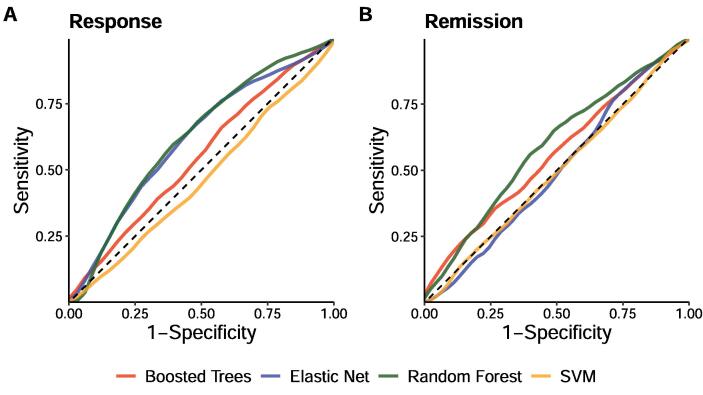
Brain morphology has been suggested to be predictive of drug treatment outcome in major depressive disorders (MDD). The current study aims at evaluating the performance of pretreatment structural brain magnetic resonance imaging (MRI) measures in predicting the outcome of a drug treatment of MDD in a large single-site cohort, and, importantly, to assess the generalizability of these findings in an independent cohort. The random forest, boosted trees, support vector machines and elastic net classifiers were evaluated in predicting treatment response and remission following an eight week drug treatment of MDD using structural brain measures derived with FastSurfer (FreeSurfer). Models were trained and tested within a nested cross-validation framework using the NeuroPharm dataset (n = 79, treatment: escitalopram); their generalizability was assessed using an independent clinical dataset, EMBARC (n = 64, treatment: sertraline). Prediction of antidepressant treatment response in the Neuropharm cohort was statistically significant for the random forest (p = 0.048), whereas none of the models could significantly predict remission. Furthermore, none of the models trained using the entire NeuroPharm dataset could significantly predict treatment outcome in the EMBARC dataset. Although our primary findings in the NeuroPharm cohort support some, but limited value in using pretreatment structural brain MRI to predict drug treatment outcome in MDD, the models did not generalize to an independent cohort suggesting limited clinical applicability. This study emphasizes the importance of assessing model generalizability for establishing clinical utility.
Keywords: MDD; Prediction; Remission; SSRI; Structural MRI; Treatment response.
Copyright © 2022 The Author(s). Published by Elsevier Inc. All rights reserved.
Conflict of interest statement
Declaration of Competing Interest The authors declare that they have no known competing financial interests or personal relationships that could have appeared to influence the work reported in this paper.
Figures
References
-
- Bartlett E.A., DeLorenzo C., Sharma P., Yang J., Zhang M., Petkova E., Weissman M., McGrath P.J., Fava M., Ogden R.T., Kurian B.T., Malchow A., Cooper C.M., Trombello J.M., McInnis M., Adams P., Oquendo M.A., Pizzagalli D.A., Trivedi M., Parsey R.V. Pretreatment and early-treatment cortical thickness is associated with SSRI treatment response in major depressive disorder. Neuropsychopharmacology. 2018;43:2221–2230. doi: 10.1038/s41386-018-0122-9. - DOI - PMC - PubMed
-
- Belov, V., Erwin-Grabner, T., Gonul, A.S., Amod, A.R., Ojha, A., Dols, A., Scharntee, A., Uyar-Demir, A., Harrison, B.J., Besteher, B., Klimes-Dougan, B., Zarate, C., Davey, C.G., Ching, C.R.K., Connolly, C.G., Stein, D.J., Dima, D., Linden, D.E.J., Mehler, D.M.A., Pozzi, E., Melloni, E., Benedetti, F., MacMaster, F.P., Grabe, J., Völzke, H., Gotlib, I.H., Soares, J.C., Evans, J.W., Sim, K., Wittfeld, K., Cullen, K., Reneman, L., Oudega, M.L., Portella, M.J., Sacchet, M.D., Li, M., Aghajani, M., Wu, M.-J., Jahanshad, N., Saemann, P., Bülow, R., Poletti, S., Whittle, S., Thomopoulos, S.I., van, J.A., Basgoze, Z., Veltman, D.J., Schmaal, L., Thompson, P.M., Unpublished results. Multi-site benchmark classification of major depressive disorder using machine learning on cortical and subcortical measures 56. https://doi.org/10.48550/arXiv.2206.08122.
-
- Benjamini Y., Hochberg Y. Controlling the false discovery rate: a practical and powerful approach to multiple testing. J. R. Stat. Soc. Ser. B Methodol. 1995;57(1):289–300.
-
- Brandt I.M., Köhler-Forsberg K., Ganz M., Ozenne B., Jorgensen M.B., Poulsen A., Knudsen G.M., Frokjaer V.G., Fisher P.M. Reward processing in major depressive disorder and prediction of treatment response – Neuropharm study. Eur. Neuropsychopharmacol. 2021;44:23–33. doi: 10.1016/j.euroneuro.2020.12.010. - DOI - PubMed
MeSH terms
Substances
LinkOut - more resources
Full Text Sources
