


Attentional biases in human anxiety
- PMID: 36252826
- PMCID: PMC9756271
- DOI: 10.1016/j.neubiorev.2022.104917
Attentional biases in human anxiety
Abstract
Across clinical and subclinical samples, anxiety has been associated with increased attentional capture by cues signaling danger. Various cognitive models attribute the onset and maintenance of anxiety symptoms to maladaptive selective information processing. In this brief review, we 1) describe the evidence for the relations between anxiety and attention bias toward threat, 2) discuss the neurobiology of anxiety-related differences in threat bias, 3) summarize work investigating the developmental origins of attention bias toward threat, and 4) examine efforts to translate threat bias research into clinical intervention. Future directions in each area are discussed, including the use of novel analytic approaches improving characterization of threat-processing-related brain networks, clarifying the role of cognitive control in the development of attention bias toward threat, and the need for larger, well-controlled randomized clinical trials examining moderators and mediators of treatment response. Ultimately, this work has important implications for understanding the etiology of and for intervening on anxiety difficulties among children and adults.
Keywords: Amygdala; Anxiety; Attention bias; Development; Intervention; Prefrontal cortex; Temperament; Threat.
Copyright © 2022 Elsevier Ltd. All rights reserved.
Conflict of interest statement
Declaration of Competing Interest The authors declare that they have no known competing financial interests or personal relationships that could have appeared to influence the work reported in this paper.
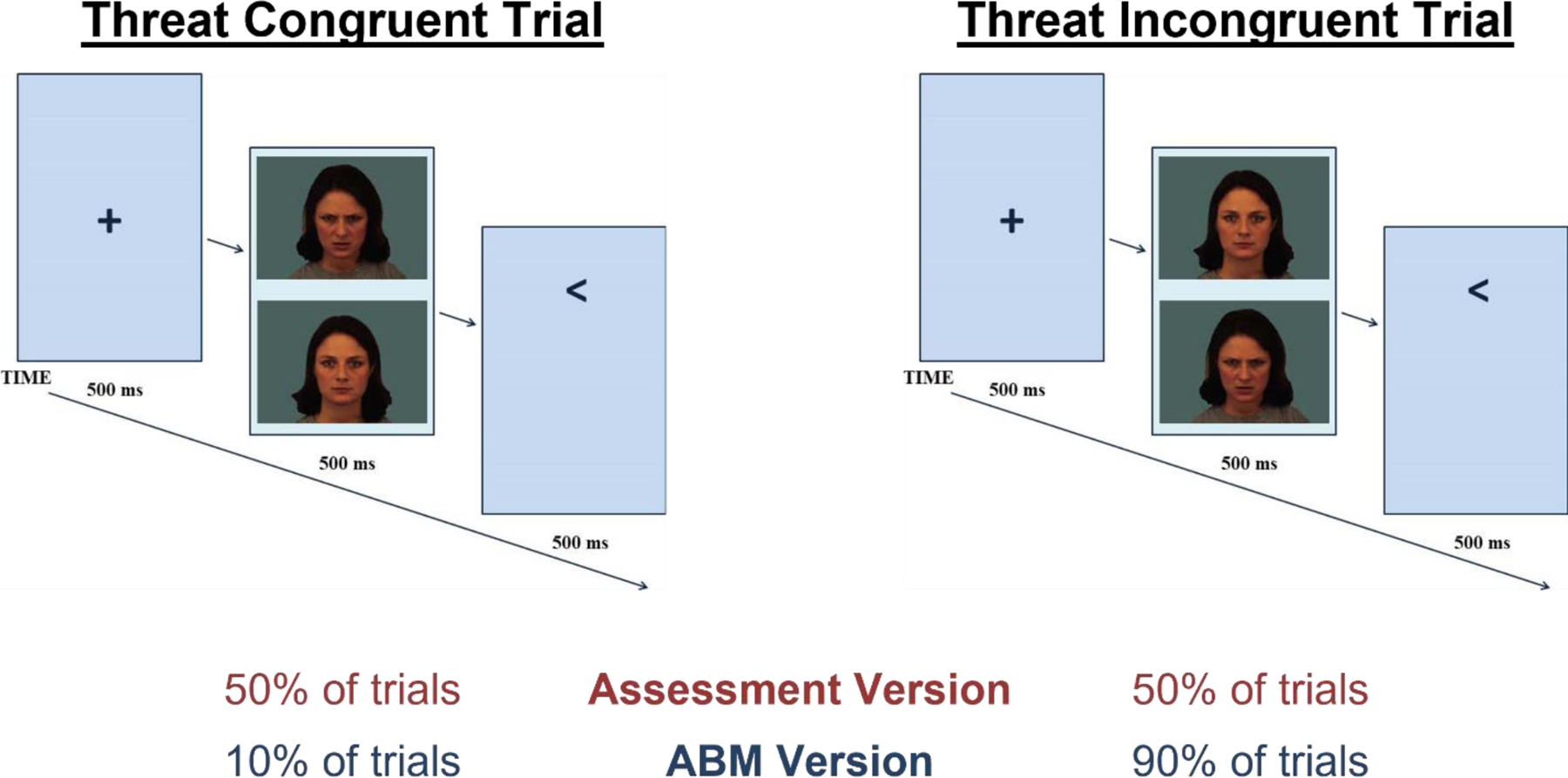
Figures

References
-
- Abend R, Bajaj MA, Matsumoto C, Yetter M, Harrewijn A, Cardinale EM, Kircanski K, Lebowitz ER, Silverman WK, Bar-Haim Y, Lazarov A, Leibenluft E, Brotman M, & Pine DS (2021). Converging Multi-modal Evidence for Implicit Threat-Related Bias in Pediatric Anxiety Disorders. Research on Child and Adolescent Psychopathology, 49(2), 227–240. 10.1007/s10802-020-00712-w - DOI - PMC - PubMed
-
- Abend R, de Voogd L, Salemink E, Wiers RW, Pérez-Edgar K, Fitzgerald A, White LK, Salum GA, He J, Silverman WK, Pettit JW, Pine DS, & Bar-Haim Y (2018). Association between attention bias to threat and anxiety symptoms in children and adolescents. Depression and Anxiety, 35(3), 229–238. 10.1002/da.22706 - DOI - PMC - PubMed
-
- Abend R, Pine DS, Fox NA, & Bar-Haim Y (2014). Learning and Memory Consolidation Processes of Attention-Bias Modification in Anxious and Nonanxious Individuals. Clinical Psychological Science, 2(5), 620–627. 10.1177/2167702614526571 - DOI
Publication types
MeSH terms
Grants and funding
LinkOut - more resources
Full Text Sources
