. 2022 Oct 17;12(1):17003.
doi: 10.1038/s41598-022-21183-7.

A wearable soft robot that can alleviate the pain and fear of the wearer

Affiliations

A wearable soft robot that can alleviate the pain and fear of the wearer

Youchan Yim et al. Sci Rep. .

Abstract

Social soft robotics may provide a new solution for alleviating human pain and fear. Here, we introduce a hand-held soft robot that can be clenched by the wearer. The robot comprises small airbags that can be inflated to provide the wearer with a feeling of being clenched. We then conducted an in-depth study of 66 adults who participated in a pain research protocol using thermal stimulation to investigate the effect of wearing the robot on pain perception and fear of injections. Pain assessment scale scores for perceived pain decreased significantly [Formula: see text] when participants wore the robot compared with the baseline condition in which the robot was not worn. In addition, the saliva test results showed a downward trend in oxytocin level when the robot provided the wearer with haptic feedback via the inflation of the internal airbags in response to the wearer's clench. Furthermore, the negative psychological state of participants, as measured using the positive and negative affect scale, improved significantly when wearing the robot. We also revealed that the salivary cortisol level, an indicator of stress, decreased significantly across all participants at the end of the experiment. In addition, participants' fear of injections was significantly improved after participation in the experiment. These results suggest that the wearable soft robot may alleviate the human perception of pain and fear in during medical treatments, such as vaccinations.


Conflict of interest statement

The authors declare no competing interests.

Figures
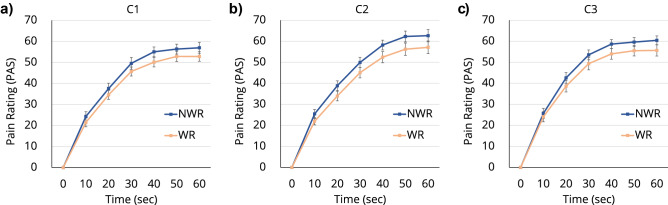
Figure 1
Figure 1
Reported PAS ratings by participants in the three conditions. Each participant rated their perceived pain level on the PAS every 10 s during a 60-s pain presentation.
Figure 2
Figure 2
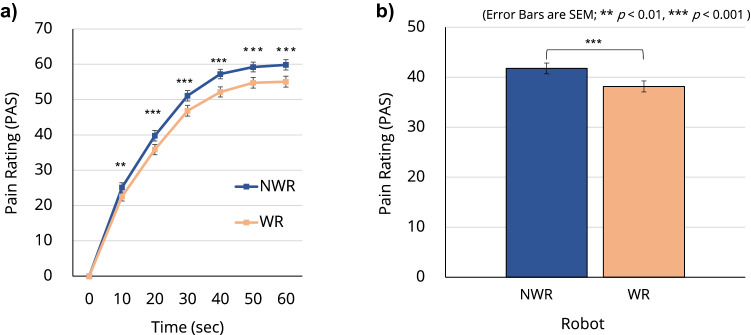
Post hoc comparisons of PAS ratings between NWR and WR. (a) Participants reported significantly lower pain ratings when they were WR than when they were NWR (p<0.01at10s and p<0.001at all the other time points). (b) A significant main effect of robot (NWR/WR) was also found.
Figure 3
Figure 3
Salivary oxytocin levels of participants in the three conditions. A trend decrease (p = 0.051) in oxytocin level was observed when participants in condition C3 were WR compared with when they were NWR.
Figure 4
Figure 4
Overall change in cortisol level of participants from the beginning to the end of the experiment. A significant main effect of time was found (p<0.01). The figure illustrates a significant decrease (p<0.01) in cortisol level.
Figure 5
Figure 5
Participants’ fear of injections before and after the experiment. (a) Q1–Q8 asked participants’ fear for eight different scenarios related to injections (see Supplementary Table S4 for descriptions of these scenarios). (b) The average score for the eight questions before and after the experiment. The post hoc comparison revealed a significant decrease in the average score (p<0.001) after the experiment.
Figure 6
Figure 6
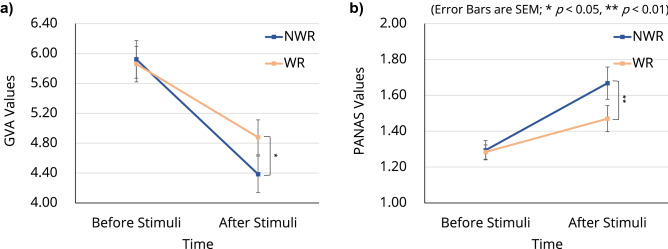
Psychological state of participants during the experiment. (a) Happiness state of GVA measured before and after each thermal stimulation. (b) Negative psychological state measured using the PANAS before and after each thermal stimulation.
Figure 7
Figure 7
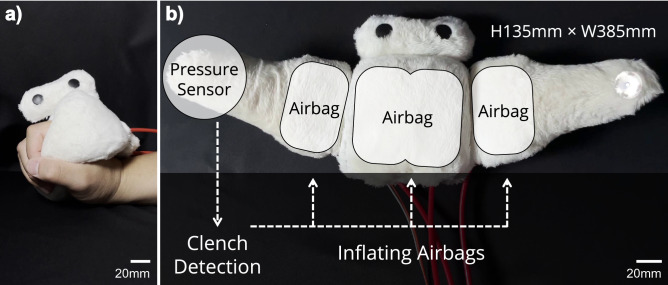
Inflatable hand-held soft robot. (a) The robot can be attached to the user’s hand. (b) Internal components were connected to an external pneumatic system with air pumps.
Figure 8
Figure 8
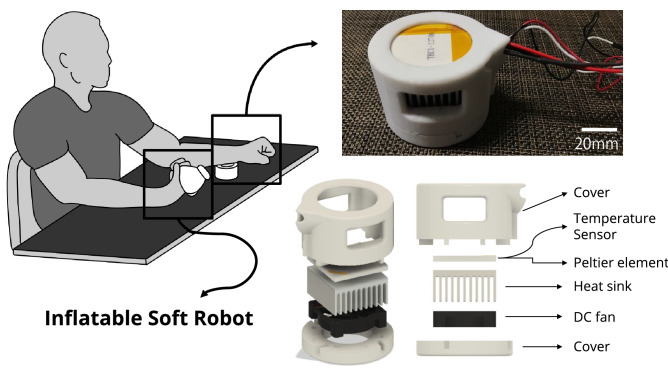
Thermal pain stimulator and experimental setup. Thermal stimuli were applied to the participant’s non-dominant arm using the thermal pain stimulator while the inflatable soft robot was placed on their dominant hand to perform haptic interaction with the robot (i.e., clenching the robot or being clenched by the robot).

References

    1. Olausson H, Wessberg J, McGlone F, Vallbo Å. The neurophysiology of unmyelinated tactile afferents. Neurosci. Biobehav. Rev. 2010;34:185–191. doi: 10.1016/j.neubiorev.2008.09.011. - DOI - PubMed
    1. Goldstein P, Shamay-Tsoory SG, Yellinek S, Weissman-Fogel I. Empathy predicts an experimental pain reduction during touch. J. Pain. 2016;17:1049–1057. doi: 10.1016/j.jpain.2016.06.007. - DOI - PubMed
    1. Goldstein P, Weissman-Fogel I, Shamay-Tsoory SG. The role of touch in regulating inter-partner physiological coupling during empathy for pain. Sci. Rep. 2017;7:3252. doi: 10.1038/s41598-017-03627-7. - DOI - PMC - PubMed
    1. Goldstein P, Weissman-Fogel I, Dumas G, Shamay-Tsoory SG. Brain-to-brain coupling during handholding is associated with pain reduction. Proc. Natl. Acad. Sci. U.S.A. 2018;115:E2528–E2537. doi: 10.1073/pnas.1703643115. - DOI - PMC - PubMed
    1. López-Solá M, Geuter S, Koban L, Coan JA, Wager TD. Brain mechanisms of social touch-induced analgesia in females. Pain. 2019;160:2072–2085. doi: 10.1097/j.pain.0000000000001599. - DOI - PubMed

Publication types

Supplementary concepts