


Materials analysis and image-based modelling of transmissibility and strain behaviour in approved face mask microstructures
- PMID: 36253423
- PMCID: PMC9574831
- DOI: 10.1038/s41598-022-22102-6
Materials analysis and image-based modelling of transmissibility and strain behaviour in approved face mask microstructures
Abstract
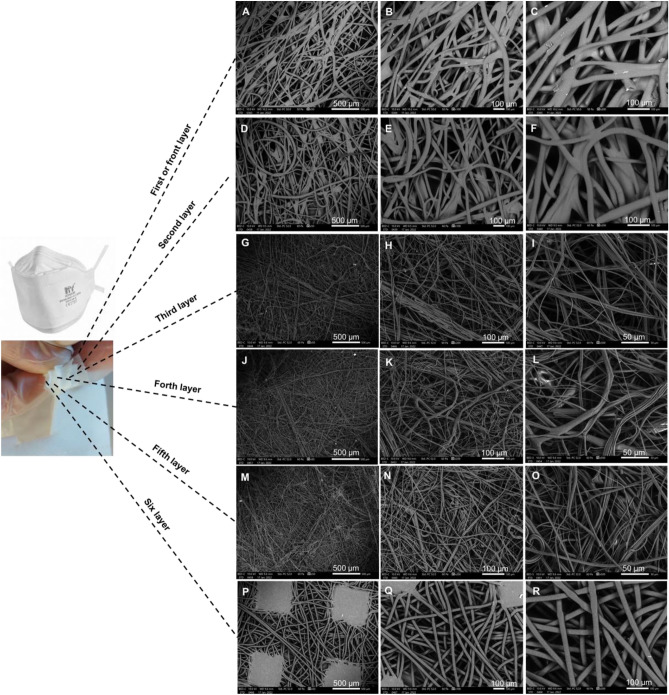
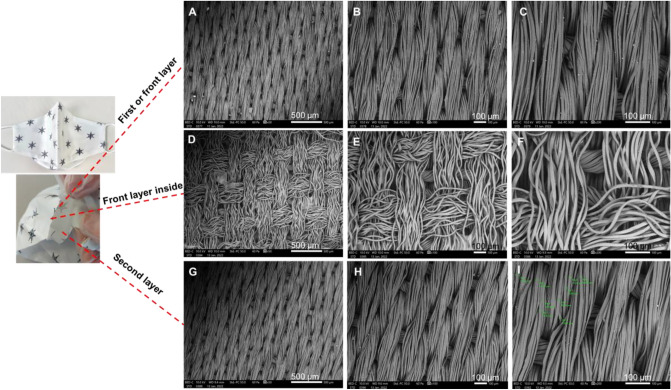
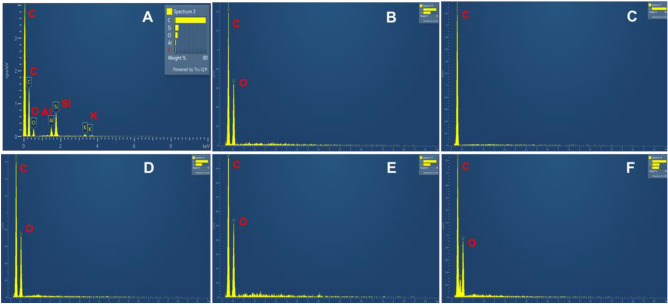
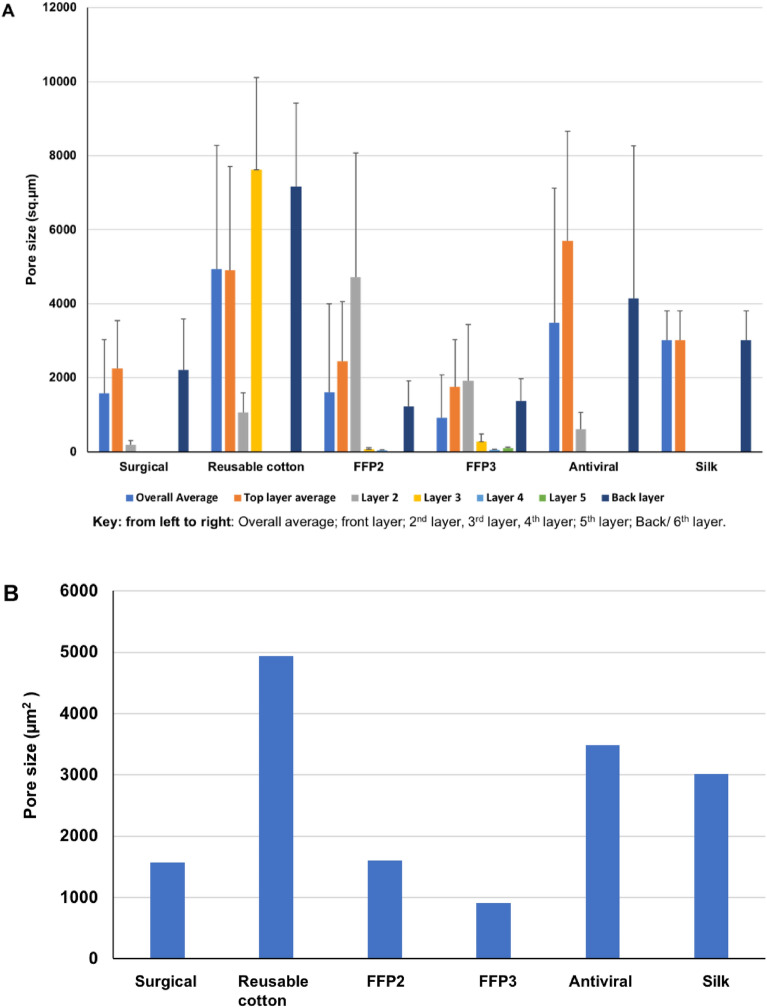
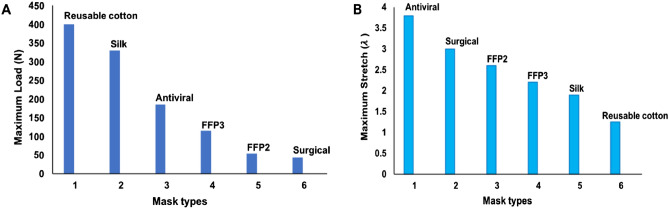
Comparisons are made between six different approved face masks concerning their particle transmissibility allied to mechanical properties. The latter involves material testing and stretch or strain behaviour under load. SEM and X-ray elemental analyses showed contrasting structures between random and ordered fibre orientations. These constitute the mask designs where transmissibility is to be minimised. Airflow velocity measurement enabled filtration to be measured between the different mask designs, from two to six layers of different fabrics in combination. SEM provided the fibre diameter and pore size of each mask layer, up to a maximum of six. Stretching each complete mask showed its elasticity and recovery behaviour on an energy basis. The energy conversion involved in mask straining involves areas enclosed within steady and cyclic load-extension plots. Thus, the work done in extending a mask and the energy recovered from its release identified a hysteresis associated with an irrecoverable permanent stretch to the mask fabric. Failure of individual layers, which occurred successively in extended stretch tests, appeared as a drop in a load-extension response. That change is associated with permanent damage to each mask and friction contact within the rearrangement of loose fibre weaves. Masks with the greatest number of layers reduced particle transmissibility. However, woven or ordered mask fabrics in two layers with different orientations provided comparable performance. Simulation of each mechanical response, velocity streamlining and fibre distribution within the mask layers are also presented.
© 2022. The Author(s).
Conflict of interest statement
The authors declare no competing interests.
Figures







References
-
- WHO (World Health Organization), Coronavirus disease (COVID-19): How is it transmitted?https://www.who.int/news-room/q-a-detail/coronavirus-disease-covid-19-ho... (updated December 2021).
-
- WHO, WHO Coronavirus (COVID-19) Dashboard. https://covid19.who.int (updated May 2022).
-
- Talic S, Shah S, Wild H, Gasevic D, Maharaj A, Ademi Z, Li X, Xu W, Mesa-Eguiagaray I, Rostron J, Theodoratou E. Effectiveness of public health measures in reducing the incidence of covid-19, SARS-CoV-2 transmission and covid-19 mortality: Systematic review and meta-analysis. Bmj. 2021;375:e068302. doi: 10.1136/bmj-2021-068302. - DOI - PMC - PubMed
-
- BBC. Covid: World’s true pandemic death toll nearly 15 million, says WHO. https://www.bbc.co.uk/news/health-61327778 (2022).
-
- Howard J, Huang A, Li Z, Tufekci Z, Zdimal V, Van der Westhuizen H-M, von Delft A, Price A, Fridman L, Tang L-H, Tang V, Watson GL, Bax CE, Shaikh R, Questier F, Hernandez D, Chu LF, Ramirez CM, Rimoin AW. An evidence review of face masks against COVID-19. PNAS. 2021;118:e2014564118. doi: 10.1073/pnas.2014564118. - DOI - PMC - PubMed
Grants and funding
LinkOut - more resources
Full Text Sources
