A potential serological biomarker for inner ear pathologies: OTOLIN-1
- PMID: 36254652
- PMCID: PMC9577683
- DOI: 10.14639/0392-100X-N2074
A potential serological biomarker for inner ear pathologies: OTOLIN-1
Abstract
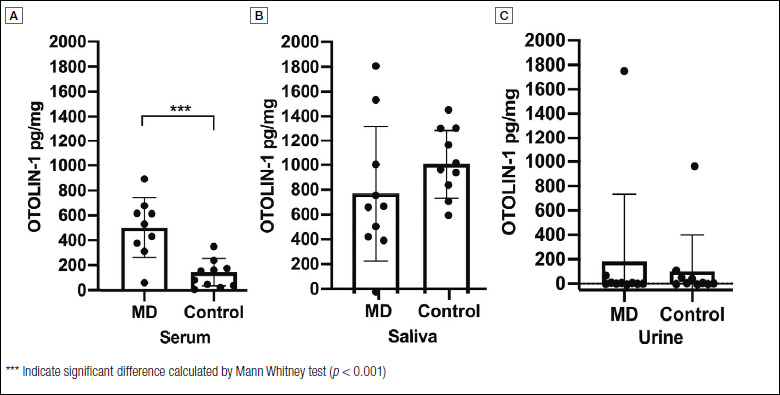
Objective: The goal of the study was to determine whether the level of OTOLIN-1, a protein whose expression is highly restricted to the inner ear,is increased in the body fluids of patients with inner ear disorders in comparison to healthy subjects.
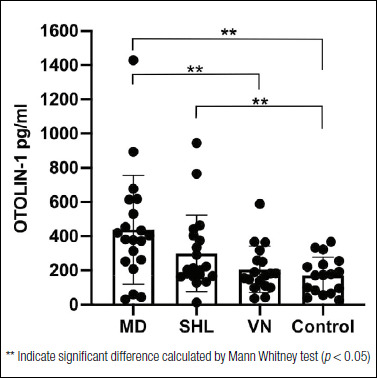
Methods: In the preliminary part of the study, OTOLIN-1 levels were measured in the serum, urine, and saliva of patients with an acute onset of Ménière´s disease and in healthy individuals. Subsequently, only serum OTOLIN-1 levels were taken into account and were compared between patients with acute onset of Ménière´s disease, sudden hearing loss, vestibular neuritis and healthy subjects.
Results: The most reliable diagnostic parameter was OTOLIN-1 levels in serum. Serum samples of patients with Ménière's disease and sudden hearing loss showed significantly higher OTOLIN-1 levels than those from healthy individuals. In addition, there was no significant difference between the serum concentration of OTOLIN-1 in patients with vestibular neuritis and the control group.
Conclusions: Serum levels of OTOLIN-1 can potentially be used as a biomarker for acute onset of inner ear disorders due to its significant increase in patients with acute Meniere´s disease and sudden hearing loss in comparison to healthy individuals.
Un potenziale biomarcatore sierologico per le patologie dell’orecchio interno: OTOLIN-1.
Obiettivo: Scopo principale dello studio è stato determinare se il livello di OTOLIN-1, una proteina la cui espressione è altamente ristretta all’orecchio interno, aumenti nei fluidi corporei di pazienti con diversi disturbi dell’orecchio interno, rispetto a soggetti sani.
Metodi: Nella parte preliminare dello studio, la concentrazione di OTOLIN-1 è stata misurata nel siero, urina e saliva di pazienti con esordio acuto della malattia di Ménière e di soggetti sani. In seguito, solo i livelli di OTOLIN-1 nel siero sono stati considerati e paragonati in pazienti con malattia di Ménière, ipoacusia improvvisa, neurite vestibolare e soggetti sani.
Risultati: Il parametro diagnostico più affidabile è stato il livello sierico di OTOLIN-1. La concentrazione sierica di OTOLIN-1 nei pazienti affetti da malattia di Ménière e ipoacusia improvvisa era significativamente più alta rispetto agli individui sani. I livelli della proteina nel siero dei pazienti con neurite vestibolare e del gruppo di controllo non differivano significativamente.
Conclusioni: La concentrazione sierica di OTOLIN-1 può essere potenzialmente utilizzata come un biomarcatore per i disturbi dell’orecchio interno, dato l’incremento significativo in pazienti con malattia di Ménière e ipoacusia improvvisa rispetto a individui sani.
Keywords: Ménière disease; OTOLIN-1; biomarker; inner ear; sudden hearing loss.
Copyright © 2022 Società Italiana di Otorinolaringoiatria e Chirurgia Cervico-Facciale, Rome, Italy.
Figures
References
-
- Gomaa NA, Jimoh Z, Campbell S, et al. Biomarkers for inner ear disorders: scoping review on the role of biomarkers in hearing and balance disorders. Diagnostics (Basel) 2020;11. https://doi.org/10.3390/diagnostics11010042 10.3390/diagnostics11010042 - DOI - PMC - PubMed
-
- Deans MR, Peterson JM, Wong GW. Mammalian Otolin: a multimeric glycoprotein specific to the inner ear that interacts with otoconial matrix protein Otoconin-90 and Cerebellin-1. PLoS One 2010;5:e12765. https://doi.org/10.1371/journal.pone.0012765 10.1371/journal.pone.0012765 - DOI - PMC - PubMed
-
- Murayama E, Herbomel P, Kawakami A, et al. Otolith matrix proteins OMP-1 and Otolin-1 are necessary for normal otolith growth and their correct anchoring onto the sensory maculae. Mech Dev 2005;122:791-803. https://doi.org/10.1016/j.mod.2005.03.002 10.1016/j.mod.2005.03.002 - DOI - PubMed
-
- Murayama E, Takagi Y, Nagasawa H. Immunohistochemical localization of two otolith matrix proteins in the otolith and inner ear of the rainbow trout, Oncorhynchus mykiss: comparative aspects between the adult inner ear and embryonic otocysts. Histochem Cell Biol 2004;121:155-166. https://doi.org/10.1007/s00418-003-0605-5 10.1007/s00418-003-0605-5 - DOI - PubMed
-
- Parham K, Sacks D, Bixby C, et al. Inner ear protein as a biomarker in circulation? Otolaryngol Head Neck Surg 2014;151:1038-1040. https://doi.org/10.1177/0194599814551127 10.1177/0194599814551127 - DOI - PubMed
MeSH terms
Substances
LinkOut - more resources
Full Text Sources
Medical
Molecular Biology Databases