Review
. 2023 Mar;41(3):266-282.
doi: 10.1007/s11604-022-01350-6. Epub 2022 Oct 18.

An introduction to photon-counting detector CT (PCD CT) for radiologists

Affiliations
Review

An introduction to photon-counting detector CT (PCD CT) for radiologists

Yuko Nakamura et al. Jpn J Radiol. 2023 Mar.

Abstract

The basic performance of photon-counting detector computed tomography (PCD CT) is superior to conventional CT (energy-integrating detector CT: EID CT) because its spatial- and contrast resolution of soft tissues is higher, and artifacts are reduced. Because the X-ray photon energy separation is better with PCD CT than conventional EID-based dual-energy CT, it has the potential to improve virtual monochromatic- and virtual non-contrast images, material decomposition including quantification of the iodine distribution, and K-edge imaging. Therefore, its clinical applicability may be increased. Although the image quality of PCD CT scans is superior to that of EID CT currently, further improvement may be possible. The introduction of iterative image reconstruction and reconstruction with deep convolutional neural networks will be useful.

Keywords: Energy separation; Energy-integrating detector CT; K-edge imaging; Photon-counting detector CT; Spatial resolution.


Conflict of interest statement

Kazuo Awai received a research grant from Canon Medical Systems Co. Ltd. and FUJIFILM Healthcare Corporation. Isao Takahashi is an employee of FUJIFILM Healthcare Corporation and FUJIFILM Corporation. The other authors declare that they have no conflict of interest.

Figures
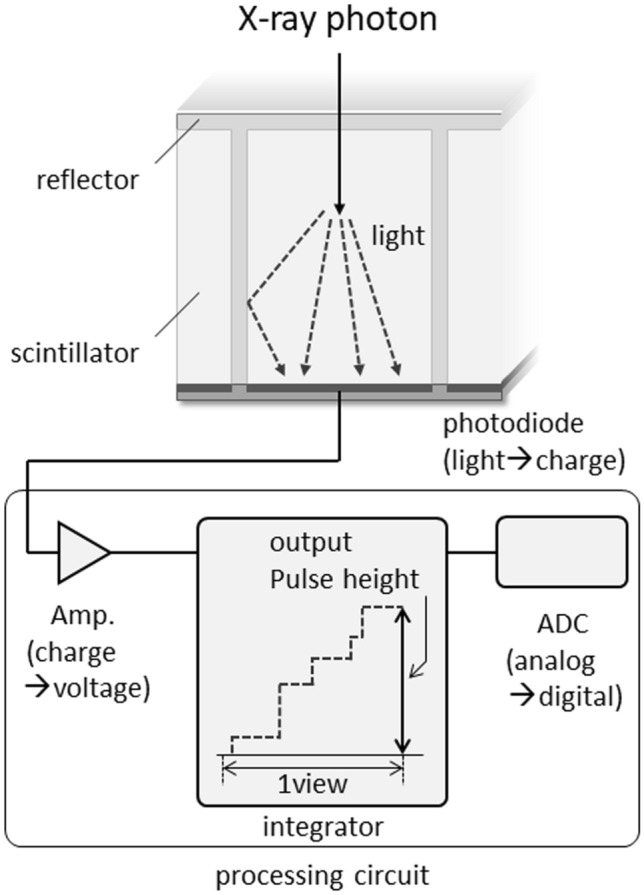
Fig. 1
Fig. 1
Schematic drawing of energy-integrating detector (EID) for conventional CT
Fig. 2
Fig. 2
Schematic drawing of photon-counting detector (PCD)
Fig. 3
Fig. 3
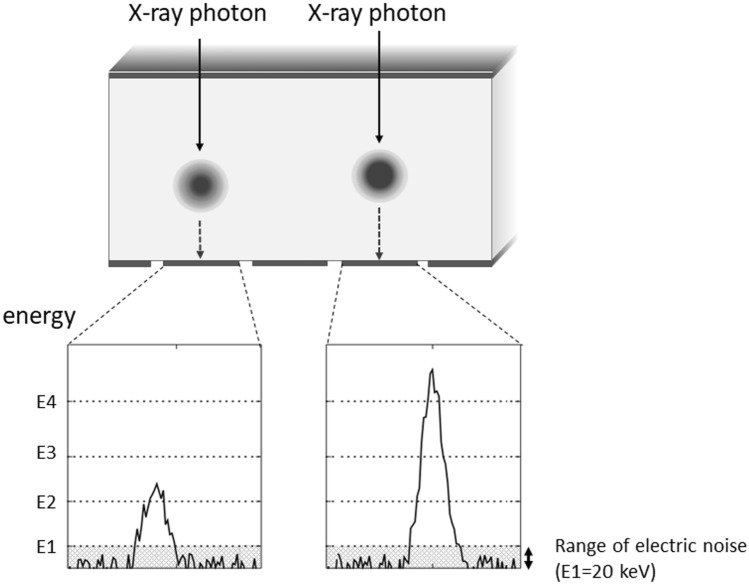
Incident X-ray photons into the detector and generation of pulse (ideal situation). Under ideal situations, one charge cloud caused by a single photon enters to one-pixel electrode and one pulse is generated. As pulse caused by electric noise is well lower than 20 keV, electric noise can be removed by setting the lowest energy threshold of PCD to around 20 keV
Fig. 4
Fig. 4
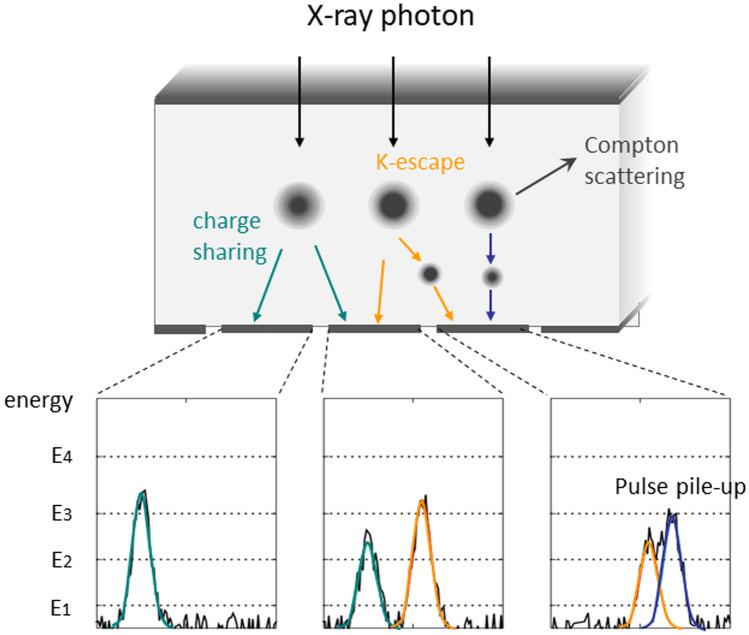
Charge sharing, K-escape, and Compton scattering causing inaccurate signal measurements in the PCD
Fig. 5
Fig. 5
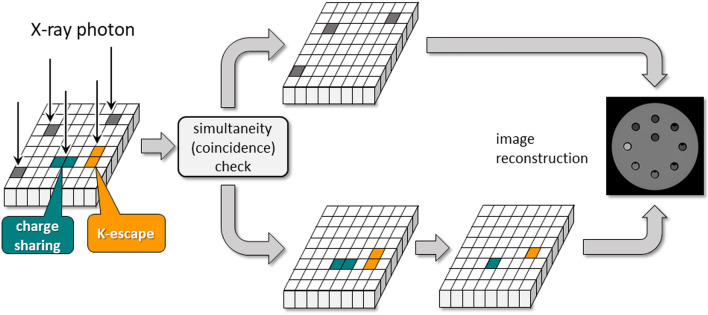
A method to correct split signals. To handle split signals caused by, e.g., charge sharing or K-escape, simultaneity of detected signals is checked in the pixel electrodes
Fig. 6
Fig. 6
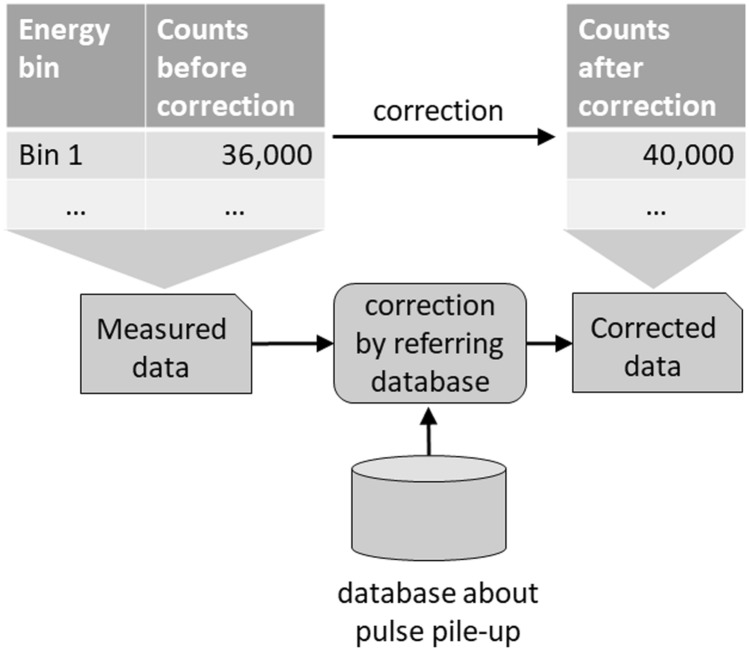
A method to correct pulse pile-up. A method to correct data affected by pulse pile-up is referring to a previously prepared database of signal deterioration due to pulse pile-up
Fig. 7
Fig. 7
A method for material decomposition in the PCD CT. This method uses a previously prepared reference table (the values in figure are not actual measurements, but only show concepts)
Fig. 8
Fig. 8
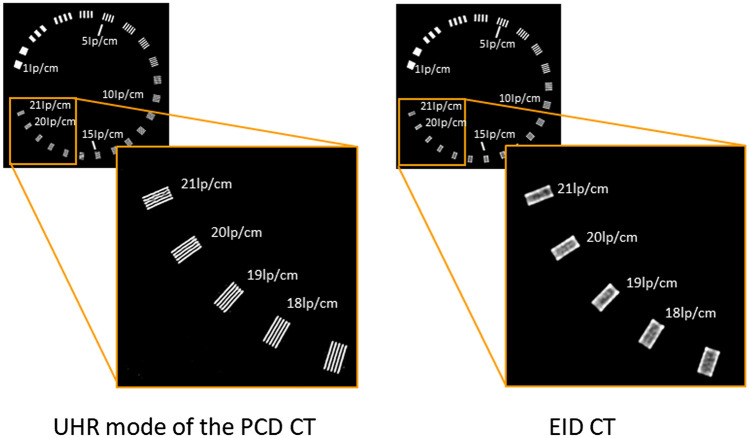
Comparison of spatial resolution in the phantom images between UHR mode of the PCD CT and EID CT (unpublished our own data). The phantom used for this imaging is Catphan 500 with CTP528 High Resolution Module (Phantom Laboratory Inc., Greenwich, USA)
Fig. 9
Fig. 9
Comparison of modulation transfer function (MTF) between PCD CT and EID CT. The MTF for PCD CT shows higher response than that for EID CT in all frequency domains (unpublished our own data)
Fig. 10
Fig. 10
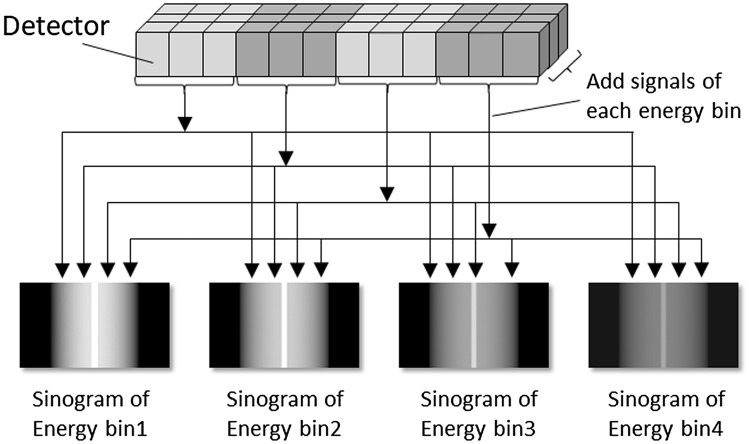
Schematic drawing of multiple energy discrimination (MED) mode of the PCD CT. In the MED mode, nine pixel electrodes are bundled together and treated like a single detector segment and the counts of the nine pixel electrodes are added for each energy bin (unpublished our own data)
Fig. 11
Fig. 11
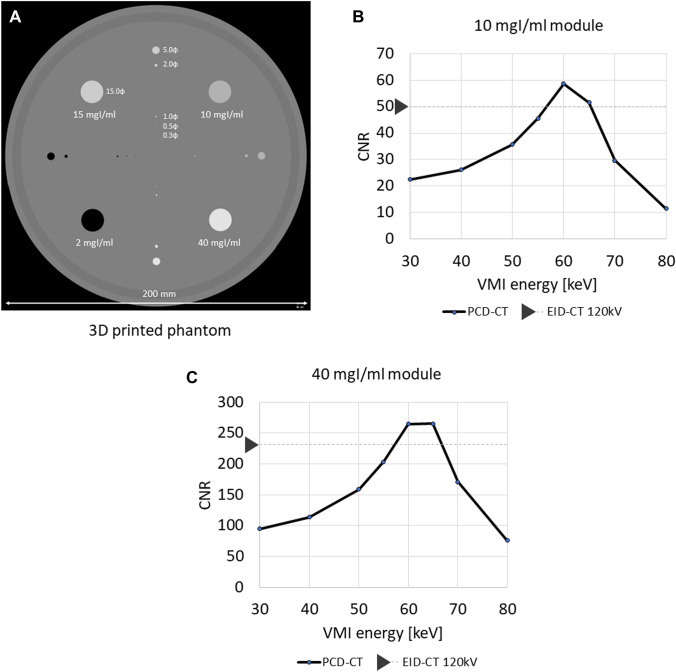
Iodine contrast-to-noise ratio (CNR) for each effective energy of virtual monochromatic images (VMI) generated from the PCD CT (unpublished our own data). A Configuration of the phantom to measure iodine CNR. The phantom is made of acrylate plastic and includes modules with different iodine concentration solutions. B and C Iodine CNR on the VMI generated from the PCD CT. Graphs show iodine CNR on the vertical axis and the effective energy (keV) of the VMI generated from the PCD CT on the horizontal axis. Iodine CNR on EID CT image is also shown on the vertical axis in each graph for reference
Fig. 12
Fig. 12
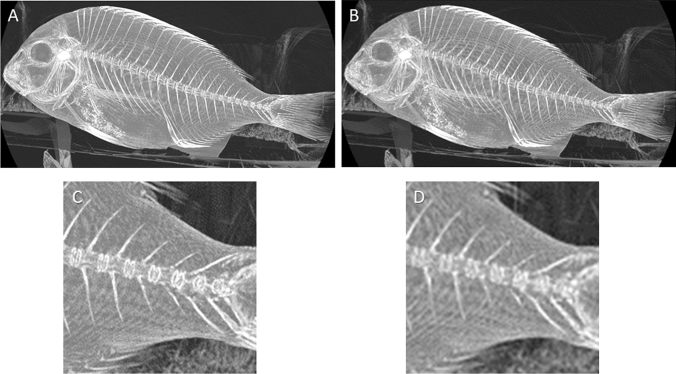
Maximum intensity projection images of fish (unpublished our own data). A PCD CT image in high resolution mode (matrix: 1024 × 1024, slab thickness: 45.75 mm). B PCD CT image with low resolution equivalent to conventional EID CT (matrix: 512 × 512, slab thickness: 45.75 mm). C Magnification of (A). D Magnification of (B). The overall structure is sharply delineated in (A and C) compared with (B and D)
Fig. 13
Fig. 13
Principle of K-edge imaging at PCD CT. Material decomposition is performed based on the difference in the attenuation coefficients obtained at different energies (A). At K-edge imaging different energies are set on higher and lower level than K-edge of the target material (B). As 70–100 kVp and 135–150 kVp are routinely set for EID-based DECT scanning, these energies do not necessarily involve the K-edge of the materials which are used clinically such as iodine. In addition, the two energy spectra used have an overlap (C). At PCD CT scanning its energy can be classified into several energy bins and less overlap of different energy spectra (D)
Fig. 14
Fig. 14
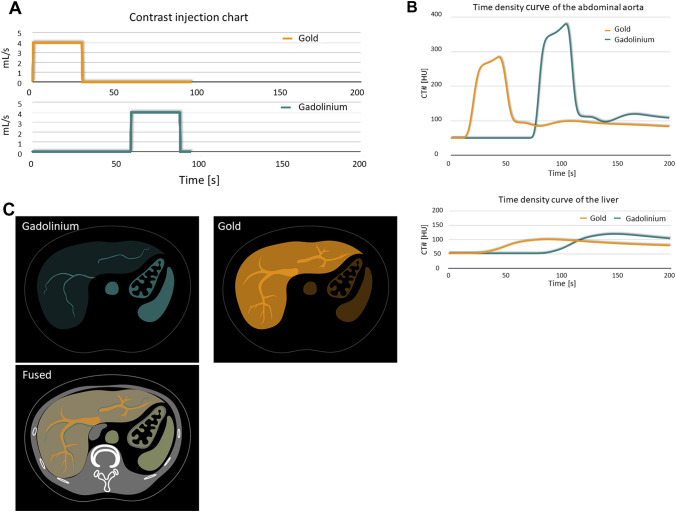
Simulated single-scan dual-contrast biphasic liver imaging using K-edge imaging. Scanning protocol to simultaneously capture maximum enhancement of gadolinium during the late arterial phase and of gold during the portal venous phase. A contrast material injection timing chart, B simulated time intensity curve of the abdominal aorta and liver. C Arteries containing gadolinium-based contrast agent can be visualized on gadolinium maps. Portal veins and liver parenchyma containing gold-based contrast agent can be visualized on gold maps

References

    1. Schlomka JP, Roessl E, Dorscheid R, Dill S, Martens G, Istel T, et al. Experimental feasibility of multi-energy photon-counting K-edge imaging in pre-clinical computed tomography. Phys Med Biol. 2008;53(15):4031–4047. doi: 10.1088/0031-9155/53/15/002. - DOI - PubMed
    1. Shikhaliev PM. Energy-resolved computed tomography: first experimental results. Phys Med Biol. 2008;53(20):5595–5613. doi: 10.1088/0031-9155/53/20/002. - DOI - PubMed
    1. Iwanczyk JS, Nygard E, Meirav O, Arenson J, Barber WC, Hartsough NE, et al. Photon counting energy dispersive detector arrays for X-ray imaging. IEEE Trans Nucl Sci. 2009;56(3):535–542. doi: 10.1109/TNS.2009.2013709. - DOI - PMC - PubMed
    1. Anderson NG, Butler AP, Scott NJ, Cook NJ, Butzer JS, Schleich N, et al. Spectroscopic (multi-energy) CT distinguishes iodine and barium contrast material in MICE. Eur Radiol. 2010;20(9):2126–2134. doi: 10.1007/s00330-010-1768-9. - DOI - PubMed
    1. Bornefalk H, Danielsson M. Photon-counting spectral computed tomography using silicon strip detectors: a feasibility study. Phys Med Biol. 2010;55(7):1999–2022. doi: 10.1088/0031-9155/55/7/014. - DOI - PubMed