. 2022 Oct 25;119(43):e2214638119.
doi: 10.1073/pnas.2214638119. Epub 2022 Oct 18.

Temporal scaling of human scalp-recorded potentials

Affiliations

Temporal scaling of human scalp-recorded potentials

Cameron D Hassall et al. Proc Natl Acad Sci U S A. .

Abstract

Much of human behavior is governed by common processes that unfold over varying timescales. Standard event-related potential analysis assumes fixed-duration responses relative to experimental events. However, recent single-unit recordings in animals have revealed neural activity scales to span different durations during behaviors demanding flexible timing. Here, we employed a general linear modeling approach using a combination of fixed-duration and variable-duration regressors to unmix fixed-time and scaled-time components in human magneto-/electroencephalography (M/EEG) data. We use this to reveal consistent temporal scaling of human scalp-recorded potentials across four independent electroencephalogram (EEG) datasets, including interval perception, production, prediction, and value-based decision making. Between-trial variation in the temporally scaled response predicts between-trial variation in subject reaction times, demonstrating the relevance of this temporally scaled signal for temporal variation in behavior. Our results provide a general approach for studying flexibly timed behavior in the human brain.

Keywords: EEG; regression; timing.


Conflict of interest statement

The authors declare no competing interest.

Figures
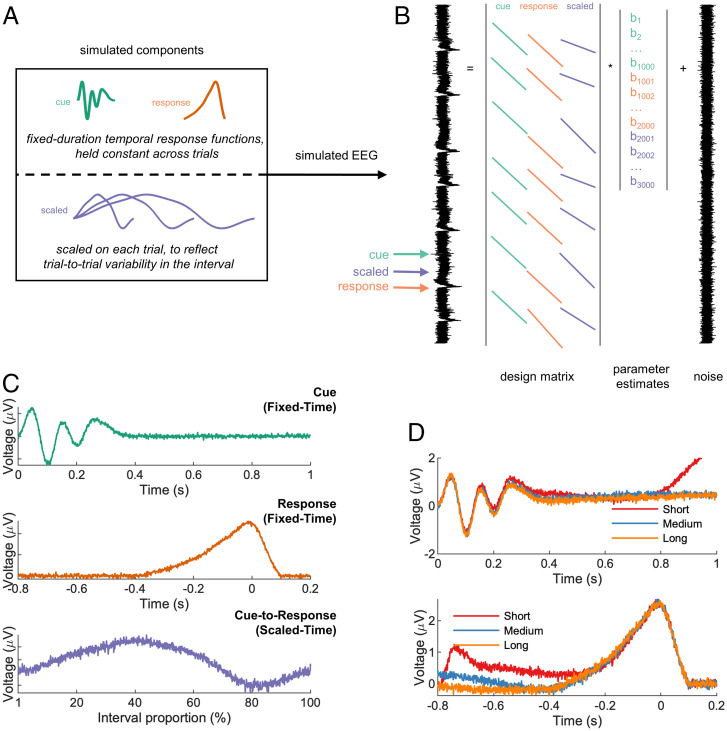
Fig. 1.
Fig. 1.
Regression-based unmixing of simulated data successfully recovers scaled-time and fixed-time components. (A) EEG data were simulated by summing fixed-time components (cue and response), a scaled-time component with differing durations for different trials (short, medium, or long), and noise. (B) The simulated responses were unmixed via a GLM with stick basis functions: cue-locked, response-locked, and a single scaled-time basis spanning from cue to response (i.e., variable duration). (C) The GLM successfully recovered all three components, including the scaled-time component. (D) A conventional ERP analysis (cue-locked and response-locked averages) of the same data obscured the scaled-time component.
Fig. 2.
Fig. 2.
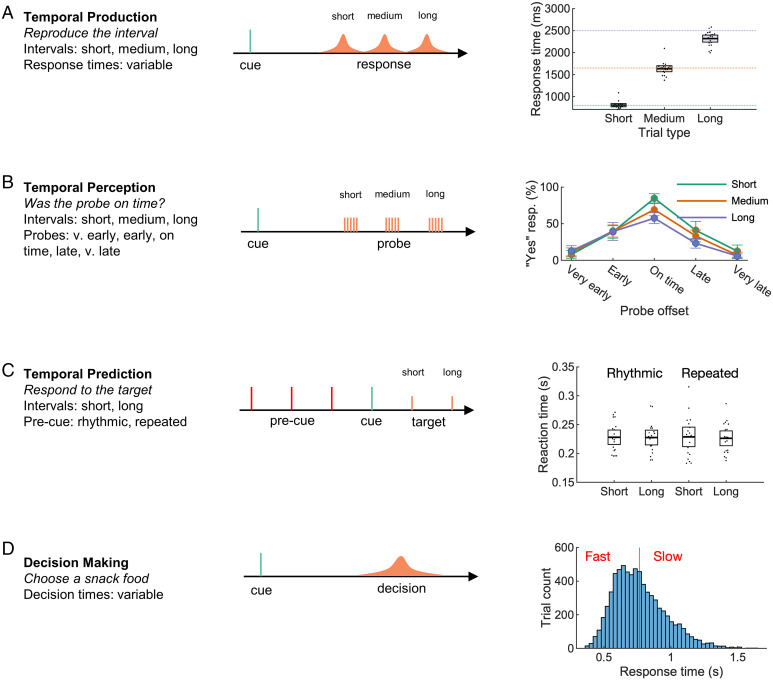
Datasets from three time-estimation and one decision-making paradigm were analyzed. In the temporal production task (A), participants successfully produced one of three cued intervals. In the temporal perception task (B), participants were able to properly judge a computer-produced interval. In a previously analyzed temporal prediction task (C) (39, 40), participants responded quickly to targets following either a rhythmic or repeated (nonrhythmic) cue. In a previously analyzed decision-making task (D) (41, 42), participants were cued to choose one of two snack food items, resulting in a range of response times (mean shown as red line). Error bars represent 95% CIs.
Fig. 3.
Fig. 3.
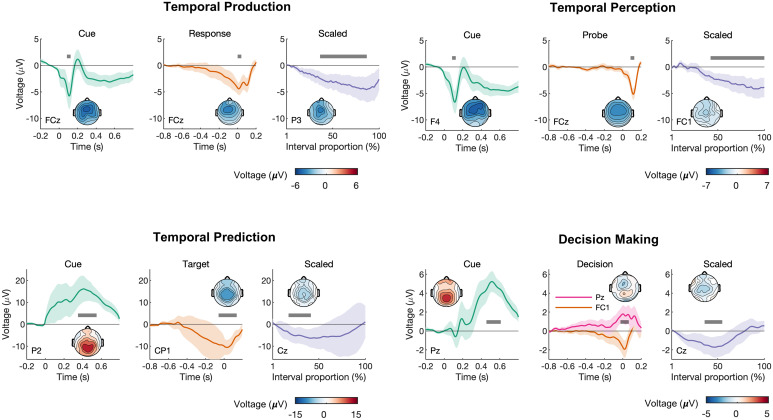
Scaled-time components were consistently observed across all four paradigms, with distinct scalp topographies from fixed-time components. Each had distinct fixed-time components relative to task-relevant events (Left/Middle Columns) and a common negative scaled-time component over central electrodes, reflecting interval time (Right Column). The scalp topographies represent the mean voltage across the intervals indicated by the gray bars. For the fixed-time components, the intervals were chosen to visualize prominent deflections in the average waveform. For the scaled-time components, the intervals represent regions of significance as determined by cluster-based permutation tests. The error bars represent 95% CIs.
Fig. 4.
Fig. 4.
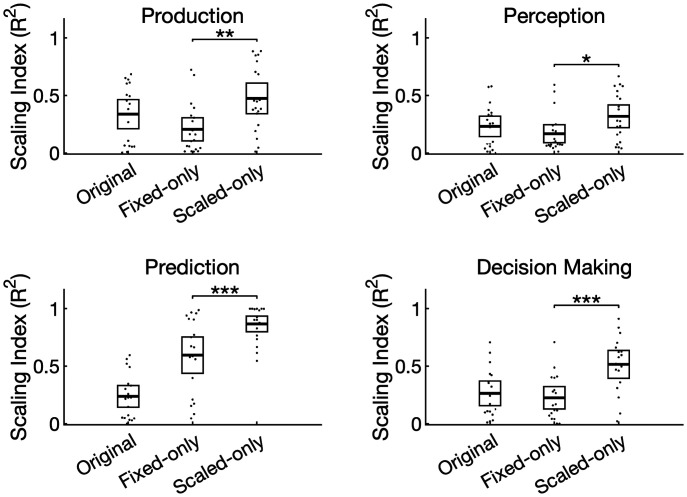
The unmixed signals differed quantitatively in their degree of scaling. The scaling index, defined as the coefficient of determination between epochs after stretching, was first computed for the raw data (“original”) and after isolating either the fixed (“fixed only”) or scaled (“scaled only”) components. In all four tasks, the scaled-time components had a greater scaling index compared with the fixed-time components. Dots represent individual participants, and error bars represent 95% CIs. *P < 0.05, *P < 0.01, ***P < 0.001.
Fig. 5.
Fig. 5.
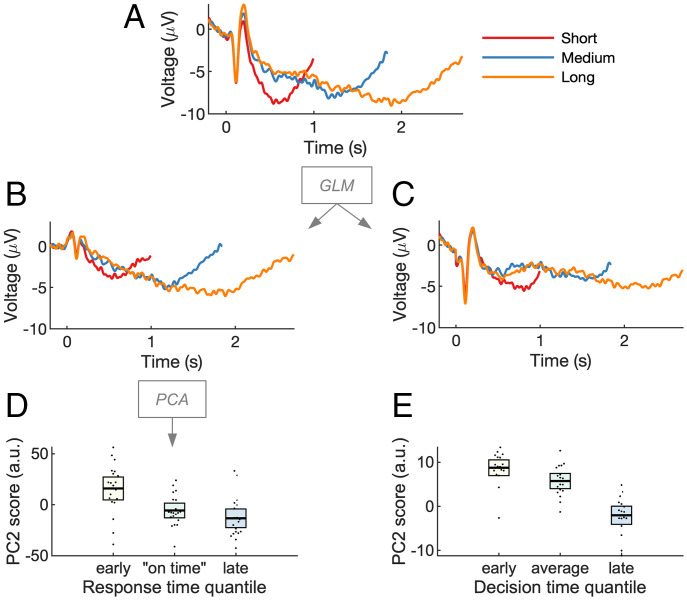
Variation in scaled-time components predicts behavioral variation in time estimation. (A) Cue-locked EEG, shown as ERPs, was analyzed via GLM. (B and C) To visualize the unmixing of scaled-time and fixed-time components, the residual (noise) was recombined with either the scaled-time component (B) or the fixed-time components (C). PCA was run on the “scaled time plus residual” EEG. The second principal component resembled the temporal derivative or “rate” of the scaled component (SI Appendix, Fig. 5). (D) PC2 scores depended on response time, implying the scaled-time component peaked earlier for fast responses and later for slow responses. (E) The effect replicated in a decision-making task. PC2 scores are in arbitrary units (a.u.). Error bars represent 95% CIs.

References

    1. Bogacz R., Brown E., Moehlis J., Holmes P., Cohen J. D., The physics of optimal decision making: A formal analysis of models of performance in two-alternative forced-choice tasks. Psychol. Rev. 113, 700–765 (2006). - PubMed
    1. Merchant H., Harrington D. L., Meck W. H., Neural basis of the perception and estimation of time. Annu. Rev. Neurosci. 36, 313–336 (2013). - PubMed
    1. Wittmann M., The inner sense of time: How the brain creates a representation of duration. Nat. Rev. Neurosci. 14, 217–223 (2013). - PubMed
    1. Nobre A. C., van Ede F., Anticipated moments: Temporal structure in attention. Nat. Rev. Neurosci. 19, 34–48 (2018). - PubMed
    1. Macar F., Vidal F., Event-related potentials as indices of time processing: A review. J. Psychophysiol. 18, 89–104 (2004).

Publication types

LinkOut - more resources