


Long-term delayed emergence after remimazolam-based general anesthesia: a case report
- PMID: 36260199
- PMCID: PMC9582068
- DOI: 10.1186/s40981-022-00576-7
Long-term delayed emergence after remimazolam-based general anesthesia: a case report
Abstract
Background: Remimazolam is an ultra-short-acting benzodiazepine anesthetic that is antagonized by flumazenil, and it is typically expected to be applied in anesthesia with the purpose of ensuring early postoperative recovery. We report a case of long-term delayed emergence with re-sedation even after three times of flumazenil administration.
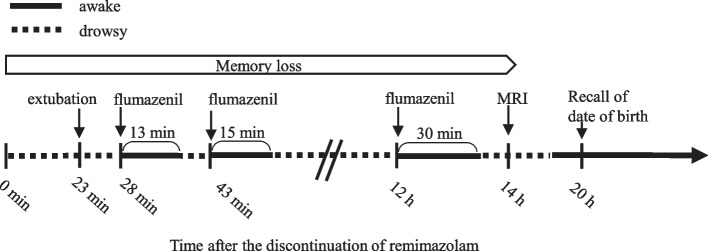
Case presentation: A 71-year-old man was scheduled for a robotic-assisted laparoscopic radical prostatectomy for prostate cancer. We used remimazolam for anesthetic induction and maintenance. The intraoperative bispectral index (BIS) was 30-50. Flumazenil was administered as patient emergence was delayed after surgery; however, re-sedation was observed. This finding persisted till 12 h after surgery, and the patient awakened on postoperative day 2.
Conclusions: Remimazolam is a short-acting anesthetic, but long-term delayed emergence with re-sedation may occur even after flumazenil administration. Anesthesia using remimazolam requires anesthesia management that takes into account the individual differences in sensitivity and metabolism, with BIS as the indicator.
Keywords: Benzodiazepines; Flumazenil; Prostatectomy; Prostatic neoplasms; Remimazolam.
© 2022. The Author(s).
Conflict of interest statement
The authors declare that they have no competing interests.
Figures
References
-
- Doi M, Hirata N, Suzuki T, Morisaki H, Morimatsu H, Sakamoto A. Safety and efficacy of remimazolam in induction and maintenance of general anesthesia in high-risk surgical patients (ASA Classt): results of a multicenter, randomized, double-blind, parallel-group comparative trial. J Anesth. 2020;34:491–501. doi: 10.1007/s00540-020-02776-w. - DOI - PubMed
LinkOut - more resources
Full Text Sources
Miscellaneous