


The Effectiveness of Patient Training in Inflammatory Bowel Disease Knowledge via Instagram: Randomized Controlled Trial
- PMID: 36260385
- PMCID: PMC9631171
- DOI: 10.2196/36767
The Effectiveness of Patient Training in Inflammatory Bowel Disease Knowledge via Instagram: Randomized Controlled Trial
Abstract
Background: Patients' knowledge was found to be a key contributor to the success of therapy. Many efforts have been made to educate patients in their disease. However, research found that many patients still lack knowledge regarding their disease. Integrating patient education into social media platforms can bring materials closer to recipients.
Objective: The aim of this study is to test the effectiveness of patient education via Instagram.
Methods: A randomized controlled trial was conducted to test the effectiveness of patient education via Instagram among patients with inflammatory bowel disease. Participants were recruited online from the open Instagram page of a patient organization. The intervention group was educated via Instagram for 5 weeks by the research team; the control group did not receive any educational intervention. The knowledge about their disease was measured pre- and postintervention using the Inflammatory Bowel Disease Knowledge questionnaire. Data were analyzed by comparing mean knowledge scores and by regression analysis. The trial was purely web based.
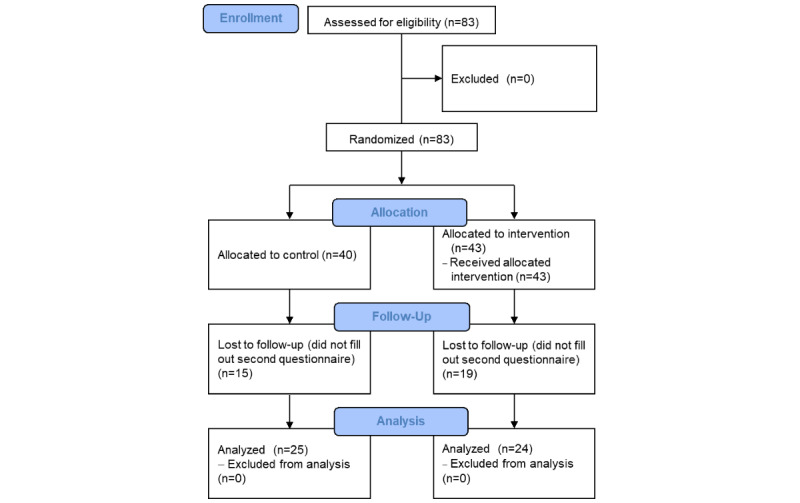
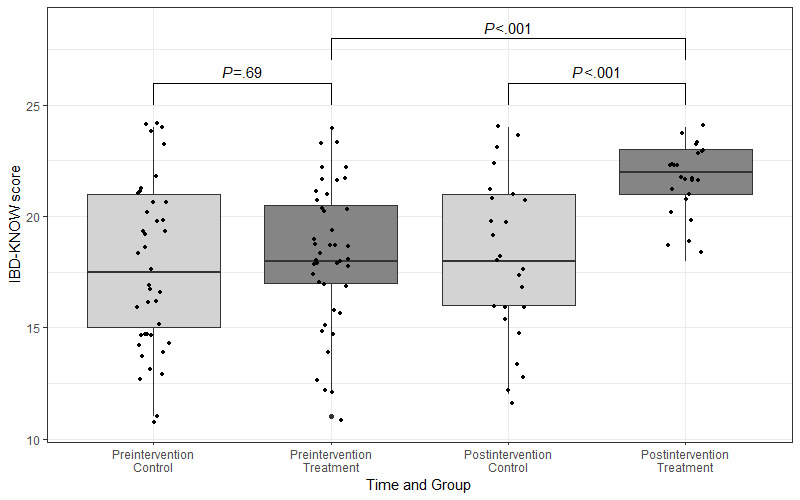
Results: In total, 49 participants filled out both questionnaires. The intervention group included 25 participants, and the control group included 24 participants. The preintervention knowledge level of the intervention group was reflected as a score of 18.67 out of 24 points; this improved by 3 points to 21.67 postintervention. The postintervention difference between the control and intervention groups was 3.59 points and was statistically significant (t32.88=-4.56, 95% CI 1.98-5.19; P<.001). Results of the regression analysis, accounting for preintervention knowledge and group heterogeneity, indicated an increase of 3.33 points that was explained by the intervention (P<.001).
Conclusions: Patient education via Instagram is an effective way to increase disease-related knowledge. Future studies are needed to assess the effects in other conditions and to compare different means of patient education.
Trial registration: German Clinical Trials Register DRKS00022935; https://tinyurl.com/bed4bzvh.
Keywords: Germany; IBD-KNOW; Instagram; RCT; disease-related knowledge; inflammatory bowel disease; patient education; patient training; randomized controlled trial; social media.
©Dominik Blunck, Lena Kastner, Michael Nissen, Jacqueline Winkler. Originally published in the Journal of Medical Internet Research (https://www.jmir.org), 19.10.2022.
Conflict of interest statement
Conflicts of Interest: JW worked during her master’s course—where this paper was initiated as a student project—for Roche Pharma AG as a patient partnership manager in the field of gastroimmunology. Roche did not provide any funding for the study and had no influence in initiating, planning, designing, and conducting the study; collection, analysis, or interpretation of data; the writing of the manuscript; or the decision to publish the paper.
Figures
References
-
- GBD 2017 Inflammatory Bowel Disease Collaborators The global, regional, and national burden of inflammatory bowel disease in 195 countries and territories, 1990-2017: A systematic analysis for the Global Burden of Disease Study 2017. Lancet Gastroenterol Hepatol. 2020 Jan;5(1):17–30. doi: 10.1016/S2468-1253(19)30333-4. https://linkinghub.elsevier.com/retrieve/pii/S2468-1253(19)30333-4 S2468-1253(19)30333-4 - DOI - PMC - PubMed
-
- Liu S, Zhao W, Lan P, Mou X. The microbiome in inflammatory bowel diseases: From pathogenesis to therapy. Protein Cell. 2021 May;12(5):331–345. doi: 10.1007/s13238-020-00745-3. https://link.springer.com/article/10.1007/s13238-020-00745-3 10.1007/s13238-020-00745-3 - DOI - PMC - PubMed
-
- Park KT, Ehrlich OG, Allen JI, Meadows P, Szigethy EM, Henrichsen K, Kim SC, Lawton RC, Murphy SM, Regueiro M, Rubin DT, Engel-Nitz NM, Heller CA. Inflamm Bowel Dis. 2020 Jan 01;26(1):1–10. doi: 10.1093/ibd/izz104. https://europepmc.org/abstract/MED/31112238 5490919 - DOI - PMC - PubMed
-
- van Linschoten RCA, Visser E, Niehot CD, van der Woude CJ, Hazelzet JA, van Noord D, West RL. Systematic review: Societal cost of illness of inflammatory bowel disease is increasing due to biologics and varies between continents. Aliment Pharmacol Ther. 2021 Aug;54(3):234–248. doi: 10.1111/apt.16445. https://europepmc.org/abstract/MED/34114667 - DOI - PMC - PubMed
Publication types
MeSH terms
LinkOut - more resources
Full Text Sources
