Twelve-month observational study of children with cancer in 41 countries during the COVID-19 pandemic
- PMID: 36261229
- PMCID: PMC9581782
- DOI: 10.1136/bmjgh-2022-008797
Twelve-month observational study of children with cancer in 41 countries during the COVID-19 pandemic
Abstract
Introduction: Childhood cancer is a leading cause of death. It is unclear whether the COVID-19 pandemic has impacted childhood cancer mortality. In this study, we aimed to establish all-cause mortality rates for childhood cancers during the COVID-19 pandemic and determine the factors associated with mortality.
Methods: Prospective cohort study in 109 institutions in 41 countries.
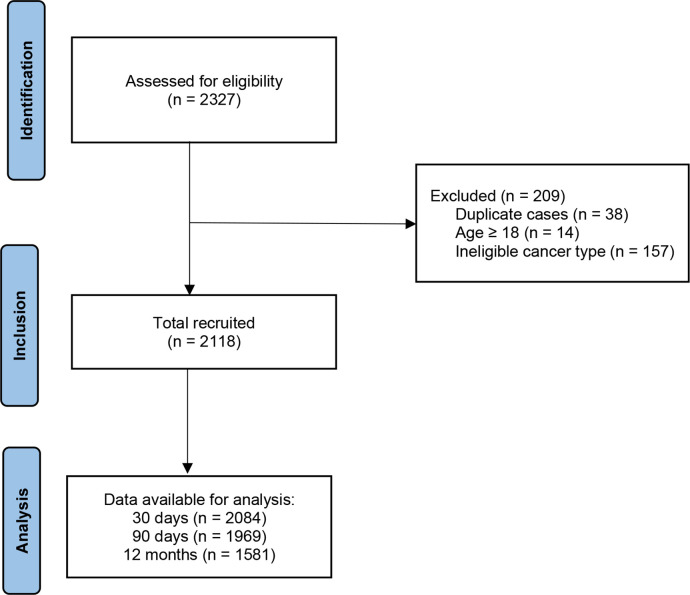
Inclusion criteria: children <18 years who were newly diagnosed with or undergoing active treatment for acute lymphoblastic leukaemia, non-Hodgkin's lymphoma, Hodgkin lymphoma, retinoblastoma, Wilms tumour, glioma, osteosarcoma, Ewing sarcoma, rhabdomyosarcoma, medulloblastoma and neuroblastoma. Of 2327 cases, 2118 patients were included in the study. The primary outcome measure was all-cause mortality at 30 days, 90 days and 12 months.
Results: All-cause mortality was 3.4% (n=71/2084) at 30-day follow-up, 5.7% (n=113/1969) at 90-day follow-up and 13.0% (n=206/1581) at 12-month follow-up. The median time from diagnosis to multidisciplinary team (MDT) plan was longest in low-income countries (7 days, IQR 3-11). Multivariable analysis revealed several factors associated with 12-month mortality, including low-income (OR 6.99 (95% CI 2.49 to 19.68); p<0.001), lower middle income (OR 3.32 (95% CI 1.96 to 5.61); p<0.001) and upper middle income (OR 3.49 (95% CI 2.02 to 6.03); p<0.001) country status and chemotherapy (OR 0.55 (95% CI 0.36 to 0.86); p=0.008) and immunotherapy (OR 0.27 (95% CI 0.08 to 0.91); p=0.035) within 30 days from MDT plan. Multivariable analysis revealed laboratory-confirmed SARS-CoV-2 infection (OR 5.33 (95% CI 1.19 to 23.84); p=0.029) was associated with 30-day mortality.
Conclusions: Children with cancer are more likely to die within 30 days if infected with SARS-CoV-2. However, timely treatment reduced odds of death. This report provides crucial information to balance the benefits of providing anticancer therapy against the risks of SARS-CoV-2 infection in children with cancer.
Keywords: COVID-19; Cancer; Health systems; Paediatrics.
© Author(s) (or their employer(s)) 2022. Re-use permitted under CC BY-NC. No commercial re-use. See rights and permissions. Published by BMJ.
Conflict of interest statement
Competing interests: None declared.
Figures
References
-
- SEER Statistics . Cancer statistics review, 1975-2015. Available: https://seer.cancer.gov/archive/csr/1975_2015/ [Accessed 02 Oct 2020].
Publication types
MeSH terms
LinkOut - more resources
Full Text Sources
Medical
Miscellaneous