. 2022 Oct 19;12(1):17431.
doi: 10.1038/s41598-022-21568-8.

Preparation, physicochemical characterization, and bioactivity evaluation of berberine-entrapped albumin nanoparticles

Affiliations

Preparation, physicochemical characterization, and bioactivity evaluation of berberine-entrapped albumin nanoparticles

Fatema A Younis et al. Sci Rep. .

Abstract

Berberine (BBR) is an isoquinoline alkaloid with several clinical therapeutic applications. Its low water solubility, absorption, and cellular bioavailability diminish BBR's therapeutic efficacy. In this study, BBR was encapsulated into bovine serum albumin nanoparticles (BSA NPs) core to reduce BBR limitations and enhance its clinical therapeutic properties. Several physicochemical characterization tools, such as Dynamic Light Scattering and Ultraviolet-Visible spectroscopic measurements, field emission transmission electron microscopy surface morphology, Fourier transforms infrared spectroscopy, thermal stability analysis, and releasing studies, were used to evaluate the BBR-BSA NPs. Compared to BBR, BBR-BSA nanoparticles demonstrated superior free radical scavenging and antioxidant capacities, anti-hemolytic and anticoagulant efficacies, and antimicrobial activities, as demonstrated by the findings of the in vitro studies. Furthermore, a stressed pancreatic rat model was induced using a high-fat, high-sucrose diet plus carbon tetrachloride injection. The in vivo results revealed that BBR-BSA NPs substantially restored peripheral glucose metabolism and insulin sensitivity. Oral administration of BBR-BSA NPs also improved pancreatic β-cells homeostasis, upregulated pancreatic antioxidant mechanisms, inhibited oxidants generation, and attenuated oxidative injury in the stressed pancreatic tissues. In conclusion, our in vitro and in vivo results confirmed that BBR-BSA NPs demonstrated more potent antioxidant properties and restored pancreatic homeostasis compared to BBR.


Conflict of interest statement

The authors declare no competing interests.

Figures
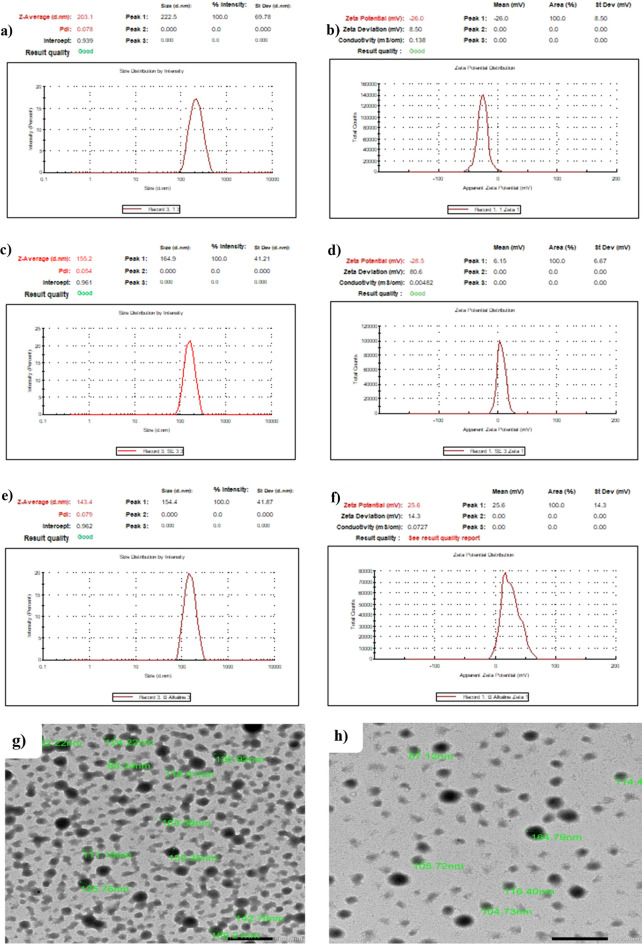
Figure 1
Figure 1
The hydrodynamic particle size diameter (nm), PDI, and zeta potential (mV) of neutral BBR-BSA NPs (a, b); alkaline BBR-BSA NPs (c, d); alkaline BSA NPs (e, f). The TEM photomicrographs of alkaline BBR-BSA NPs, magnification = 10,000 × (g); alkaline BSA NPs, magnification = 12,000 × (h). (Scale bar is 500 nm).
Figure 2
Figure 2
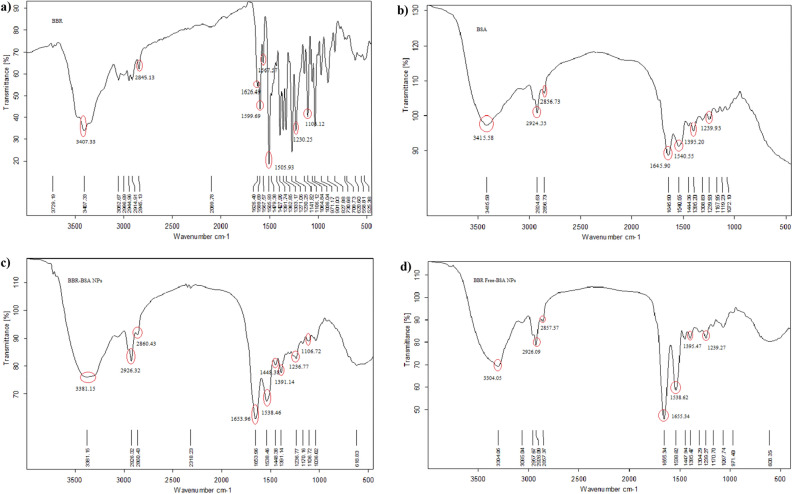
The FTIR characteristic spectra of standard BBR-chloride (a), crystalline BSA (b), BBR-BSA NPs (c), and BSA NPs (d).
Figure 3
Figure 3
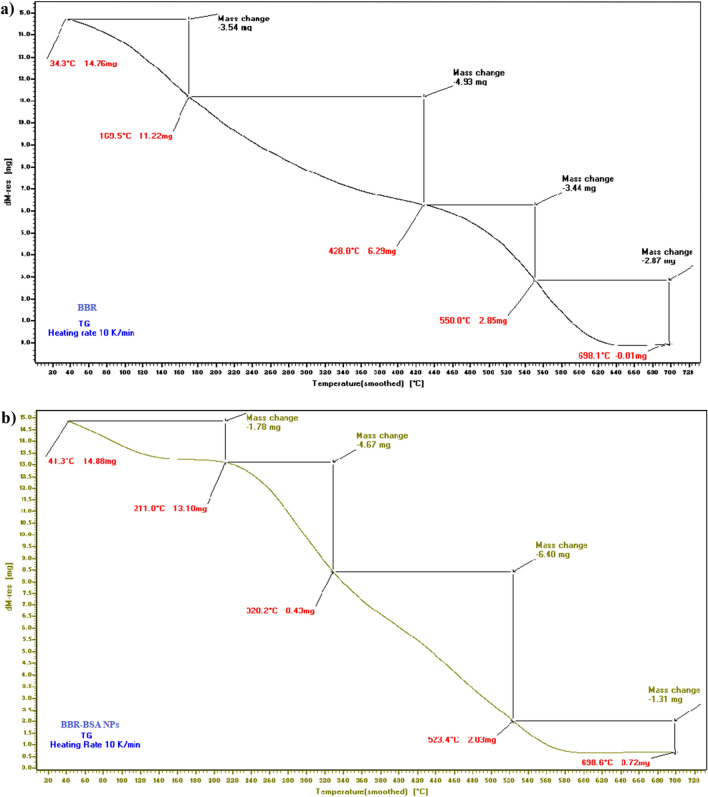
The TGA thermograms of standard BBR-chloride (a) and BBR-BSA NPs (b).
Figure 4
Figure 4
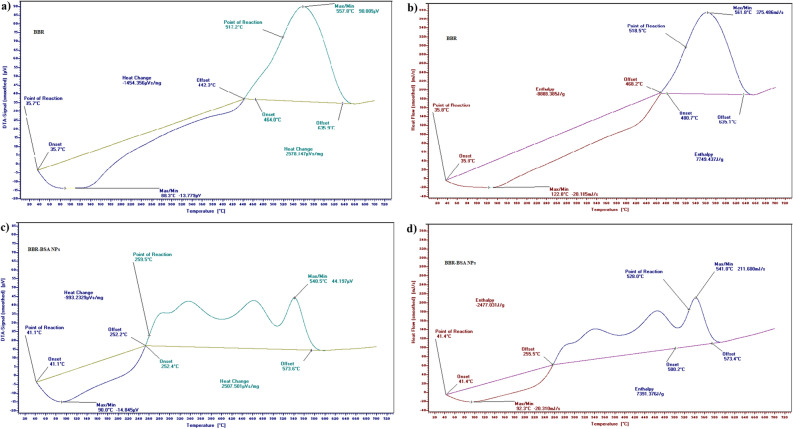
Thermograms of standard BBR-chloride and BBR-BSA NPs DTA (a, c), and DSC (b, d), respectively.
Figure 5
Figure 5
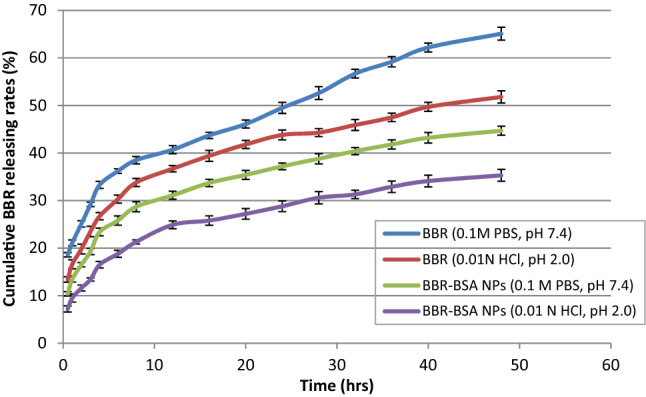
The BBR-releasing rate after 48 h. Data values are expressed as means ± SD (n = 5).
Figure 6
Figure 6
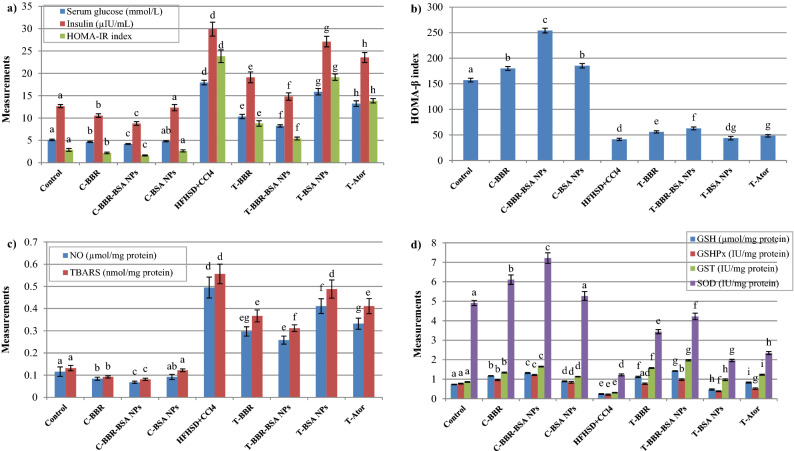
The effect of BBR and BBR-BSA NPs on the stressed pancreatic rat model. Serum glucose, insulin, and HOMA-IR index levels (a); Serum HOMA-β index (b); Pancreatic NO and TBARS levels (c); Pancreatic GSH level, GSHPx, GST, and SOD activities (d). Data values are expressed as means ± SD (n = 5). Different letters indicated statistically significant differences (P < 0.05) between the experimental groups within the same parameter, which were evaluated using the analysis of one-way ANOVA with the post hoc LSD test.
Figure 7
Figure 7
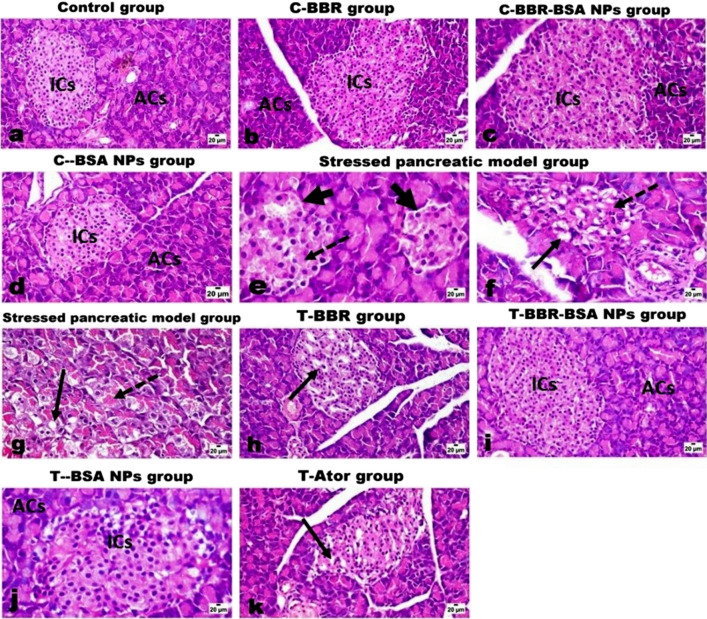
The histopathological investigations of the effect of BBR and BBR-BSA NPs on the stressed pancreatic rat model. Control (a), C-BBR (b), C-BBR-BSA NPs (c), and C-BSA NPs groups (d) show normal endocrine islets of Langerhans (ICs) and exocrine acinar cells (ACs). The stressed pancreatic rat model (eg) shows a decrease in size and number of islets cells (thick arrow) with its necrosis (dashed arrow) (e), vacuolar degeneration (arrow), and necrosis (dashed arrow) of some islet cells (f), and marked swelling, vacuolation (arrow) and necrosis (dashed arrow) of pancreatic acinar cells (g). T-BBR group (h) shows scattered necrotic islets cells (arrow) and mild pancreatic congested vessels. T-BBR-BSA NPs group (i) shows normal islets cells (ICs) as well as the acinar cells (ACs) with only a few islets' cells with pyknotic nuclei. T-BSA NPs group (j) shows normal ACs and mild cytoplasmic vacuolation of a few islets' cells. T-Ator group (k) shows a mild degree of islets cell degeneration (arrow) and scattered necrosis. (H&E, X200, scale bar = 20 μm).

References

    1. More GK, Makola RT. In-vitro analysis of free radical scavenging activities and suppression of LPS-induced ROS production in macrophage cells by Solanum sisymbriifolium extracts. Sci. Rep. 2020;10:6493. doi: 10.1038/s41598-020-63491-w. - DOI - PMC - PubMed
    1. Chandirasegaran G, Elanchezhiyan C, Ghosh K, Sethupathy S. Berberine chloride ameliorates oxidative stress, inflammation and apoptosis in the pancreas of Streptozotocin induced diabetic rats. Biomed. Pharmacother. 2017;95:175–185. doi: 10.1016/j.biopha.2017.08.040. - DOI - PubMed
    1. Vaiserman, A., Koliada, A., Zayachkivska, A. & Lushchak, O. Nanodelivery of Natural Antioxidants: An Anti-aging Perspective. 7, doi:10.3389/fbioe.2019.00447 (2020). - PMC - PubMed
    1. Liu Y, et al. Synthesis and antioxidant activities of berberine 9-O-benzoic acid derivatives. RSC Adv. 2021;11:17611–17621. doi: 10.1039/D1RA01339D. - DOI - PMC - PubMed
    1. Lam PL, et al. Evaluation of berberine/bovine serum albumin nanoparticles for liver fibrosis therapy. Green Chem. 2015;17:1640–1646. doi: 10.1039/C4GC01815J. - DOI

Publication types