Review
. 2022 Oct 15:15:25168657221130041.
doi: 10.1177/25168657221130041. eCollection 2022.

Therapeutic Potential of miRNAs for Type 2 Diabetes Mellitus: An Overview

Affiliations
Review

Therapeutic Potential of miRNAs for Type 2 Diabetes Mellitus: An Overview

Pads Palihaderu et al. Epigenet Insights. .

Abstract

MicroRNA(miRNA)s have been identified as an emerging class for therapeutic interventions mainly due to their extracellularly stable presence in humans and animals and their potential for horizontal transmission and action. However, treating Type 2 diabetes mellitus using this technology has yet been in a nascent state. MiRNAs play a significant role in the pathogenesis of Type 2 diabetes mellitus establishing the potential for utilizing miRNA-based therapeutic interventions to treat the disease. Recently, the administration of miRNA mimics or antimiRs in-vivo has resulted in positive modulation of glucose and lipid metabolism. Further, several cell culture-based interventions have suggested beta cell regeneration potential in miRNAs. Nevertheless, few such miRNA-based therapeutic approaches have reached the clinical phase. Therefore, future research contributions would identify the possibility of miRNA therapeutics for tackling T2DM. This article briefly reported recent developments on miRNA-based therapeutics for treating Type 2 Diabetes mellitus, associated implications, gaps, and recommendations for future studies.

Keywords: antimiRs; beta-cell differentiation; metabolism; miRNA; miRNA-mimics; therapeutic.


Conflict of interest statement

The author(s) declared no potential conflicts of interest with respect to the research, authorship, and/or publication of this article.

Figures
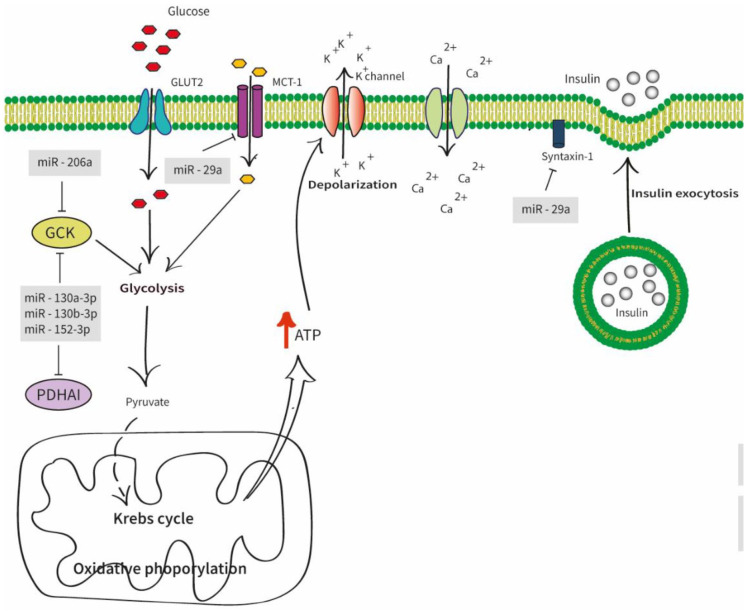
Figure 1.
Figure 1.
Diagram of different miRNAs involves in insulin secretion. The glucose uptake initiates the glucose-stimulated insulin secretion (GSIS) via the Glucose transporter 2 (GLUT2). The glucokinase (Gck) and other enzymes control glycolysis, Krebs cycle, and oxidative phosphorylation. This leads to high cytosolic adenosine triphosphate (ATP) concentration causing electrical excitation on the β-cell. The elevated ATP/adenosine diphosphate (ADP) ratio closes the K + ATP channels which ultimately aids the Ca2 + influx to the pancreatic β-cells which contributes to the insulin granule fusion from β-cells inducing insulin secretion. Abbreviations: GLUT2, glucose transporter 2; GCK, glucose kinase; PDHA1, pyruvate dehydrogenase alpha 1; ATP, adenosine triphosphate.
Figure 2.
Figure 2.
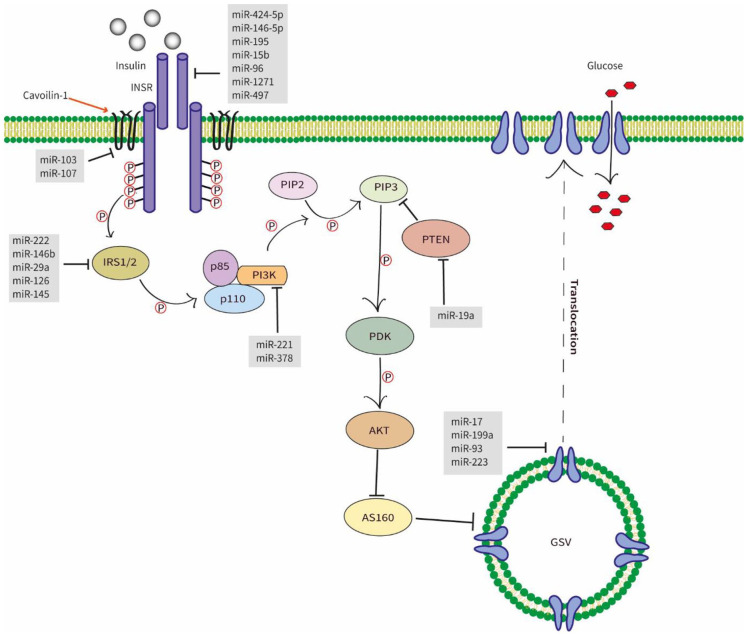
Diagram of different miRNAs involves in the insulin signaling pathway. Once the insulin binds with the extracellular subunit of the INSR, intracellular subunits auto-phosphorylate, leading to the phosphorylation of IRS1/2. This leads to the activation of PI3K which, phosphorylating PIP2 to PIP3. The increased level of PIP3 activates the PDK-1 that activates the AKT which aids the translocation of GLUT4 to the cell membrane via the inactivation of AS160. The translocated GLUT4 can uptake glucose into the cell. Abbreviations: INSR, insulin signaling receptor; IRS-(1/2), insulin receptor substrate; PI3K, phosphoinositide 3-kinase; AKT2, serine/threonine kinase 2; PIP2, phosphaditylinositol bisphosphate; PIP3, phosphaditylinositol triphosphate; PTEN, phosphate and tensin homolog; PDK, phospoinositide dependent protein kinase-1; AKT, serine/threonine kinase; GLUT4, glucose transporter 4; GSV, GLUT4 storage vesicles.
Figure 3.
Figure 3.
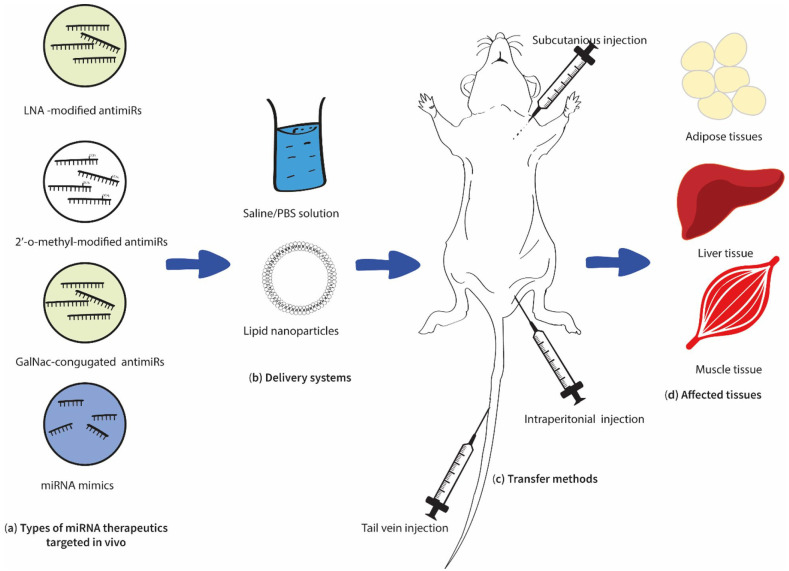
Summary of the current in vivo approaches in miRNA therapeutics for T2DM. Recent in vivo studies have evaluated the possibility of utilizing LNA-modified anitimiRs, 2′-o-methyl modified antimiRs, and miRNA mimics (a), delivered in saline/PBS (Phosphate buffer solution) or lipid nanoparticles (b), and subcutaneously, intraperitoneally or via tail vein (c). Treated subjects showed positive impacts on adipose, liver, and muscle tissues (d) (Table 1).

References

    1. Tang G, Tang X, Mendu V, et al.. The art of microRNA: various strategies leading to gene silencing via an ancient pathway. Biochim Biophys Acta. 2008;1779:655-662. - PubMed
    1. Eulalio A, Huntzinger E, Izaurralde E. Getting to the root of miRNA-Mediated gene silencing. Cell. 2008;132:9-14. - PubMed
    1. Bartel DP. MicroRNAs: genomics, biogenesis, mechanism, and function. Cell. 2004;116:281-297. - PubMed
    1. Lewis BP, Burge CB, Bartel DP. Conserved seed pairing, often flanked by adenosines, indicates that thousands of human genes are microRNA targets. Cell. 2005;120:15-20. - PubMed
    1. Peng Y, Croce CM. The role of microRNAs in human cancer. Signal Transduct Target Ther. 2016;1:15004. doi:10.1038/sigtrans.2015.4. - DOI - PMC - PubMed

LinkOut - more resources