


Association of metabolic syndrome and the risk of bladder cancer: A prospective cohort study
- PMID: 36263231
- PMCID: PMC9574437
- DOI: 10.3389/fonc.2022.996440
Association of metabolic syndrome and the risk of bladder cancer: A prospective cohort study
Abstract
Background: Metabolic syndrome (MetS) and its components have been shown as risk factors for several solid cancers. However, current epidemiological evidence about the relevance of MetS and bladder cancer risk was limited.
Methods: We conducted a prospective cohort study of 476,986 participants with undiagnosed bladder cancer based on the UK Biobank. MetS was defined as the presence of at least three of the five selected indicators: hypertension, central obesity, raised triglyceride, reduced HDL-cholesterol, and raised fasting plasma glucose. Bladder cancer has been identified through contact with the British Cancer Registry (median follow-up time: 6.6 years). We assessed hazard ratio (HR) and 95% confidence interval (CI) through Cox proportional hazard regression after adjusting for demographic and lifestyle factors. Non-linear associations for individual MetS components were assessed by the restricted cubic spline method.
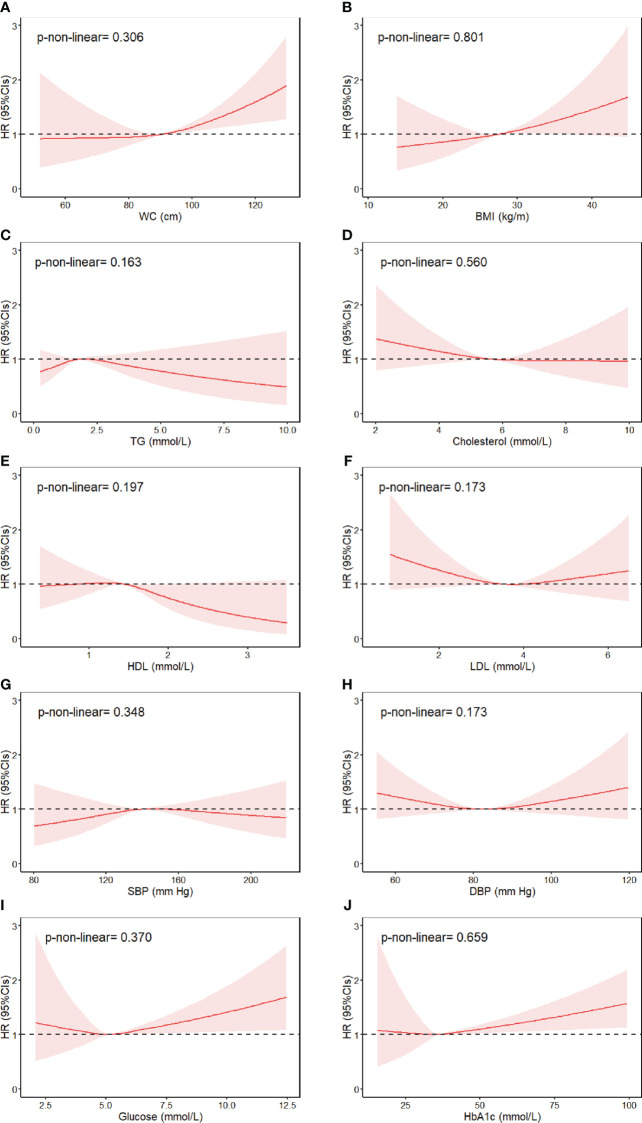
Results: During a follow-up of 3,112,566 person-years, 487 cases of bladder cancer were ascertained. MetS (HR = 1.32, 95% CI = 1.08-1.61), central obesity (HR = 1.39, 95% CI = 1.15-1.68), dyslipidemia for HDL cholesterol (HR = 1.31, 95% CI = 1.04-1.66), and hyperglycemia (HR = 1.44, 95% CI = 1.16-1.79) were associated with elevated risk of bladder cancer. Bladder cancer risk increased with the number of MetS components. In stratified analyses, MetS showed similar effects in bladder cancer independently with sex, age, cigarette and alcohol use, physical activity, and dietary factors. Higher waist circumference, BMI, fasting blood glucose, and glycosylated hemoglobin were independently associated with increased risk of bladder cancer, with no evidence against non-linearity.
Conclusion: MetS might be an independent risk factor for bladder cancer. Our findings highlighted the importance of individualized management of MetS components for preventing bladder cancer.
Keywords: bladder cancer; blood glucose; central obesity; independent risk; metabolic syndrome.
Copyright © 2022 Fang, Liu, Dai, Gao, Zeng, Sun, Zheng, Yuan, Xia and Pan.
Conflict of interest statement
The authors declare that the research was conducted in the absence of any commercial or financial relationships that could be construed as a potential conflict of interest.
Figures
References
-
- Mishra V, Balasubramaniam G. Urinary bladder cancer and its associated factors – an epidemiological overview. Indian J Med Sci (2020) 0:1–10. doi: 10.25259/ijms_159_2020 - DOI
-
- van Kruijsdijk RC, van der Graaf Y, Peeters PH, Visseren FL, Second Manifestations of Adsg . Cancer risk in patients with manifest vascular disease: effects of smoking, obesity, and metabolic syndrome. Cancer Epidemiol Biomarkers Prev (2013) 22(7):1267–77. doi: 10.1158/1055-9965.EPI-13-0090 - DOI - PubMed
Grants and funding
LinkOut - more resources
Full Text Sources
