


Evaluating clinician-led quality improvement initiatives: A system-wide embedded research partnership at Stanford Medicine
- PMID: 36263267
- PMCID: PMC9576232
- DOI: 10.1002/lrh2.10335
Evaluating clinician-led quality improvement initiatives: A system-wide embedded research partnership at Stanford Medicine
Abstract
Introduction: Many healthcare delivery systems have developed clinician-led quality improvement (QI) initiatives but fewer have also developed in-house evaluation units. Engagement between the two entities creates unique opportunities. Stanford Medicine funded a collaboration between their Improvement Capability Development Program (ICDP), which coordinates and incentivizes clinician-led QI efforts, and the Evaluation Sciences Unit (ESU), a multidisciplinary group of embedded researchers with expertise in implementation and evaluation sciences.
Aim: To describe the ICDP-ESU partnership and report key learnings from the first 2 y of operation September 2019 to August 2021.
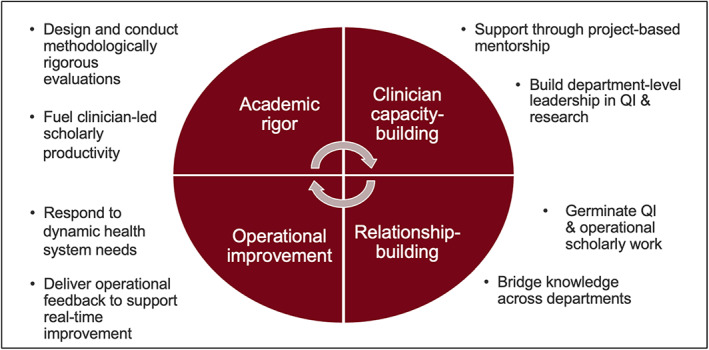
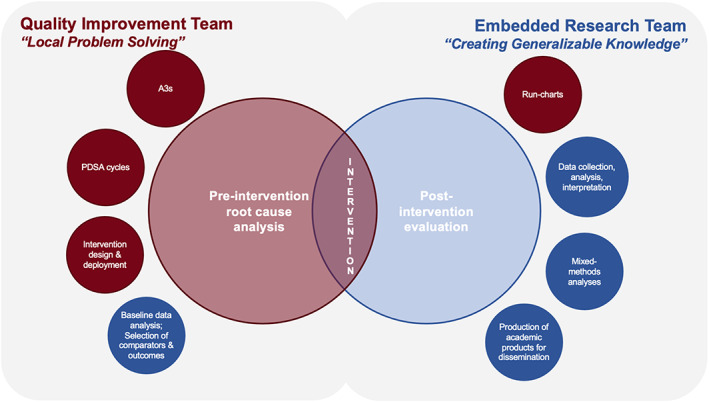
Methods: Department-level physician and operational QI leaders were offered an ESU consultation to workshop design, methods, and overall scope of their annual QI projects. A steering committee of high-level stakeholders from operational, clinical, and research perspectives subsequently selected three projects for in-depth partnered evaluation with the ESU based on evaluability, importance to the health system, and broader relevance. Selected project teams met regularly with the ESU to develop mixed methods evaluations informed by relevant implementation science frameworks, while aligning the evaluation approach with the clinical teams' QI goals.
Results: Sixty and 62 ICDP projects were initiated during the 2 cycles, respectively, across 18 departments, of which ESU consulted with 15 (83%). Within each annual cycle, evaluators made actionable, summative findings rapidly available to partners to inform ongoing improvement. Other reported benefits of the partnership included rapid adaptation to COVID-19 needs, expanded clinician evaluation skills, external knowledge dissemination through scholarship, and health system-wide knowledge exchange. Ongoing considerations for improving the collaboration included the need for multi-year support to enable nimble response to dynamic health system needs and timely data access.
Conclusion: Presence of embedded evaluation partners in the enterprise-wide QI program supported identification of analogous endeavors (eg, telemedicine adoption) and cross-cutting lessons across QI efforts, clinician capacity building, and knowledge dissemination through scholarship.
Keywords: embedded research; learning health systems; partnership; quality improvement.
© 2022 The Authors. Learning Health Systems published by Wiley Periodicals LLC on behalf of University of Michigan.
Conflict of interest statement
The authors have no conflicts of interest to report.
Figures
References
-
- Institute of Medicine (U.S.) , Grossmann C, Powers B, JM MG. Digital infrastructure for the learning health system: the Foundation for Continuous Improvement in health and health care: workshop series summary. Washington, DC: National Academies Press; 2011. - PubMed
LinkOut - more resources
Full Text Sources
Miscellaneous
