. 2022 Oct 6:2022:7405349.
doi: 10.1155/2022/7405349. eCollection 2022.

Coronavirus Host Genomics Study: South Africa (COVIGen-SA)

Affiliations

Coronavirus Host Genomics Study: South Africa (COVIGen-SA)

Andrew K May et al. Glob Health Epidemiol Genom. .

Abstract

Host genetic factors are known to modify the susceptibility, severity, and outcomes of COVID-19 and vary across populations. However, continental Africans are yet to be adequately represented in such studies despite the importance of genetic factors in understanding Africa's response to the pandemic. We describe the development of a research resource for coronavirus host genomics studies in South Africa known as COVIGen-SA-a multicollaborator strategic partnership designed to provide harmonised demographic, clinical, and genetic information specific to Black South Africans with COVID-19. Over 2,000 participants have been recruited to date. Preliminary results on 1,354 SARS-CoV-2 positive participants from four participating studies showed that 64.7% were female, 333 had severe disease, and 329 were people living with HIV. Through this resource, we aim to provide insights into host genetic factors relevant to African-ancestry populations, using both genome-wide association testing and targeted sequencing of important genomic loci. This project will promote and enhance partnerships, build skills, and develop resources needed to address the COVID-19 burden and associated risk factors in South African communities.


Conflict of interest statement

The authors declare that there are no conflicts of interest regarding the publication of this paper.

Figures

Figure 1
Figure 1
COVID-19 case numbers and tests per thousand across different regions: (a) confirmed case numbers on the African continent remain low in comparison to other continents despite early predictions that African countries would struggle the most to maintain infection control and (b) however, testing per thousand individuals in selected African countries is a fraction of those conducted in, for example, the United States and the United Kingdom. Data sourced from [19, 20].
Figure 2
Figure 2
Study sites for COVIGen-SA. Participants for COVIGen-SA are currently being recruited from 10 different sites, in and around areas including Johannesburg, Polokwane, Bushbuckridge, Klerksdorp, Pietermaritzburg, and Northern KwaZulu Natal (KZN).
Figure 3
Figure 3
Overview of the COVIGen-SA research resource and planned host genetic studies. COVIGen-SA is based on a governance framework that promotes cross-disciplinary collaboration and transparent data and sample sharing that is ethically approved and legally compliant. In addition to the SBIMB and WDGMC, seven partners have joined the study to date, all contributing to a unified research resource that will facilitate host genetic and other COVID-related studies. The project data will be made available to improve the representation of continental Africans in public data sets. SBIMB: Sydney Brenner Institute for Molecular Bioscience, WDGMC: Wits Donald Gordon Medical Centre, AHRI: Africa Health Research Institute, CRDM: Centre for Respiratory Disease and Meningitis, National Institute for Communicable Diseases, PHRU: Perinatal HIV Research unit, RPHHT: Rural Public Health and Health Transitions Research Unit, (Agincourt) VIDA: Vaccines and Infectious Diseases Analytics Unit, and HVTR: HIV Vaccine Translational Research Entity.
Figure 4
Figure 4
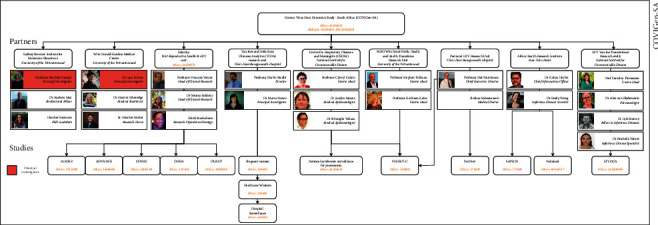
An organisational chart of the COVIGen-SA project. COVIGen-SA currently incorporates five institutions and seven study partners. Each partner is engaged in one or several independent studies from which eligible participants were recruited for the COVIGen-SA study. Each study has ethical clearance, while each partnership is also covered by an ethically approved agreement.
Figure 5
Figure 5
Preliminary PCA plots of COVIGen-SA data. (a) Initial genotyping results for 503 COVIGen-SA (CVG, case) participants were merged with data from 5,139 Black South African AWI-Gen (AWG, control) participants. Participants from both studies overlapped substantially, suggesting common ancestry, but some individuals map further from the centre of the cluster, reflecting the considerable genetic variation of Black South Africans and possible minor admixture components from other ancestries. (b) Case and control data were then merged with publicly available 1,000 Genomes Project data for select populations across the globe (n = 2,504). The first principal component separated continental African ethnicities from others. The second principal component then separated out non-African ethnicities. AWG: AWI-Gen (controls); BEB: Bengali in Bangladesh; CDX: Chinese Dai in Xishuangbanna, China; CHB: Han Chinese in Beijing, China; CVG: COVIGen-SA (cases); FIN: Finnish in Finland; GBR: British in England and Scotland; GIH: Gujarati Indian in Houston, TX; ITU: Indian Telugu in the UK; JPT: Japanese in Tokyo, Japan; LWK: Luhya in Webuye, Kenya; MSL, Mende in Sierra Leone; PJL: Punjabi in Lahore, Pakistan; and TSI: Toscani in Italia.

References

    1. Health Organisation World. WHO Coronavirus Disease (COVID-19) Dashboard. 2021. https://covid19.who.int .
    1. Tregoning J. S., Brown E. S., Cheeseman H. M., et al. Vaccines for COVID-19. Clinical and Experimental Immunology . 2020;202(2):162–192. doi: 10.1111/cei.13517. - DOI - PMC - PubMed
    1. Gorman E., Connolly B., Couper K., Perkins G. D., McAuley D. F. Non-invasive respiratory support strategies in COVID-19. The Lancet Respiratory Medicine . 2021;9(6):553–556. doi: 10.1016/S2213-2600(21)00168-5. - DOI - PMC - PubMed
    1. Alunno A., Najm A., Mariette X., et al. Immunomodulatory therapies for SARS-CoV 2 infection: a systematic literature review to inform EULAR points to consider. Annals of the Rheumatic Diseases . 2021;80(6):803–815. doi: 10.1136/annrheumdis-2020-219725. - DOI - PMC - PubMed
    1. El-Sadr W. M., Justman J. Africa in the path of covid-19. New England Journal of Medicine . 2020;383(3):p. e11. doi: 10.1056/nejmp2008193. - DOI - PubMed

Publication types