Review
. 2023 Apr;71(2):130-152.
doi: 10.1007/s12026-022-09330-8. Epub 2022 Oct 21.

Macrophage subsets and their role: co-relation with colony-stimulating factor-1 receptor and clinical relevance

Affiliations
Review

Macrophage subsets and their role: co-relation with colony-stimulating factor-1 receptor and clinical relevance

Shivani Yadav et al. Immunol Res. 2023 Apr.

Abstract

Macrophages are one of the first innate immune cells to reach the site of infection or injury. Diverse functions from the uptake of pathogen or antigen, its killing, and presentation, the release of pro- or anti-inflammatory cytokines, activation of adaptive immune cells, clearing off tissue debris, tissue repair, and maintenance of tissue homeostasis have been attributed to macrophages. Besides tissue-resident macrophages, the circulating macrophages are recruited to different tissues to get activated. These are highly plastic cells, showing a spectrum of phenotypes depending on the stimulus received from their immediate environment. The macrophage differentiation requires colony-stimulating factor-1 (CSF-1) or macrophage colony-stimulating factor (M-CSF), colony-stimulating factor-2 (CSF-2), or granulocyte-macrophage colony-stimulating factor (GM-CSF) and different stimuli activate them to different phenotypes. The richness of tissue macrophages is precisely controlled via the CSF-1 and CSF-1R axis. In this review, we have given an overview of macrophage origin via hematopoiesis/myelopoiesis, different phenotypes associated with macrophages, their clinical significance, and how they are altered in various diseases. We have specifically focused on the function of CSF-1/CSF-1R signaling in deciding macrophage fate and the outcome of aberrant CSF-1R signaling in relation to macrophage phenotype in different diseases. We further extend the review to briefly discuss the possible strategies to manipulate CSF-1R and its signaling with the recent updates.

Keywords: CSF-1R; CSF-1R inhibitors; M1 macrophages; M2 macrophages; Macrophage; Macrophage polarization; Myelopoiesis.


Conflict of interest statement

The authors declare no competing interests.

Figures
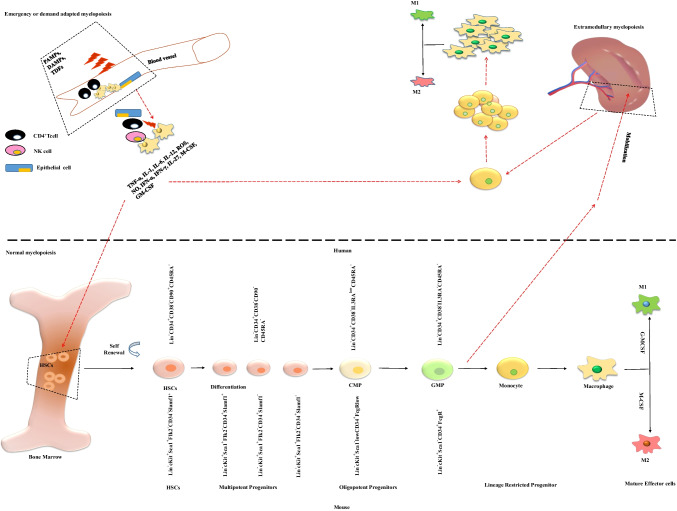
Fig. 1
Fig. 1
Normal and demand adapted or emergency myelopoiesis. The quiescent bone marrow-HSCs maintain the normal hematopoiesis/myelopoiesis. Any systemic inflammation/infection/stress leading to the release of inflammatory cytokines, PAMPs, and DAMPs is sensed by HSCs. HSCs activate and differentiate to myeloid progenitors. Under inflammation/infection/stress conditions, the GMPs are recruited to organs like the spleen in a CCR-2-dependent manner to carry out extramedullary myelopoiesis to meet the demand adapted emergency myelopoiesis. HSCs, hematopoietic stem cells; CMPs, common myeloid progenitors; GMPs, granulocyte monocyte progenitors
Fig. 2
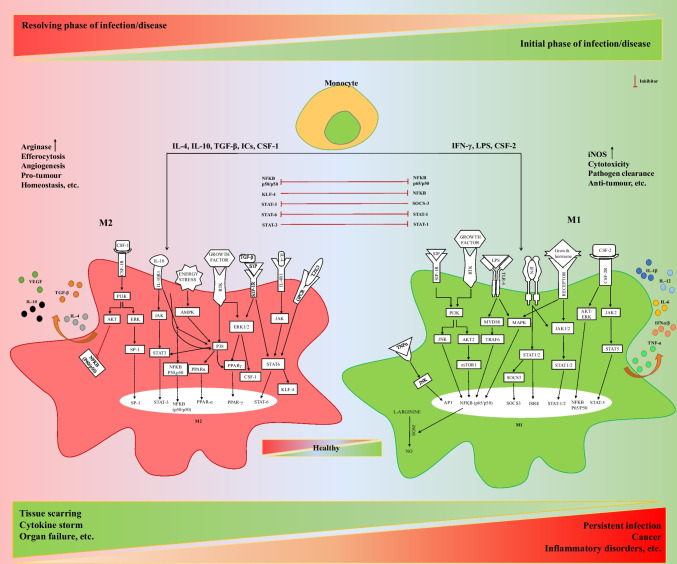
Fig. 2
A balance of inflammatory (M1) and anti-inflammatory (M2) macrophages is required for a healthy immune response. Macrophage phenotypes play an important role in maintaining a healthy immune response and resolving infections and other diseases. Various factors induce the M1 or M2 macrophage phenotype, which is tightly regulated by transcriptional factors as depicted in the image. Any dis-regulation in the activation of macrophage phenotypes may lead to chronic infections, inflammatory disorders, cytokine storm, or tumor escape and development to cancer
Fig. 3
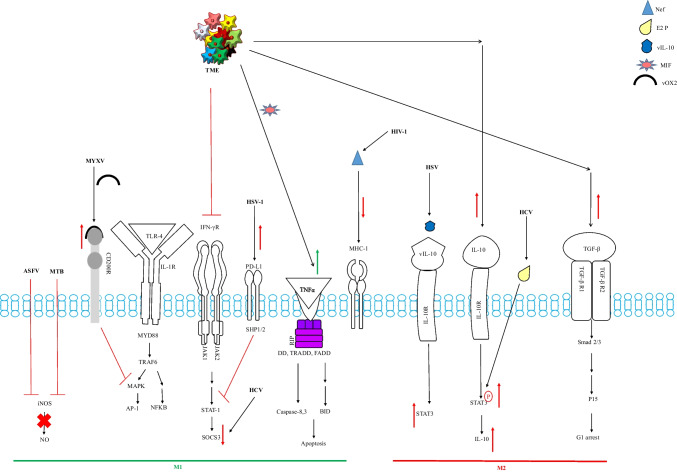
Fig. 3
Pathogens and tumor cells cause a dis-regulation in the generation of macrophage phenotypes to escape the immune system. ASFV, African swine flu virus; MTB, mycobacterium tuberculosis; MYXV, myxoma virus; HSV, herpes simplex virus; HIV, human immunodeficiency virus; HCV, hepatitis C virus; TME, tumor microenvironment; DD, death domain; TRADD, TNFR1-associated death domain; FADD, Fas-associated protein with death domain; BID, BH3 interacting domain death; MYD88, myeloid differentiation primary response 88; TRAF6, TNF receptor-associated factor 6; MAPK, mitogen-activated protein kinase, SHP, protein tyrosine phosphatase; vOX2, CD200 viral analogue; vIL-10, viral IL-10 analogue; E2P, E2 viral protein; nef, HIV viral protein; MIF, migration inhibition factor
Fig. 4
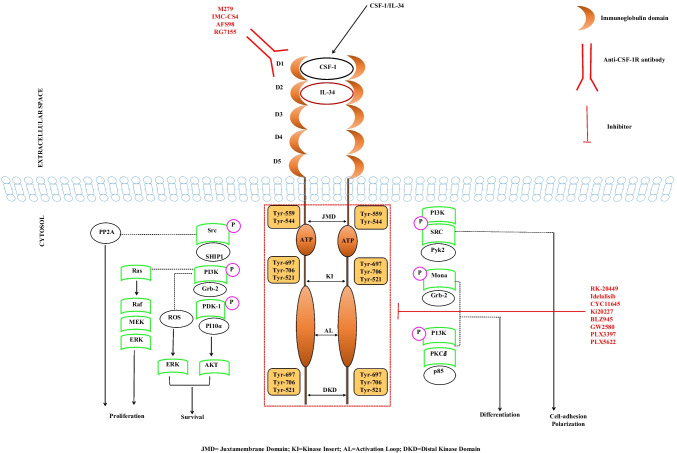
Fig. 4
CSF-1R signaling and its inhibitors. M279, rat monoclonal antibody (mAb) targeted to CSF-1R;IMC CS4, mAB targeted to CSF-1R; AFS98, mAB targeted to CSF-1R; RG-7155 (emactuzumab), humanized mAb targeted to CSF-1R; RK-20449 (A 419259), broad-spectrum pyrrolo-pyrimidine Src family inhibitor; idelalisib (IDEL), an oral phosphatidylinositol 3-kinase inhibitor; CYC11645, small molecules targeting the tyrosine kinase domain of CSF-1R; Ki20227, orally active, selective tyrosine kinase inhibitor; BLZ945, a highly selective, brain penetrant, CSF-1R kinase domain inhibitor; GW2580, an orally available, selective inhibitor of the tyrosine kinase activity of CSF1R; PLX3397 (pexidartinib), oral tyrosine kinase inhibitor of CSF1R; PLX5622, a highly selective, brain penetrant, orally active CSF1R inhibitor

References

    1. Mertens, C. et al. The macrophage iron signature in health and disease. Int. J. Mol. Sci.22, (2021). - PMC - PubMed
    1. Hirayama, D., Iida, T. & Nakase, H. The Phagocytic function of macrophage-enforcing innate immunity and tissue homeostasis. Int. J. Mol. Sci.19, (2017). - PMC - PubMed
    1. Sica A, Mantovani A. Science in medicine macrophage plasticity and polarization : in vivo veritas. J Clin Invest. 2012;122:787–795. doi: 10.1172/JCI59643. - DOI - PMC - PubMed
    1. Italiani, P. & Boraschi, D. From monocytes to M1/M2 macrophages: phenotypical vs. functional differentiation. Frontiers in Immunology vol. 5 (2014). - PMC - PubMed
    1. Benoit M, Desnues B, Mege J-L. Macrophage polarization in bacterial infections. J Immunol. 2008;181:3733–3739. doi: 10.4049/jimmunol.181.6.3733. - DOI - PubMed

Publication types

Substances