


Replacing statistical significance and non-significance with better approaches to sampling uncertainty
- PMID: 36267575
- PMCID: PMC9578285
- DOI: 10.3389/fphys.2022.962132
Replacing statistical significance and non-significance with better approaches to sampling uncertainty
Abstract
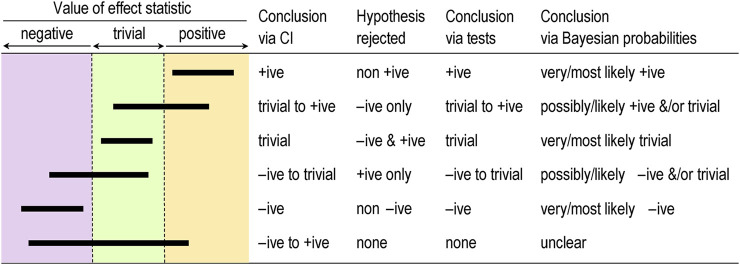
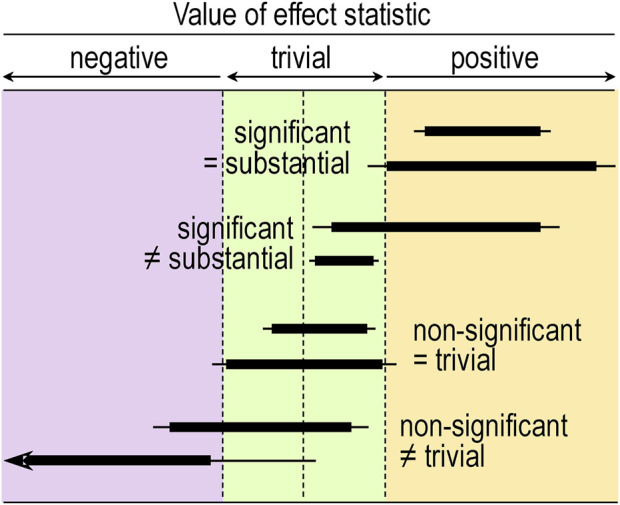
A sample provides only an approximate estimate of the magnitude of an effect, owing to sampling uncertainty. The following methods address the issue of sampling uncertainty when researchers make a claim about effect magnitude: informal assessment of the range of magnitudes represented by the confidence interval; testing of hypotheses of substantial (meaningful) and non-substantial magnitudes; assessment of the probabilities of substantial and trivial (inconsequential) magnitudes with Bayesian methods based on non-informative or informative priors; and testing of the nil or zero hypothesis. Assessment of the confidence interval, testing of substantial and non-substantial hypotheses, and assessment of Bayesian probabilities with a non-informative prior are subject to differing interpretations but are all effectively equivalent and can reasonably define and provide necessary and sufficient evidence for substantial and trivial effects. Informative priors in Bayesian assessments are problematic, because they are hard to quantify and can bias the outcome. Rejection of the nil hypothesis (presented as statistical significance), and failure to reject the nil hypothesis (presented as statistical non-significance), provide neither necessary nor sufficient evidence for substantial and trivial effects. To properly account for sampling uncertainty in effect magnitudes, researchers should therefore replace rather than supplement the nil-hypothesis test with one or more of the other three equivalent methods. Surprisal values, second-generation p values, and the hypothesis comparisons of evidential statistics are three other recent approaches to sampling uncertainty that are not recommended. Important issues beyond sampling uncertainty include representativeness of sampling, accuracy of the statistical model, individual differences, individual responses, and rewards of benefit and costs of harm of clinically or practically important interventions and side effects.
Keywords: Bayesian inference; confidence interval; effect magnitude; magnitude-based inference; sampling uncertainty; significance test.
Copyright © 2022 Hopkins.
Conflict of interest statement
The author declares that the research was conducted in the absence of any commercial or financial relationships that could be construed as a potential conflict of interest.
Figures
References
-
- Albers C. J., Kiers H. A., Van Ravenzwaaij D. (2018). Credible confidence: A pragmatic view on the frequentist vs bayesian debate. Collabra Psychol. 4, 31. 10.1525/collabra.149 - DOI
-
- Allen I. E., Seaman C. A. (2007). Superiority, equivalence and non-inferiority. Qual. Prog. 40, 52–54.
LinkOut - more resources
Full Text Sources
