Review
. 2022 Oct 4:15:1017568.
doi: 10.3389/fnmol.2022.1017568. eCollection 2022.

WNT signaling at the intersection between neurogenesis and brain tumorigenesis

Affiliations
Review

WNT signaling at the intersection between neurogenesis and brain tumorigenesis

Maisa I Alkailani et al. Front Mol Neurosci. .

Abstract

Neurogenesis and tumorigenesis share signaling molecules/pathways involved in cell proliferation, differentiation, migration, and death. Self-renewal of neural stem cells is a tightly regulated process that secures the accuracy of cell division and eliminates cells that undergo mitotic errors. Abnormalities in the molecular mechanisms controlling this process can trigger aneuploidy and genome instability, leading to neoplastic transformation. Mutations that affect cell adhesion, polarity, or migration enhance the invasive potential and favor the progression of tumors. Here, we review recent evidence of the WNT pathway's involvement in both neurogenesis and tumorigenesis and discuss the experimental progress on therapeutic opportunities targeting components of this pathway.

Keywords: WNT/calcium; Wnt/PCP; Wnt/β-catenin; glioblastoma therapy; glioma; neural progenitor cells; neurogenesis.


Conflict of interest statement

The authors declare that the research was conducted in the absence of any commercial or financial relationships that could be construed as a potential conflict of interest.

Figures
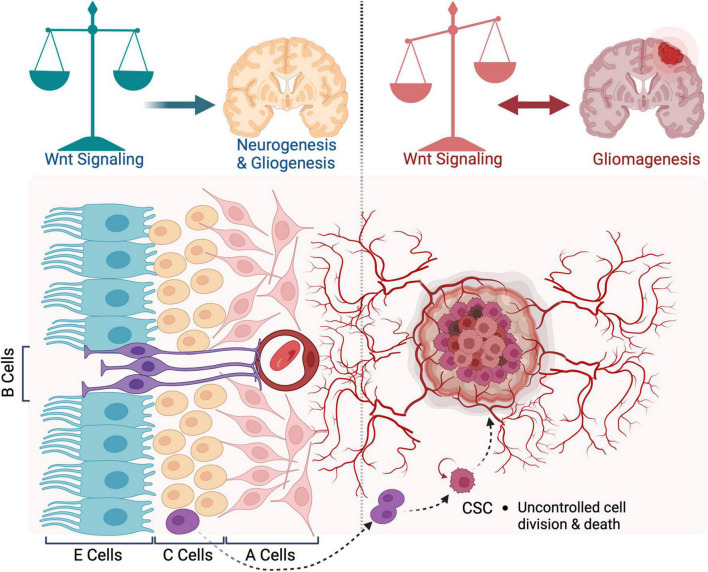
FIGURE 1
FIGURE 1
Organization of the subventricular zone in health and disease. A schematic representation of the subventricular zone (SVZ) neurogenic niche in adult brain. During neurogenesis, WNT signaling regulates the balance between proliferation and differentiation of neural stem cells (NSCs). In gliomagenesis, WNT promotes the ETM-like process and migration of cancer stem cells. Blocking WNT inhibits the proliferation of tumor cells. In turn, WNT signaling is activated by oncogenes expressed in glioblastoma (GBM) cells.
FIGURE 2
FIGURE 2
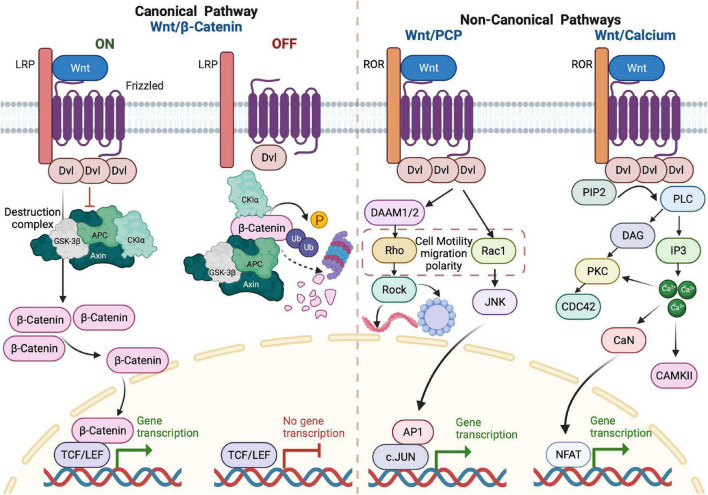
Overview of WNT signaling pathways. In the ON state of the canonical pathway, the binding of WNT to frizzled (FZD) receptor and LRP on the plasma membrane results in activation of DVL protein in the form of polymerization. When polymerized, DVL adaptor proteins inhibit the destruction complex (Axin, GSK-3β, APC, and CKIα) function, leading to unphosphorylated β-catenin accumulation and nuclear translocation. In the nucleus, β-catenin acts as a transcriptional co-activator to TCF/LEF factors that, in turn, activate the transcription of WNT target genes. In the OFF state, there is no WNT ligand binding and no DVL polymerization and β-catenin undergoes phosphorylation by components of the destruction complex. This phosphorylation triggers ubiquitylation of β-catenin and its consequent proteasomal degradation. In WNT/PCP, the binding of WNT ligand to FZD receptor and the receptor tyrosine kinase-like orphan receptor (ROR) on the plasma membrane recruits and activates DVL protein. This binding initiates a cascade of signals via Rho or Rac GTPases to promote polarized cellular behaviors or promote cell survival by activating the transcription of AP1 target genes. The binding of the WNT ligand to the FZD receptor and ROR also activates the WNT/Ca2+ signaling by G-protein-dependent release of Ca2+. The increase of intracellular calcium activates PKC and CAMKII. Increased Ca2+ can also activate calcineurin, leading to the accumulation of nuclear factor of activated T cells (NFAT) in the nucleus and promoting transcription of target genes.
FIGURE 3
FIGURE 3
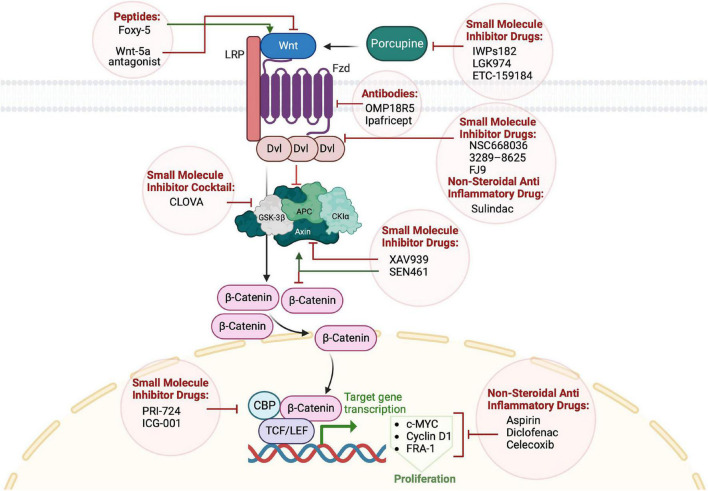
Targeting WNT signaling in glioblastoma therapy. Small inhibitors target WNT secretion, components of the destruction complex, or activity of the transcription machinery. Non-steroidal anti-inflammatory drugs inhibit cellular proliferation promoted by β-catenin downstream targets. Anti-Frizzled antibodies inhibit the activation of WNT signaling.

References

    1. Adachi K., Mirzadeh Z., Sakaguchi M., Yamashita T., Nikolcheva T., Gotoh Y., et al. (2007). β-catenin signaling promotes proliferation of progenitor cells in the adult mouse subventricular zone. Stem Cells 25 2827–2836. 10.1634/stemcells.2007-0177 - DOI - PubMed
    1. Aiello N. M., Stanger B. Z. (2016). Echoes of the embryo: Using the developmental biology toolkit to study cancer. DMM Dis. Mod. Mech. 9 105–114. 10.1242/dmm.023184 - DOI - PMC - PubMed
    1. Alcantara Llaguno S., Chen J., Kwon C. H., Jackson E. L., Li Y., Burns D. K., et al. (2009). Malignant astrocytomas originate from neural stem/progenitor cells in a somatic tumor suppressor mouse model. Cancer Cell 15 45–56. 10.1016/j.ccr.2008.12.006 - DOI - PMC - PubMed
    1. Alcantara Llaguno S., Sun D., Pedraza A. M., Vera E., Wang Z., Burns D. K., et al. (2019). Cell-of-origin susceptibility to glioblastoma formation declines with neural lineage restriction. Nat. Neurosci. 22 545–555. 10.1038/s41593-018-0333-8 - DOI - PMC - PubMed
    1. Allache R., de Marco P., Merello E., Capra V., Kibar Z. (2012). Role of the planar cell polarity gene CELSR1 in neural tube defects and caudal agenesis. Bir. Defects Res. A. Clin. Mol. Teratol. 94 176–181. 10.1002/bdra.23002 - DOI - PubMed

LinkOut - more resources