. 2023 Jan 6;51(D1):D708-D716.
doi: 10.1093/nar/gkac926.

Fungal names: a comprehensive nomenclatural repository and knowledge base for fungal taxonomy

Affiliations

Fungal names: a comprehensive nomenclatural repository and knowledge base for fungal taxonomy

Fang Wang et al. Nucleic Acids Res. .

Abstract

Fungal taxonomy is a complex and rapidly changing subject, which makes proper naming of fungi challenging for taxonomists. A registration platform with a standardized and information-integrated database is a powerful tool for efficient research on fungal taxonomy. Fungal Names (FN, https://nmdc.cn/fungalnames/; launched in 2011) is one of the three official fungal nomenclatural repositories authorized by the International Nomenclature Committee for Fungi (NCF). Currently, FN includes >567 000 taxon names from >10 000 related journals and books published since 1596 and covers >147 000 collection records of type specimens/illustrations from >5000 preserving agencies. FN is also a knowledge base that integrates nomenclature information with specimens, culture collections and herbaria/fungaria, publications and taxonomists, and represents a summary of the history and recent advances in fungal taxonomy. Published fungal names are categorized based on well-accepted nomenclature rules and can be readily searched with different keywords and strategies. In combination with a standardized name checking tool and a sequence alignment-based identification package, FN makes the registration and typification of nomenclatural novelties of fungi convenient and accurate.


Figures

Figure 1.
Figure 1.
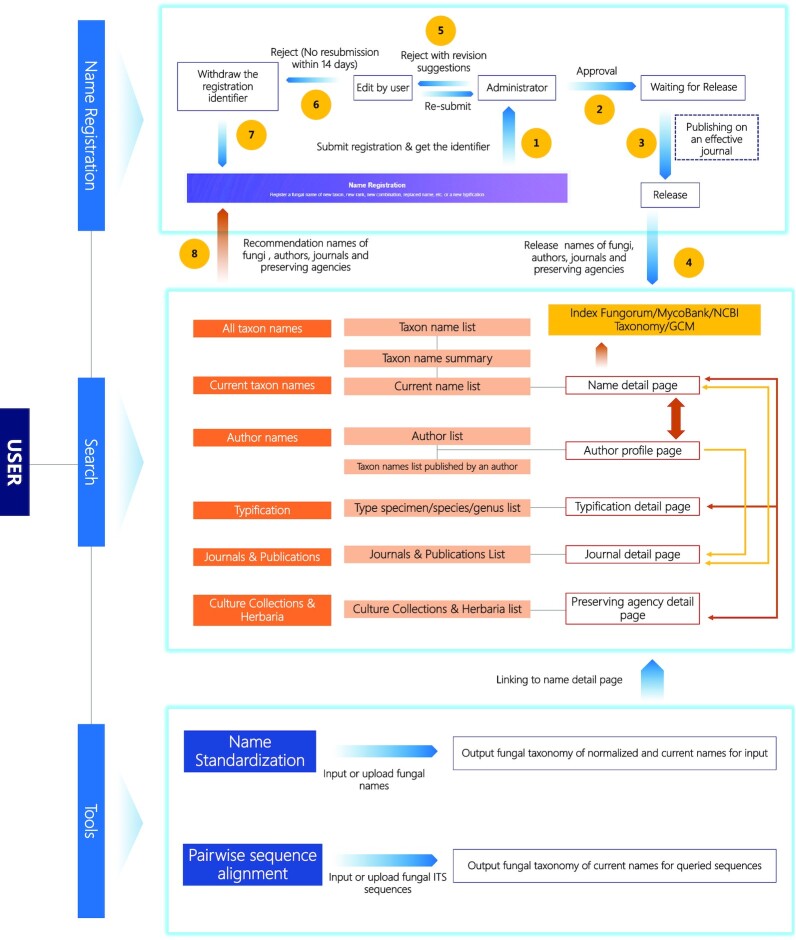
User guide of FN. An identifier for nomenclature novelties is issued immediately after the submission of the registration (Step 1) and administrative approval (Step 2–4). The identifier will be withdrawn if no reply to the ‘Revision Suggestion’ is received within 14 days (Step 5–7). Search functions are provided for all taxon names, current names, author names, typification, journals & other publications and culture collections and herbaria. For each query, a name list with an interconnecting detail page for each name is returned. Useful tools for normalizing taxon names or preliminary identification of fungal internal transcribed spacer (ITS) sequences are also provided by FN. All taxon names in the result are linked to detail pages in FN.
Figure 2.
Figure 2.
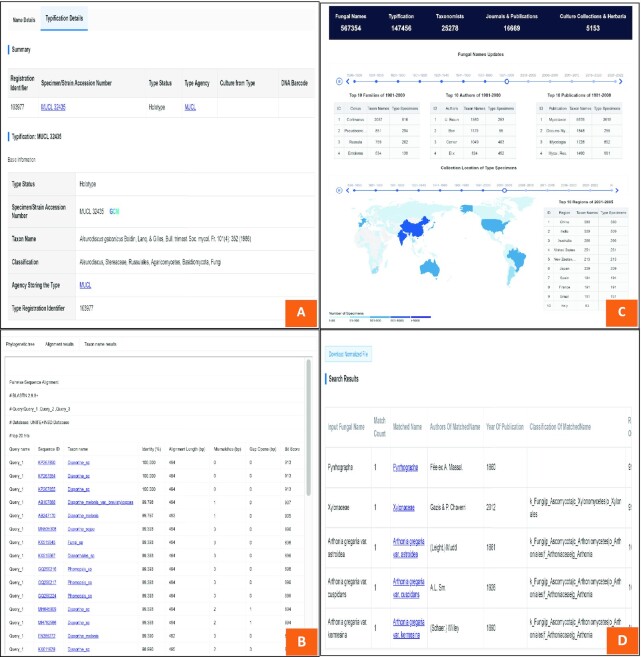
Detail pages of names of taxon (author/preserving agency/journal) (A), identification (B), statistics (C) and name standardization (D). (A) Detail page of taxon name shows the information of fungal taxonomy, typification and bibliography, and links to detail pages of author, preserving agency and journal. (B) Identification result of Pairwise Sequence Alignment for ITS sequence(s). The result supplies phylogenetic tree, alignment result, taxon name result with links to NCBI (Sequence ID) and names in FN (Taxon name). (C) Statistics page shows the summary of main data in FN. (D) Result of Name Standardization. This tool helps to normalize the fungal names with misspellings to standardized format in FN and provides taxonomy information of normalized names and corresponding current names.
Figure 3.
Figure 3.
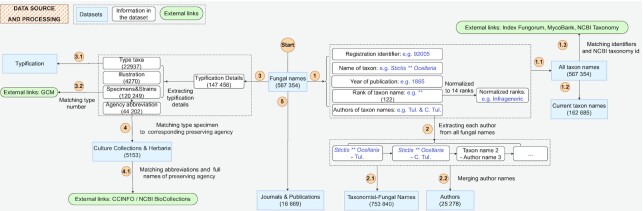
Data source and processing of FN. (1) All taxon names are cleaned and standardized to constitute the datasets of All Taxon Names and Current Taxon Names (1.1, 1.2). Taxon names are matched with and linked to names in Index Fungorum, MycoBank and NCBI Taxonomy if available (1.3). (2) Datasets of Authors and Taxonomist-Fungal Names: Authors’ names re separated and extracted from each taxon names to constitute the one author one fungal name dataset (2.1). Author names with duplicates are merged based on the information of author names, year of publication of taxon name and average publication interval of taxonomists (2.2). (3) Typification details of each taxon name, if available, are extracted and separated into three type status (type specimen, type species and type genus/phylum) and constitute the Typification dataset (3.1). Type specimens are linked to more details in Global Catalogue of Microorganisms (GCM) via strain numbers and taxon names (3.2). (4) Preserving agencies abbreviation are separated from type specimens and matched with dataset of Culture Collection & Herbaria. External information about the preserving agencies in Culture Collections Information Worldwide (CCINFO) and NCBI are matched via agency abbreviations and full names (4.1). (5) Journals or books that have published fungal names or are relevant to fungal taxonomy constitute the Journal & Publication dataset.
Figure 4.
Figure 4.
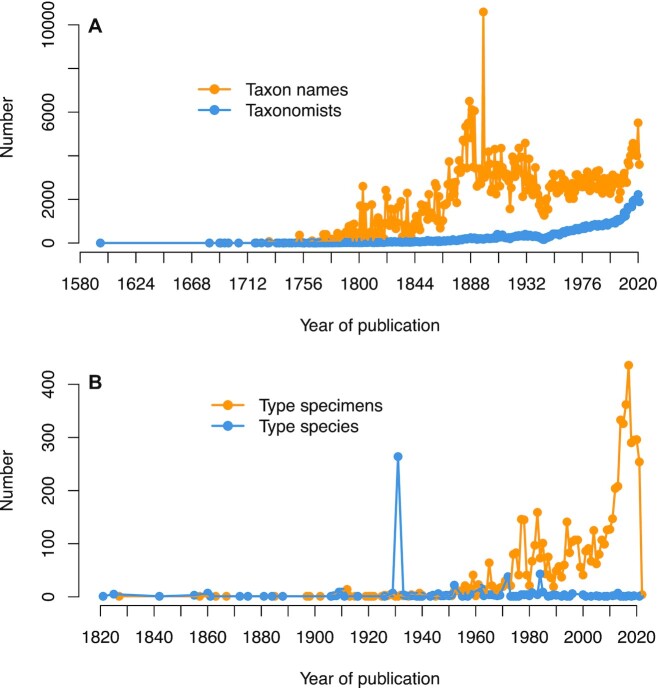
The annual increase of published taxon name and type specimens/species. (A) Number of taxonomists (blue) and taxon names (orange) published each year. 1596–1869 ascending phase, 1870–1899 steep phase, 1900–2009 constant phase, 2010–present second steep phage. The sharp increase in 1882–1898 coincided with the publication of Revisio generum plantarum, Sylloge fungorum and Enchiridion Fungorum, in Europa Media Præsertim in Gallia vigentium. (B) Designation of type species (blue) and type specimens (specimens and illustrations, orange) each year.
Figure 5.
Figure 5.
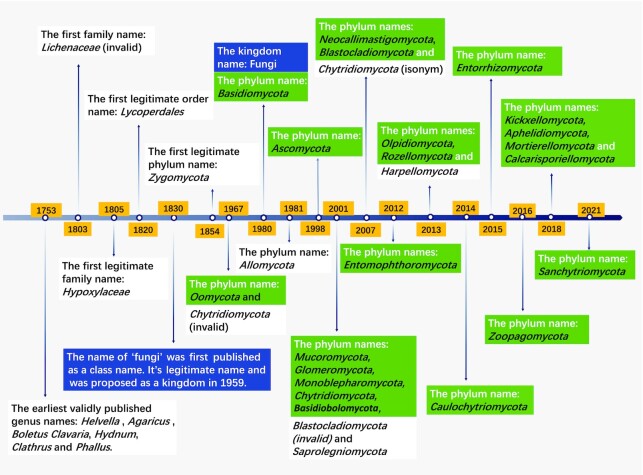
Brief history of main fungal names in fungal taxonomy (the important events in fungal taxonomy and nomenclature can be referred to the important perspective of Lücking et al. (1)). The taxon names in green boxes are 20 currently used phyla of kingdom fungi and other taxa of fungus-like taxa based on the research of Wijayawardene et al. (24,31). The taxon names in white boxes are the other phyla published in the history but not included in Wijayawardene's research and first taxa at ranks of order, family and genus published in the history. The taxon names in blue boxes are names related to kingdom name history of ‘fungi’.

References

    1. Lücking R., Aime M.C., Robbertse B., Miller A.N., Aoki T., Ariyawansa H.A., Cardinali G., Crous P.W., Druzhinina I.S., Geiser D.M.et al. .. Fungal taxonomy and sequence-based nomenclature. Nat Microbiol. 2021; 6:540–548. - PMC - PubMed
    1. Turland N., Wiersema J., Barrie F., Greuter W., Hawksworth D., Herendeen P., Knapp S., Kusber W.-H., Li D.-Z., Marhold K.et al. .. International Code of Nomenclature for Algae, Fungi, and Plants (Shenzhen Code) adopted by the Nineteenth International Botanical Congress Shenzhen, China, July 2017. 2018; Glashütten: Koeltz Botanical Books.
    1. Aime M.C., Miller A.N., Aoki T., Bensch K., Cai L., Crous P.W., Hawksworth D.L., Hyde K.D., Kirk P.M., Lücking R.et al. .. How to publish a new fungal species, or name, version 3.0. IMA Fungus. 2021; 12:11. - PMC - PubMed
    1. Lücking R., Aime M.C., Robbertse B., Miller A.N., Ariyawansa H.A., Aoki T., Cardinali G., Crous P.W., Druzhinina I.S., Geiser D.M.et al. .. Unambiguous identification of fungi: where do we stand and how accurate and precise is fungal DNA barcoding?. IMA Fungus. 2020; 11:14. - PMC - PubMed
    1. McNeill J., Turland N.J.. Major changes to the code of nomenclature—melbourne. Taxon. 2011; 60:1495–1497.

Publication types