


Climate change and human health in the Eastern Mediterranean and Middle East: Literature review, research priorities and policy suggestions
- PMID: 36273599
- PMCID: PMC9729515
- DOI: 10.1016/j.envres.2022.114537
Climate change and human health in the Eastern Mediterranean and Middle East: Literature review, research priorities and policy suggestions
Abstract
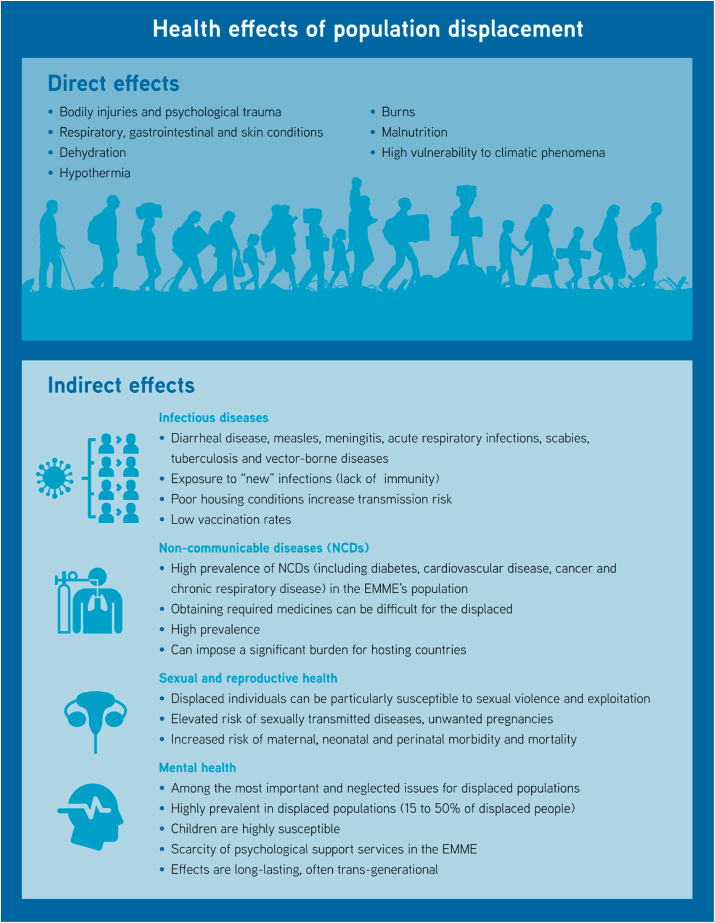
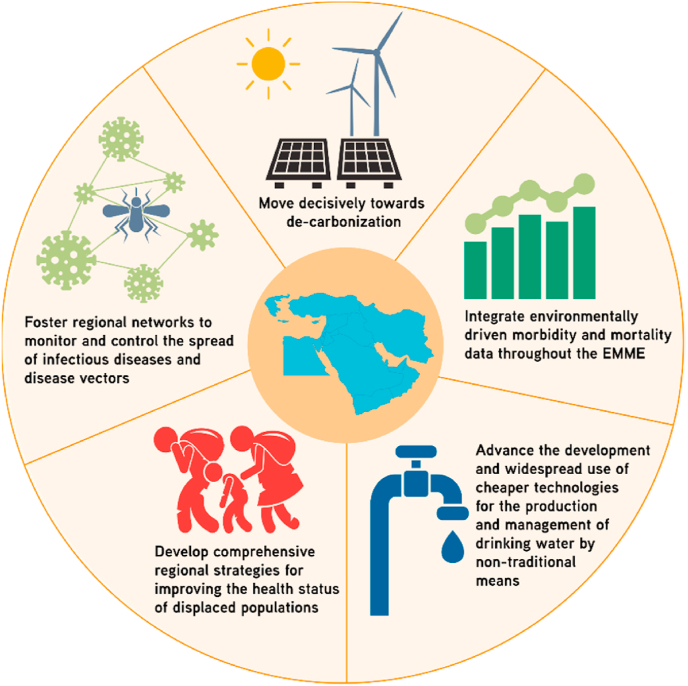
Human health is linked to climatic factors in complex ways, and climate change can have profound direct and indirect impacts on the health status of any given region. Susceptibility to climate change is modulated by biological, ecological and socio-political factors such as age, gender, geographic location, socio-economic status, occupation, health status and housing conditions, among other. In the Eastern Mediterranean and Middle East (EMME), climatic factors known to affect human health include extreme heat, water shortages and air pollution. Furthermore, the epidemiology of vector-borne diseases (VBDs) and the health consequences of population displacement are also influenced by climate change in this region. To inform future policies for adaptation and mitigation measures, and based on an extensive review of the available knowledge, we recommend several research priorities for the region. These include the generation of more empirical evidence on exposure-response functions involving climate change and specific health outcomes, the development of appropriate methodologies to evaluate the physical and psychological effects of climate change on vulnerable populations, determining how climate change alters the ecological determinants of human health, improving our understanding of the effects of long-term exposure to heat stress and air pollution, and evaluating the interactions between adaptation and mitigation strategies. Because national boundaries do not limit most climate-related factors expected to impact human health, we propose that adaptation/mitigation policies must have a regional scope, and therefore require collaborative efforts among EMME nations. Policy suggestions include a decisive region-wide decarbonisation, the integration of environmentally driven morbidity and mortality data throughout the region, advancing the development and widespread use of affordable technologies for the production and management of drinking water by non-traditional means, the development of comprehensive strategies to improve the health status of displaced populations, and fostering regional networks for monitoring and controlling the spread of infectious diseases and disease vectors.
Keywords: Air pollution; Climate change; Eastern Mediterranean; Extreme heat; Health; Middle East; Population displacement; Vector-borne diseases; Water shortage.
Copyright © 2022 The Author(s). Published by Elsevier Inc. All rights reserved.
Conflict of interest statement
Declaration of competing interest The authors declare that they have no known competing financial interests or personal relationships that could have appeared to influence the work reported in this paper.
Figures
References
-
- Ahmady-Birgani H., Mirnejad H., Feiznia S., McQueen K.G. Mineralogy and geochemistry of atmospheric particulates in western Iran. Atmos. Environ. 2015;119:262–272. doi: 10.1016/j.atmosenv.2015.08.021. - DOI
-
- Ahmady-Birgani H., McQueen K.G., Mirnejad H. Characteristics of mineral dust impacting the Persian Gulf. Aeolian Res. 2018;30:11–19. doi: 10.1016/J.AEOLIA.2017.11.001. - DOI
Publication types
MeSH terms
LinkOut - more resources
Full Text Sources
Medical
