


New anti-cancer explorations based on metal ions
- PMID: 36274142
- PMCID: PMC9590139
- DOI: 10.1186/s12951-022-01661-w
New anti-cancer explorations based on metal ions
Abstract
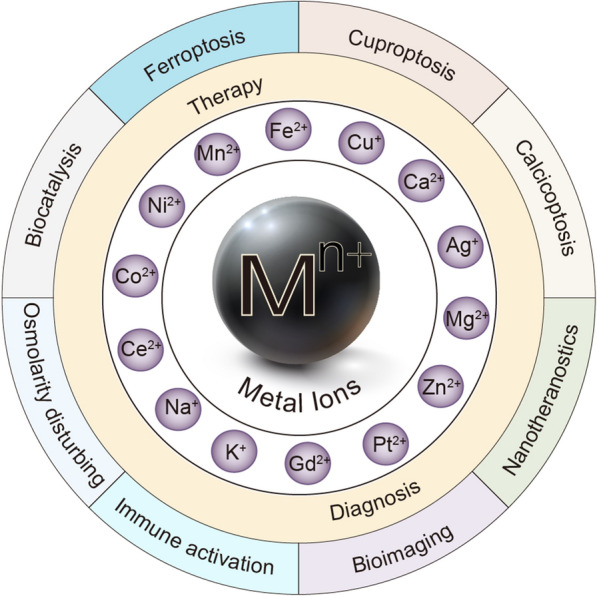
Due to the urgent demand for more anti-cancer methods, the new applications of metal ions in cancer have attracted increasing attention. Especially the three kinds of the new mode of cell death, including ferroptosis, calcicoptosis, and cuproptosis, are of great concern. Meanwhile, many metal ions have been found to induce cell death through different approaches, such as interfering with osmotic pressure, triggering biocatalysis, activating immune pathways, and generating the prooxidant effect. Therefore, varieties of new strategies based on the above approaches have been studied and applied for anti-cancer applications. Moreover, many contrast agents based on metal ions have gradually become the core components of the bioimaging technologies, such as MRI, CT, and fluorescence imaging, which exhibit guiding significance for cancer diagnosis. Besides, the new nano-theranostic platforms based on metal ions have experimentally shown efficient response to endogenous and exogenous stimuli, which realizes simultaneous cancer therapy and diagnosis through a more controlled nano-system. However, most metal-based agents have still been in the early stages, and controlled clinical trials are necessary to confirm or not the current expectations. This article will focus on these new explorations based on metal ions, hoping to provide some theoretical support for more anti-cancer ideas.
Keywords: Bioimaging; Cancer therapy; Cell death; Diagnosis; Metal ions; Nano-theranostic.
© 2022. The Author(s).
Conflict of interest statement
The authors declare that they have no competing interests.
Figures


References
-
- Kashyap D, Tuli HS, Yerer MB, Sharma A, Sak K, Srivastava S, Pandey A, Garg VK, Sethi G, Bishayee A. Natural product-based nanoformulations for cancer therapy: Opportunities and challenges. Semin Cancer Biol. 2021;69:5–23. - PubMed
-
- Dow JAT. The essential roles of metal ions in insect homeostasis and physiology. Curr Opin Insect Sci. 2017;23:43–50. - PubMed
-
- Tenneti P, Chojecki A, Knovich MA. Iron overload in the HCT patient: a review. Bone Marrow Transplant. 2021;56:1794–1804. - PubMed
Publication types
MeSH terms
Substances
Grants and funding
LinkOut - more resources
Full Text Sources
Medical
