


Trajectories of 24-h movement guidelines from middle adolescence to adulthood on depression and suicidal ideation: a 22-year follow-up study
- PMID: 36274150
- PMCID: PMC9590171
- DOI: 10.1186/s12966-022-01367-0
Trajectories of 24-h movement guidelines from middle adolescence to adulthood on depression and suicidal ideation: a 22-year follow-up study
Abstract
Background: The 24-h movement guidelines for youth and adults recommend the specific duration of physical activity, sedentary time, and sleep duration to ensure optimal health, but little is known about its relationship to mental health indicators. The aim of the study was to explore the association between 24-h movement guidelines in adolescence and its trajectories from middle adolescence (12-17 years old) to adulthood (33-39 years old) with depression and suicidal ideation in adulthood.
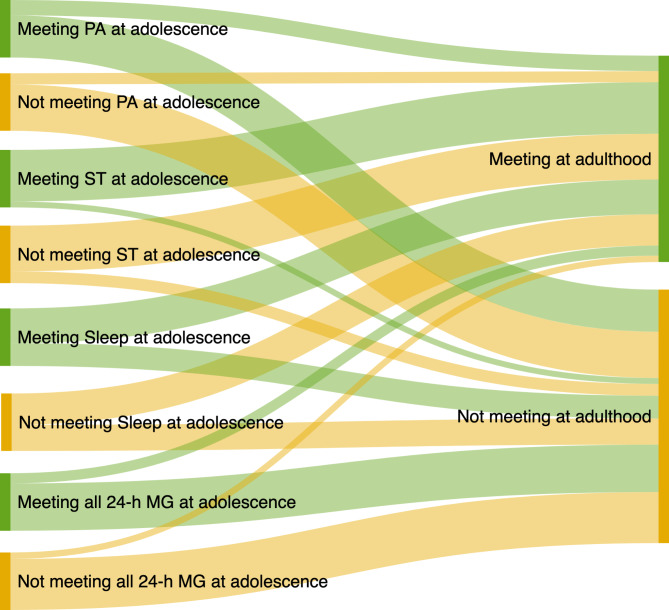
Methods: This prospective cohort study included individuals who participated in Waves I (1994-1995) and V (2016-2018) of the National Longitudinal Study of Adolescent Health (Add Health) in the United States. Physical activity, screen time and sleep duration were measured using questionnaires. Adults were categorized as having depression if they had a self-reported history of depression and/or prescription medication-use for depression in the previous four weeks. Suicidal ideation was assessed by a self-reported single question in both waves. Poisson regression analyses were used to estimate the incidence rate ratio (IRR) of depression and suicidal ideation at adulthood, according to meeting specific and combinations of 24-h movement guidelines at Wave I and its trajectories from adolescence to adulthood.
Results: The study included 7,069 individuals (56.8% women). Adolescents who met physical activity guidelines and all three guidelines at middle adolescence had lower risk of depression (IRR = 0.84, 95%CI 0.72 to 0.98) and suicidal ideation (IRR = 0.74, 95%CI 0.55 to 0.99) at adulthood than those who did not meet any of these guidelines, respectively. Individuals who met the guidelines for screen time and all three guidelines in both adolescence and adulthood had lower risk of depression (screen time, IRR = 0.87, 95% CI 0.72 to 0.98; all three, IRR = 0.37, 95% CI 0.15 to 0.92) and suicidal ideation (screen time, IRR = 0.74, 95% CI 0.51 to 0.97; all three, IRR = 0.12, 95% CI 0.06 to 0.33) than those who never met the guidelines. Additionally, individuals who did not meet all three guidelines in adolescence but met the guidelines in adulthood had lower risk of suicidal ideation than those who never met the guidelines (IRR = 0.81, 95%CI 0.45 to 0.89).
Conclusion: Our findings highlight the importance of promoting and maintaining adherence to the 24-h movement guidelines from middle adolescence to adulthood to prevent mental health problems. However, our findings must be interpreted carefully due to declared limitations, e.g., the self-reported assessments which are subject to sources of error and bias or that the dataset used to gauge meeting a guidelines (1994-1996) was made later (2016).
Keywords: Mental health; Physical activity; Screen time; Sleep duration.
© 2022. The Author(s).
Conflict of interest statement
The authors declare that they have no competing interests.
Figures
Similar articles
-
Twenty-four-hour movement guidelines during adolescence and its association with obesity at adulthood: results from a nationally representative study.Eur J Pediatr. 2023 Mar;182(3):1009-1017. doi: 10.1007/s00431-022-04760-w. Epub 2022 Dec 21. Eur J Pediatr. 2023. PMID: 36542161 Free PMC article.
-
Association Between Daily Physical Education Attendance and Meeting 24-Hour Movement Guidelines in Adolescence and Adulthood.J Adolesc Health. 2023 Nov;73(5):896-902. doi: 10.1016/j.jadohealth.2023.06.014. Epub 2023 Aug 21. J Adolesc Health. 2023. PMID: 37610389
-
Twenty-four-hour movement guidelines during middle adolescence and their association with glucose outcomes and type 2 diabetes mellitus in adulthood.J Sport Health Sci. 2023 Mar;12(2):167-174. doi: 10.1016/j.jshs.2022.08.001. Epub 2022 Aug 6. J Sport Health Sci. 2023. PMID: 35940532 Free PMC article.
-
Combinations of physical activity, sedentary time, and sleep duration and their associations with depressive symptoms and other mental health problems in children and adolescents: a systematic review.Int J Behav Nutr Phys Act. 2020 Jun 5;17(1):72. doi: 10.1186/s12966-020-00976-x. Int J Behav Nutr Phys Act. 2020. PMID: 32503638 Free PMC article.
-
Twenty-Five Years of National-Level Research on Adolescent and Young Adult Mental Health in the United States.J Adolesc Health. 2022 Dec;71(6S):S40-S46. doi: 10.1016/j.jadohealth.2022.08.008. J Adolesc Health. 2022. PMID: 36404018 Review.
Cited by
-
Physical activity in childhood and adolescence and future depressive symptoms: an 11-year prospective cohort study.Eur J Public Health. 2023 Oct 10;33(5):878-883. doi: 10.1093/eurpub/ckad122. Eur J Public Health. 2023. PMID: 37616554 Free PMC article.
-
Healthy Lifestyle Related to Executive Functions in Chilean University Students: A Pilot Study.Healthcare (Basel). 2024 May 15;12(10):1022. doi: 10.3390/healthcare12101022. Healthcare (Basel). 2024. PMID: 38786435 Free PMC article.
-
A Cluster Randomized Controlled Trial of the Archena Infancia Saludable Project on 24-h Movement Behaviors and Adherence to the Mediterranean Diet among Schoolchildren: A Pilot Study Protocol.Children (Basel). 2023 Apr 17;10(4):738. doi: 10.3390/children10040738. Children (Basel). 2023. PMID: 37189987 Free PMC article.
-
Adherence to the 24-hour movement behavior guidelines and depression risk among older adults from the United States.J Act Sedentary Sleep Behav. 2025 Jan 9;4(1):1. doi: 10.1186/s44167-024-00071-7. J Act Sedentary Sleep Behav. 2025. PMID: 40217442 Free PMC article.
-
Twenty-four-hour movement guidelines and depressive symptoms: association, temporal trends and moderators over a ten-year period among 45,297 US adolescents.Eur Child Adolesc Psychiatry. 2025 Feb 24. doi: 10.1007/s00787-025-02663-3. Online ahead of print. Eur Child Adolesc Psychiatry. 2025. PMID: 39994034
References
-
- Patel V, Saxena S, Lund C, Thornicroft G, Baingana F, Bolton P, et al. The Lancet Commission on global mental health and sustainable development. The Lancet. 2018;392:1553–98. - PubMed
-
- Clayborne ZM, Varin M, Colman I. Systematic Review and Meta-Analysis: Adolescent Depression and Long-Term Psychosocial Outcomes. J Am Acad Child Adolesc Psychiatry. 2019;58:72–9. - PubMed
MeSH terms
LinkOut - more resources
Full Text Sources
Medical
Miscellaneous
