


Experimental and conceptual approaches to root water transport
- PMID: 36277078
- PMCID: PMC9579117
- DOI: 10.1007/s11104-022-05427-z
Experimental and conceptual approaches to root water transport
Abstract
Background: Root water transport, which critically contributes to the plant water status and thereby plant productivity, has been the object of extensive experimental and theoretical studies. However, root systems represent an intricate assembly of cells in complex architectures, including many tissues at distinct developmental stages. Our comprehension of where and how molecular actors integrate their function in order to provide the root with its hydraulic properties is therefore still limited.
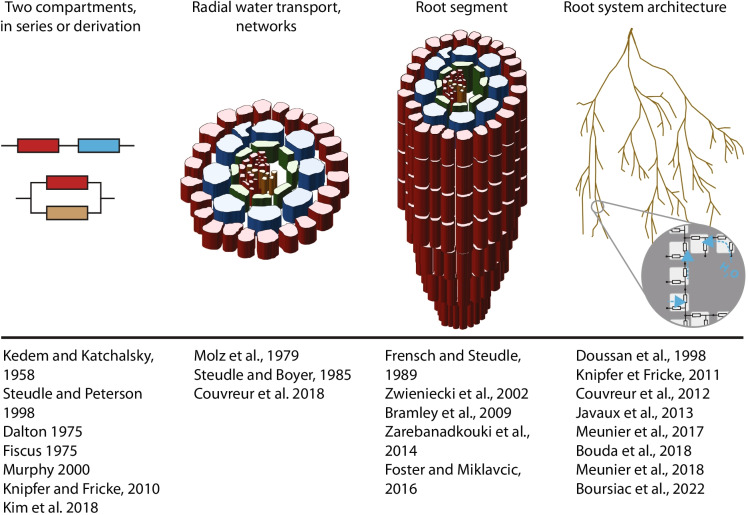
Scope: Based on current literature and prospective discussions, this review addresses how root water transport can be experimentally measured, what is known about the underlying molecular actors, and how elementary water transport processes are scaled up in numerical/mathematical models.
Conclusions: The theoretical framework and experimental procedures on root water transport that are in use today have been established a few decades ago. However, recent years have seen the appearance of new techniques and models with enhanced resolution, down to a portion of root or to the tissue level. These advances pave the way for a better comprehension of the dynamics of water uptake by roots in the soil.
Keywords: Biophysics; Forward genetics; Modeling; Pressure chamber; Root pressure probe; Root water transport.
© The Author(s), under exclusive licence to Springer Nature Switzerland AG 2022.
Conflict of interest statement
Competing interestsThe authors declare no competing interests.
Figures
References
-
- Adachi S, Tsuru Y, Kondo M, Yamamoto T, Arai-Sanoh Y, Ando T, Ookawa T, Yano M, Hirasawa T. Characterization of a rice variety with high hydraulic conductance and identification of the chromosome region responsible using chromosome segment substitution lines. Ann Bot. 2010;106:803–811. - PMC - PubMed
-
- Alexandersson E, Gustavsson N, Bernfur K, Karlsson A, Kjellbom P, Larsson C. Purification and Proteomic Analysis of Plant Plasma Membranes. In: Pflieger D, Rossier J, editors. Organelle Proteomics. Totowa: Humana Press; 2008. pp. 161–173. - PubMed
-
- Anderegg WRL. Spatial and temporal variation in plant hydraulic traits and their relevance for climate change impacts on vegetation. New Phytol. 2015;205:1008–1014. - PubMed
-
- Barberon M (2017) The endodermis as a checkpoint for nutrients. New Phytol 213(4):1604–1610 - PubMed
Publication types
LinkOut - more resources
Full Text Sources