Review
. 2022 Oct 21;10(4):35.
doi: 10.3390/proteomes10040035.

Proteomics-Based Identification of Dysregulated Proteins in Breast Cancer

Affiliations
Review

Proteomics-Based Identification of Dysregulated Proteins in Breast Cancer

Anca-Narcisa Neagu et al. Proteomes. .

Abstract

Immunohistochemistry (IHC) is still widely used as a morphology-based assay for in situ analysis of target proteins as specific tumor antigens. However, as a very heterogeneous collection of neoplastic diseases, breast cancer (BC) requires an accurate identification and characterization of larger panels of candidate biomarkers, beyond ER, PR, and HER2 proteins, for diagnosis and personalized treatment, without the limited availability of antibodies that are required to identify specific proteins. Top-down, middle-down, and bottom-up mass spectrometry (MS)-based proteomics approaches complement traditional histopathological tissue analysis to examine expression, modification, and interaction of hundreds to thousands of proteins simultaneously. In this review, we discuss the proteomics-based identification of dysregulated proteins in BC that are essential for the following issues: discovery and validation of new biomarkers by analysis of solid and liquid/non-invasive biopsies, cell lines, organoids and xenograft models; identification of panels of biomarkers for early detection and accurate discrimination between cancer, benign and normal tissues; identification of subtype-specific and stage-specific protein expression profiles in BC grading and measurement of disease progression; characterization of new subtypes of BC; characterization and quantitation of post-translational modifications (PTMs) and aberrant protein-protein interactions (PPI) involved in tumor development; characterization of the global remodeling of BC tissue homeostasis, diagnosis and prognostic information; and deciphering of molecular functions, biological processes and mechanisms through which the dysregulated proteins cause tumor initiation, invasion, and treatment resistance.

Keywords: breast cancer; dysregulated proteins; proteoforms; proteomics.


Conflict of interest statement

The authors declare no conflict of interest.

Figures
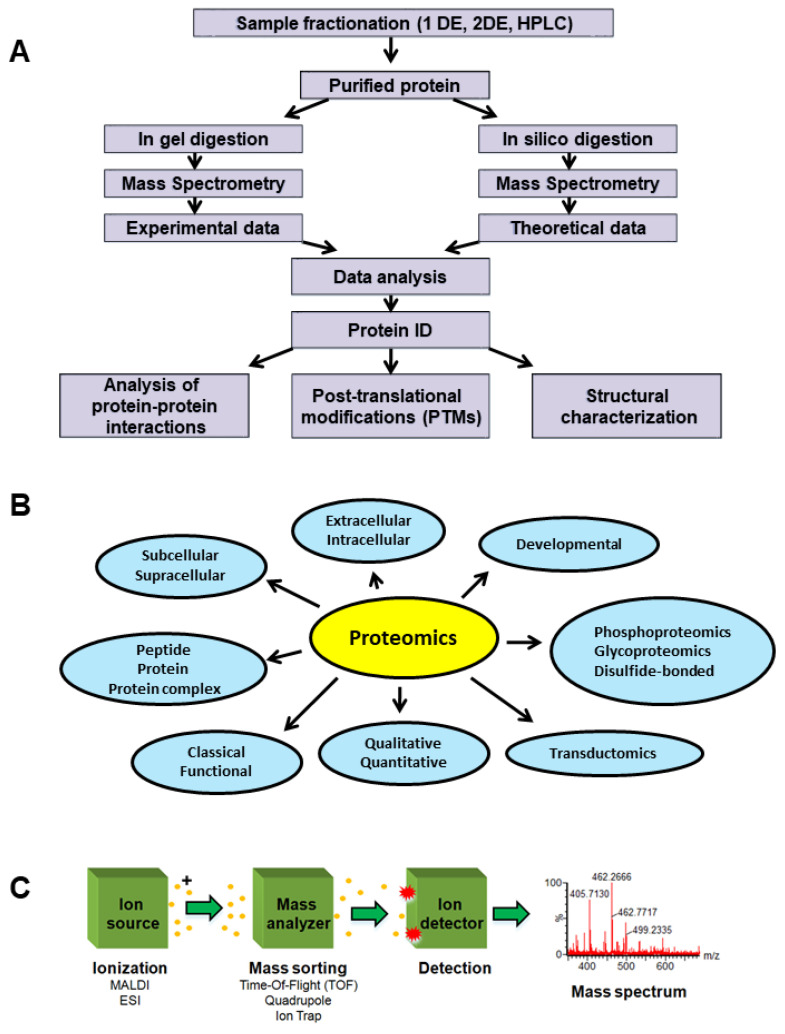
Figure 1
Figure 1
General proteomics experiment. (A) Proteomics experiment workflow schematic. (B) Proteomics and applications schematic. (C) Mass spectrometer schematic. Reprinted and adapted with permission from Sokolowska, I.; Woods, A.G.; Wagner, J.; Dorler, J.; Wormwood, K.; Thome, J.; Darie, C.C. Mass spectrometry for proteomics-based investigation of oxidative stress and heat shock proteins. In Oxidative Stress: Diagnostics, Prevention, and Therapy; Andreescu, S., Hepel, M., Eds.; American Chemical Society: Washington, DC, USA, 2011 [25]. Copyright @ 2011, American Chemical Society.
Figure 2
Figure 2
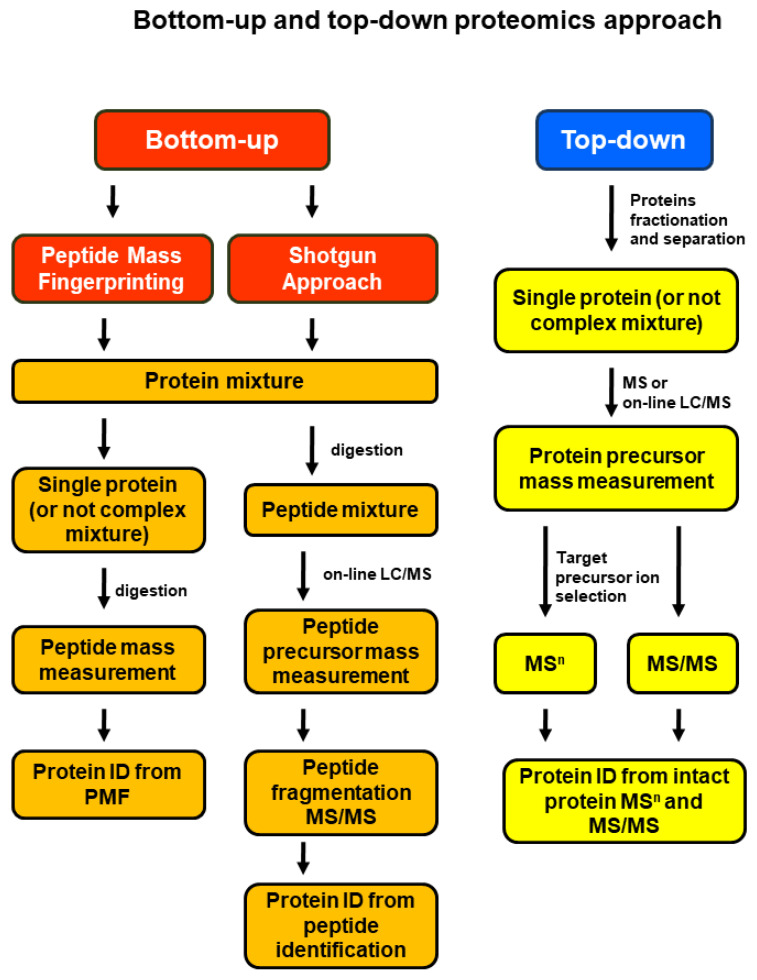
Schematic workflow for bottom-up and top-down MS-based protein characterization and identification. Reprinted and adapted with permission from Woods, A.G.; Sokolowska, I.; Ngounou Wetie, A.G.; Channaveerappa, D.; Dupree, E.J.; Jayathirtha, M.; Aslebagh, R.; Wormwood, K.L.; Darie, C.C. Mass Spectrometry for Proteomics-Based Investigation. Adv. Exp. Med. Biol. 2019, 1140, 1–26. [26]. Copyright @ 2019, Springer Nature Switzerland AG.
Figure 3
Figure 3
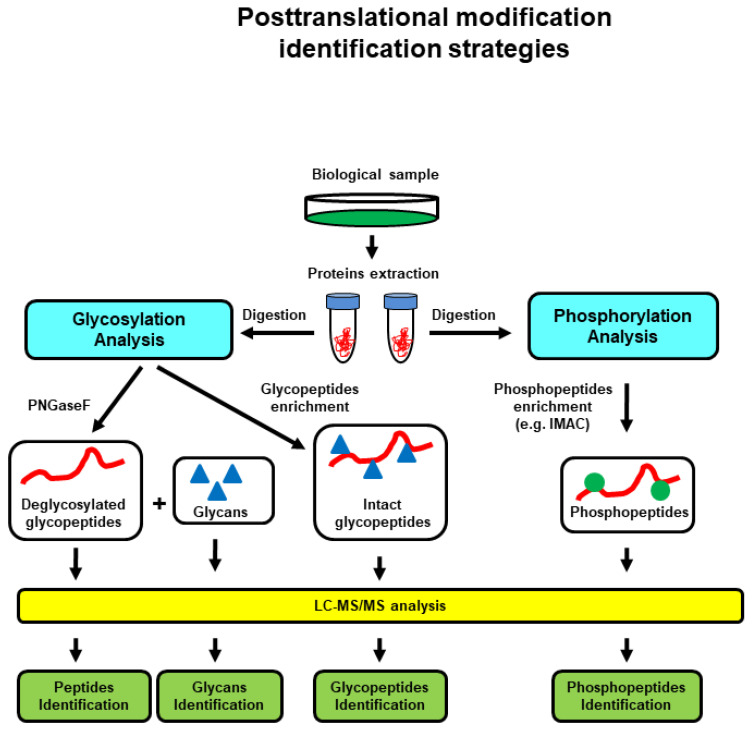
MS-based characterization of protein PTMs (glycosylation and phosphorylation), general strategies. Reprinted and adapted with permission from Woods, A.G.; Sokolowska, I.; Ngounou Wetie, A.G.; Channaveerappa, D.; Dupree, E.J.; Jayathirtha, M.; Aslebagh, R.; Wormwood, K.L.; Darie, C.C. Mass Spectrometry for Proteomics-Based Investigation. Adv. Exp. Med. Biol. 2019, 1140, 1–26. [26]. Copyright @ 2019, Springer Nature Switzerland AG.
Figure 4
Figure 4
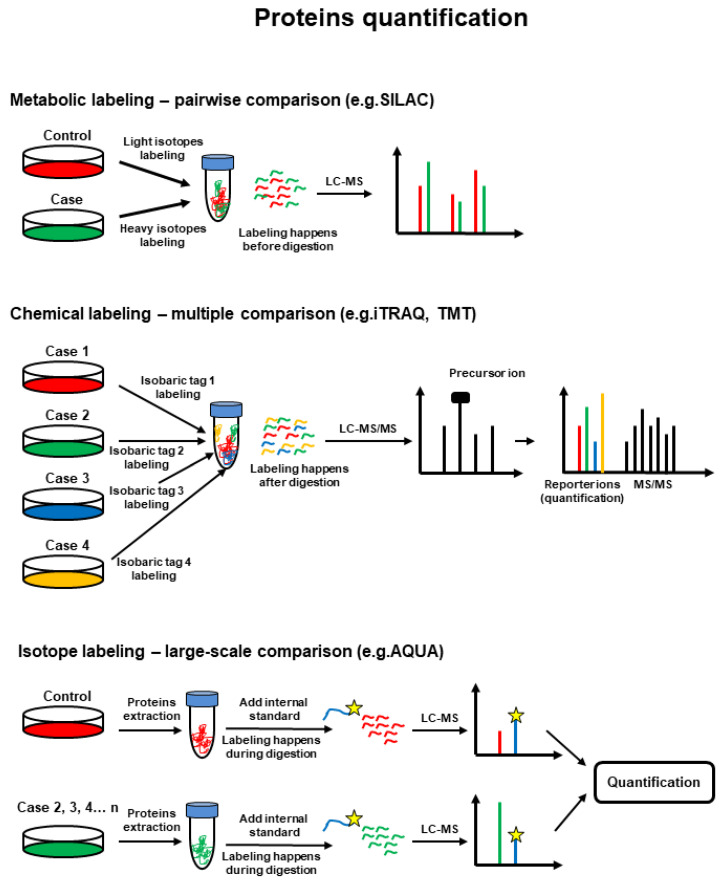
MS-based protein quantification workflow strategies via stable isotope labeling. Reprinted and adapted with permission from Woods, A.G.; Sokolowska, I.; Ngounou Wetie, A.G.; Channaveerappa, D.; Dupree, E.J.; Jayathirtha, M.; Aslebagh, R.; Wormwood, K.L.; Darie, C.C. Mass Spectrometry for Proteomics-Based Investigation. Adv. Exp. Med. Biol. 2019, 1140, 1–26. [26]. Copyright @ 2019, Springer Nature Switzerland AG.

References

    1. Rossi C., Cicalini I., Cufaro M.C., Consalvo A., Upadhyaya P., Sala G., Antonucci I., Del Boccio P., Stuppia L., De Laurenzi V. Breast cancer in the era of integrating “Omics” approaches. Oncogenesis. 2022;11:17. doi: 10.1038/s41389-022-00393-8. - DOI - PMC - PubMed
    1. Flores M., Glusman G., Brogaard K., Price N.D., Hood L. P4 medicine: How systems medicine will transform the healthcare sector and society. Per. Med. 2013;10:565–576. doi: 10.2217/pme.13.57. - DOI - PMC - PubMed
    1. Ginsburg G., Phillips K. Precision Medicine: From Science To Value. Health Affairs. 2018;37:694–701. doi: 10.1377/hlthaff.2017.1624. - DOI - PMC - PubMed
    1. Pires I.M., Denysyuk H.V., Villasana M.V., Sá J., Lameski P., Chorbev I., Zdravevski E., Trajkovik V., Morgado J.F., Garcia N.M. Mobile 5P-Medicine Approach for Cardiovascular Patients. Sensors. 2021;21:6986. doi: 10.3390/s21216986. - DOI - PMC - PubMed
    1. Zhan X., Li J., Guo Y., Golubnitschaja O. Mass spectrometry analysis of human tear fluid biomarkers specific for ocular and systemic diseases in the context of 3P medicine. EPMA J. 2021;12:449–475. doi: 10.1007/s13167-021-00265-y. - DOI - PMC - PubMed