


Age-Related Changes in Skeletal Muscle Oxygen Utilization
- PMID: 36278748
- PMCID: PMC9590092
- DOI: 10.3390/jfmk7040087
Age-Related Changes in Skeletal Muscle Oxygen Utilization
Abstract
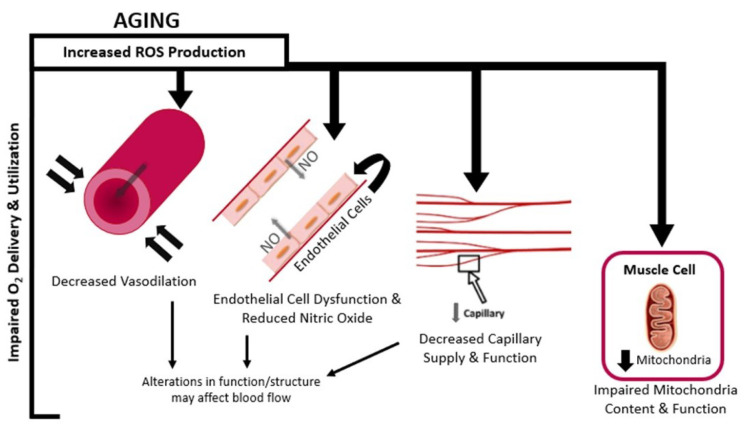
The cardiovascular and skeletal muscle systems are intrinsically interconnected, sharing the goal of delivering oxygen to metabolically active tissue. Deficiencies within those systems that affect oxygen delivery to working tissues are a hallmark of advancing age. Oxygen delivery and utilization are reflected as muscle oxygen saturation (SmO2) and are assessed using near-infrared resonance spectroscopy (NIRS). SmO2 has been observed to be reduced by ~38% at rest, ~24% during submaximal exercise, and ~59% during maximal exercise with aging (>65 y). Furthermore, aging prolongs restoration of SmO2 back to baseline by >50% after intense exercise. Regulatory factors that contribute to reduced SmO2 with age include blood flow, capillarization, endothelial cells, nitric oxide, and mitochondrial function. These mechanisms are governed by reactive oxygen species (ROS) at the cellular level. However, mishandling of ROS with age ultimately leads to alterations in structure and function of the regulatory factors tasked with maintaining SmO2. The purpose of this review is to provide an update on the current state of the literature regarding age-related effects in SmO2. Furthermore, we attempt to bridge the gap between SmO2 and associated underlying mechanisms affected by aging.
Keywords: aging; muscle metabolism; muscle oxygen saturation (SmO2); near-infrared resonance spectroscopy (NIRS).
Conflict of interest statement
The authors declare no conflict of interest.
Figures
References
-
- Heart Disease & Stroke Statistical Update Fact Sheet Older Americans & Cardiovascular Diseases. 2021. [(accessed on 2 January 2022)]. Available online: https://professional.heart.org/-/media/PHD-Files-2/Science-News/2/2021-H....
-
- Virani S.S., Alonso A., Aparicio H.J., Benjamin E.J., Bittencourt M.S., Callaway C.W., Carson A.P., Chamberlain A.M., Cheng S., Delling F.N., et al. Heart disease and stroke statistics-2021 update: A report from the American heart association. Circulation. 2021;143:e254–e743. doi: 10.1161/CIR.0000000000000950. - DOI - PubMed
-
- Cardiovascular Disease: A Costly Burden for America Projections through 2035. [(accessed on 3 January 2022)]. Available online: https://www.heart.org/-/media/Files/Get-Involved/Advocacy/Burden-Report-....
Publication types
LinkOut - more resources
Full Text Sources
Miscellaneous
