Observational Study
. 2022 Dec:157:105321.
doi: 10.1016/j.jcv.2022.105321. Epub 2022 Oct 18.

NVX-CoV2373-induced cellular and humoral immunity towards parental SARS-CoV-2 and VOCs compared to BNT162b2 and mRNA-1273-regimens

Affiliations
Observational Study

NVX-CoV2373-induced cellular and humoral immunity towards parental SARS-CoV-2 and VOCs compared to BNT162b2 and mRNA-1273-regimens

Franziska Hielscher et al. J Clin Virol. 2022 Dec.

Abstract

Background: The NVX-CoV2373-vaccine has recently been licensed, although knowledge on vaccine-induced humoral and cellular immunity towards the parental strain and variants of concern (VOCs) in comparison to mRNA-regimens is limited.

Methods: In this observational study, 66 individuals were recruited to compare immunogenicity and reactogenicity of NVX-CoV2373 with BNT162b2 or mRNA-1273. Vaccine-induced antibodies were analyzed using ELISA and neutralization assays, specific CD4 and CD8 T-cells were characterized based on intracellular cytokine staining using flow-cytometry after antigen-specific stimulation with parental spike or VOCs.

Results: Two doses of NVX-CoV2373 strongly induced anti-spike IgG, although IgG-levels were lower than after vaccination with BNT162b2 or mRNA-1273 (p = 0.006). Regardless of the vaccine and despite different IgG-levels, neutralizing activity towards VOCs was highest for Delta, followed by BA.2 and BA.1. The protein-based vaccine failed to induce any spike-specific CD8 T-cells which were detectable in 3/22 (14%) individuals only. In contrast, spike-specific CD4 T-cells were induced in 18/22 (82%) individuals, although their levels were lower (p<0.001), had lower CTLA-4 expression (p<0.0001) and comprised less multifunctional cells co-expressing IFNγ, TNFα and IL-2 (p = 0.0007). Unlike neutralizing antibodies, NVX-CoV2373-induced CD4 T-cells equally recognized all tested VOCs from Alpha to Omicron. In individuals with a history of infection, one dose of NVX-CoV2373 had similar immunogenicity as two doses in non-infected individuals. The vaccine was overall well tolerated.

Conclusion: NVX-CoV2373 strongly induced spike-specific antibodies and CD4 T-cells, albeit at lower levels as mRNA-regimens. Cross-reactivity of CD4 T-cells towards the parental strain and all tested VOCs may hold promise to protect from severe disease.

Keywords: Antibodies; COVID-19; Coronavirus; Neutralization; SARS-CoV-2; T-cells; Vaccination; Variant of concern.


Conflict of interest statement

Declaration of Competing Interest M.S. has received grant support from Astellas and Biotest to the organization Saarland University outside the submitted work, and honoraria for lectures from Biotest and Novartis. M.W. has received speaker fees from Astra Zeneca and grant support from Roche Molecular Diagnostics to the organization Goethe University Frankfurt outside the submitted work. All other authors of this manuscript have no conflicts of interest to disclose.

Figures
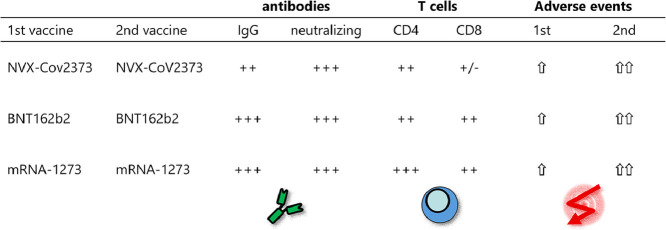
Image, graphical abstract
Graphical abstract
Fig 1
Fig. 1
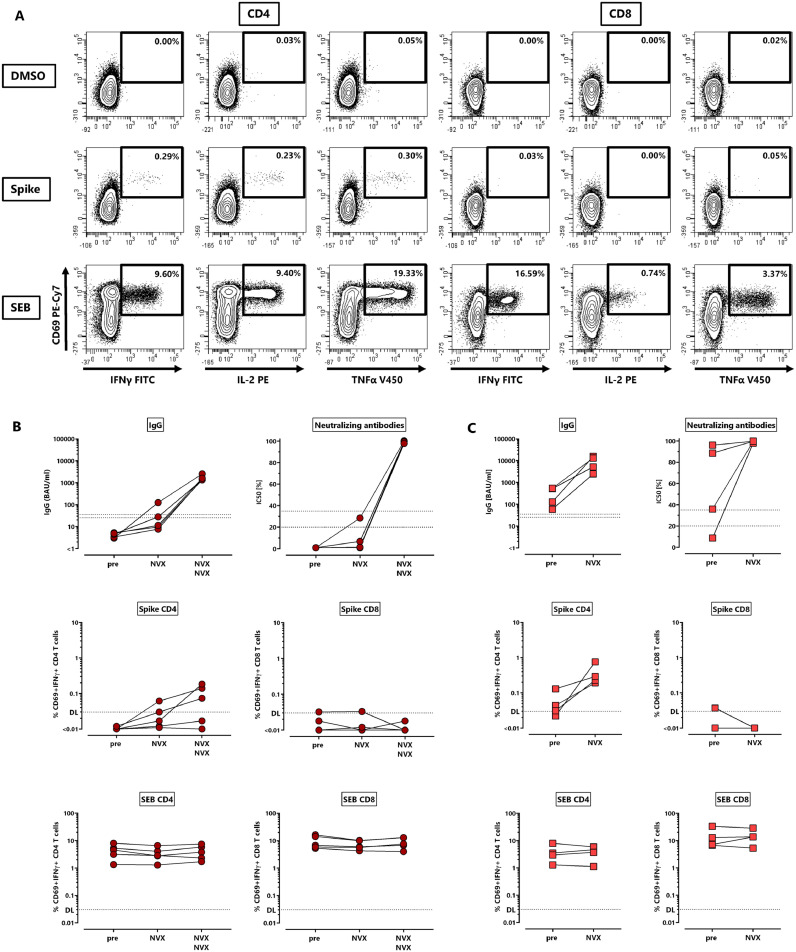
Evolution of antibodies and T-cells against the SARS-CoV-2 spike protein after NVX-CoV2373-vaccination. (A) Representative contour plots of CD4 and CD8 T-cells after stimulation of a whole blood sample from a 37-years old female 14 days after the second dose of the NVX-CoV2373-vaccine (NVX). Percentages of activated (CD69+) cells producing IFNγ, TNFα or IL-2 among CD4 or CD8 T-cells are shown after stimulation with DMSO (negative control), overlapping peptides of SARS-CoV-2 spike protein or SEB (positive control). Spike-specific IgG, neutralizing activity, spike-specific CD4 and CD8 T-cells, and SEB-reactive CD4 and CD8 T-cells were determined (B) in non-infected individuals (n = 5) prior to vaccination as well as after the first and the second vaccination, or (C) in individuals with history of one prior infection (n = 4) before and after a single dose of NVX-CoV2373-vaccine. Specific T-cells in panels B and C show CD4 or CD8 T-cells co-expressing CD69 and IFNγ with respective reactivity after control stimulation subtracted. Bars represent medians with interquartile ranges. Dotted lines represent detection limits for antibodies indicating negative, intermediate and positive levels or levels of inhibition, respectively as per manufacturer's instructions, and detection limits for specific T-cells. IFN, interferon; IL, interleukin; SEB, Staphylococcus aureus enterotoxin B; TNF, tumor necrosis factor.
Fig 2
Fig. 2
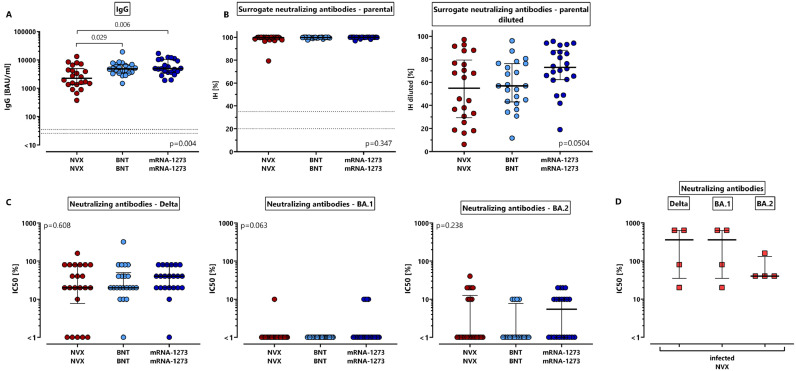
Lower levels of spike-specific IgG after NVX-CoV2373-vaccination with similar neutralizing activity as mRNA-vaccinated individuals. Spike-specific antibodies were characterized among 66 individuals 13–18 days after the second vaccination with NVX-CoV2373 (NVX), BNT162b2 (BNT) or mRNA-1273 (n = 22 each). (A) ELISA and (B) a surrogate neutralization assay were performed to quantify levels of spike-specific IgG and neutralizing antibodies towards parental SARS-CoV-2 (expressed as percentage of inhibition (IH), left panel). In addition, samples were further diluted 1:16 to provide a higher resolution (right panel, expressed as percentage of inhibition of diluted samples). (C) A micro-neutralization assay was used to determine antibody-mediated neutralization of authentic SARS-CoV-2 variants of concern Delta and Omicron BA.1 and BA.2 among the three vaccine groups and (D) in the four individuals with history of infection after the first NVX-CoV2373-vaccine dose. Bars represent medians with interquartile ranges (expressed as IC50). Differences between the groups were calculated using two-sided Kruskal-Wallis test with Dunn´s multiple comparisons post-test. Dotted lines represent detection limits indicating negative, intermediate and positive IgG-levels or levels of inhibition, respectively as per manufacturer's instructions.
Fig 3
Fig. 3
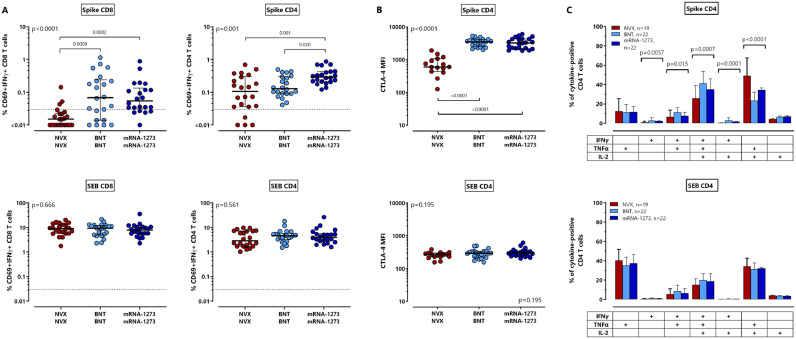
Lower levels of spike-specific T-cells, lower CTLA-4 expression and lower percentages of polyfunctional CD4 T-cells after NVX-CoV2373-vaccination. Spike-specific CD4 and CD8 T-cells were quantified and characterized by intracellular cytokine staining after antigen-specific stimulation of whole blood samples of 66 individuals 13–18 days after the second vaccination with NVX-CoV2373 (NVX), BNT162b2 (BNT) or mRNA-1273 (n = 22 each). (A) Spike-specific and SEB-reactive CD4 and CD8 T-cells were determined based on co-expression of CD69 and IFNγ with respective reactivity after control stimulation subtracted. Bars represent medians with interquartile ranges. Dotted lines indicate detection limits for specific T-cells. (B) CTLA-4 expression of spike-specific and SEB-reactive CD4 T-cells was determined in all samples with at least 20 CD69+ IFNγ-positive CD4 T-cells (n = 15 for NVX CoV2373, n = 22 for mRNA-vaccinated individuals). Bars in panels A and B represent medians with interquartile ranges. Differences between the groups were calculated using two-sided Kruskal-Wallis test with Dunn´s multiple comparisons post-test. (C) After spike-specific or polyclonal stimulation, cytokine expressing CD4 T-cells were subclassified into 7 subpopulations according to single or combined expression of IFNγ, TNFα and IL-2. Blood samples from all individuals were analyzed. To ensure robust statistics, only samples with at least 30 cytokine-expressing CD4 T-cells after normalization to the negative control stimulation were considered (with sample size in each vaccine group indicated in the figures). Bars represent means and standard deviations, and ordinary one-way ANOVA tests were performed. Analyses in panels B and C were restricted to CD4 T-cells due to the lack of spike-specific CD8 T-cells in most NVX-CoV2373-vaccinated individuals. CTLA-4, cytotoxic T-lymphocyte associated protein 4; IFN, interferon; IL, interleukin; MFI, median fluorescence intensity; SEB, Staphylococcus aureus enterotoxin B; TNF, tumor necrosis factor.
Fig 4
Fig. 4
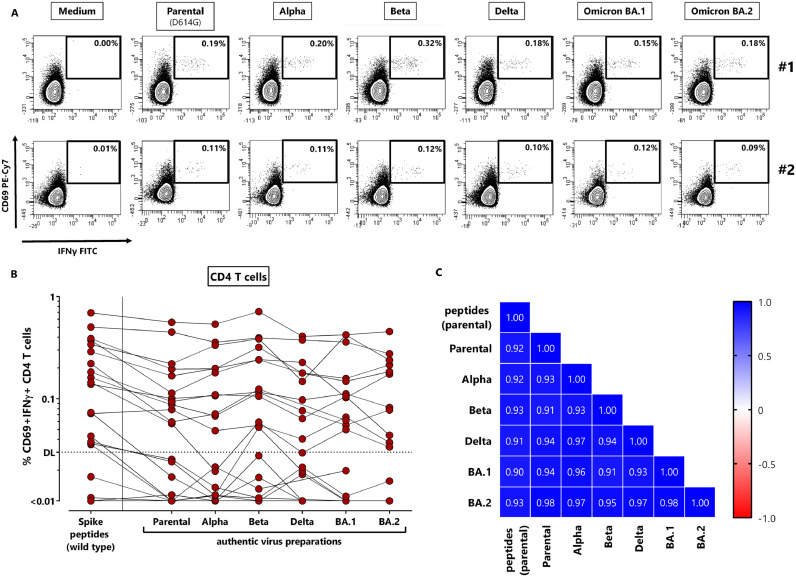
NVX-CoV2373-induced T-cells equally recognize parental SARS-CoV-2 and variants of concern. Whole blood samples of 22 NVX-CoV2373-vaccinated individuals 13–18 days after the second vaccination were stimulated with overlapping peptides of parental SARS-CoV-2 spike or UV-inactivated parental SARS-CoV-2 or variants of concern. (A) Dotplots of two individuals with detectable spike-specific CD4 T-cells are shown (#1: 56 year old female, #2: 32 year old male). Percentages of activated (CD69+) cells producing IFNγ among CD4 T-cells are shown after stimulation with medium (negative control), parental SARS-CoV-2 or variants Alpha, Beta, Delta, Omicron BA.1 and BA.2. (B) Specific CD4 T-cells were quantified for all individuals based on co-expression of CD69 and IFNγ with respective reactivity after control stimulation subtracted. Indeterminate results of one person had to be excluded due to excessive background reactivity in the medium control; Delta and BA.2 stimulations were available from 19 individuals only. (C) Correlation matrix of specific T-cell levels determined after stimulation with spike-peptides and the different UV-inactivated virus preparations. Correlation coefficients were calculated according to two-tailed Spearman and displayed using a color code. IFN, Interferon.
Fig 5
Fig. 5
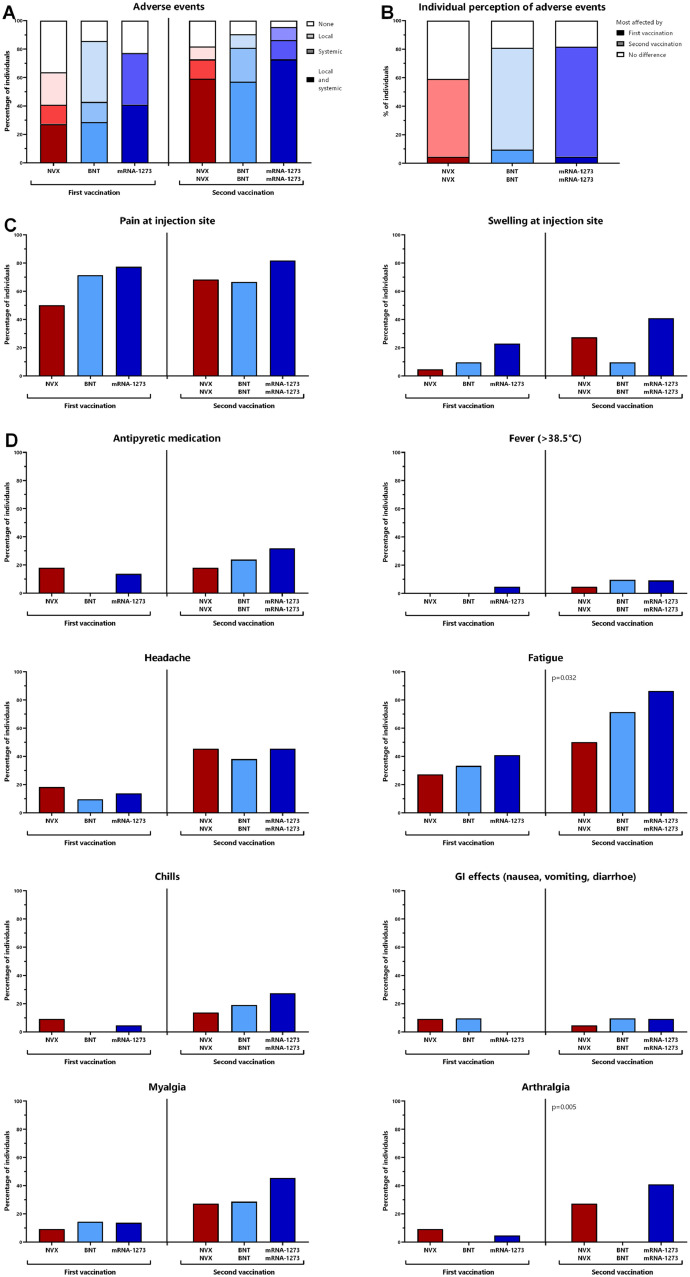
Reactogenicity after primary and secondary vaccination with NVX-CoV2373, BNT162b2 or mRNA-1273. Self-reported reactogenicity within the first week after the first and the second vaccine dose was assessed using a standardized questionnaire. (A) The presence of local or systemic adverse events or both in general, (B) individual perception of which of the two vaccinations affected more, (C) local adverse events, or (D) systemic adverse events are shown. Statistical analysis was performed using X² test. BNT, BNT162b2-vaccine; NVX, NVX-CoV2373-vaccine.

References

    1. European Medicine Agency (EMA). EMA recommends nuvaxovid for authorisation in the EU. 2021 20th december 2021 [cited; Available from: https://www.ema.europa.eu/en/news/ema-recommends-nuvaxovid-authorisation-eu.
    1. Ständige Impfkommission Aktualisierung der COVID-19-impfempfehlung. Epid. Bull. 2022;7:3–18.
    1. U.S. Food & Drug Administration (FDA). Coronavirus (COVID-19) update: FDA authorizes emergency use of novavax COVID-19 vaccine, adjuvanted. 2022 13th july [cited; Available from: https://www.fda.gov/news-events/press-announcements/coronavirus-COVID-19....
    1. Dunkle L.M., Kotloff K.L., Gay C.L., Anez G., Adelglass J.M., Barrat Hernandez A.Q., et al. Efficacy and safety of NVX-CoV2373 in adults in the United States and Mexico. N. Engl. J. Med. 2021 - PMC - PubMed
    1. Heath P.T., Galiza E.P., Baxter D.N., Boffito M., Browne D., Burns F., et al. Safety and efficacy of NVX-CoV2373 COVID-19 vaccine. N. Engl. J. Med. 2021;385:1172–1183. - PMC - PubMed

Publication types