Evaluation of Cardiac Mechanical Dyssynchrony in Heart Failure Patients Using Current Echo-Doppler Modalities
- PMID: 36280273
- PMCID: PMC9592249
- DOI: 10.4250/jcvi.2022.0061
Evaluation of Cardiac Mechanical Dyssynchrony in Heart Failure Patients Using Current Echo-Doppler Modalities
Abstract
Background: Current guidelines indicate electrical dyssynchrony as the major criteria for selecting patients for cardiac resynchronization therapy, and 25-35% of patients exhibit unfavorable responses to cardiac resynchronization therapy (CRT). We aimed to evaluate different cardiac mechanical dyssynchrony parameters in heart failure patients using current echo-Doppler modalities and we analyzed their association with electrical dyssynchrony.
Methods: The study included 120 heart failure with reduced ejection fraction (HFrEF) who underwent assessments for left ventricular mechanical dyssynchrony (LVMD) and interventricular mechanical dyssynchrony (IVMD).
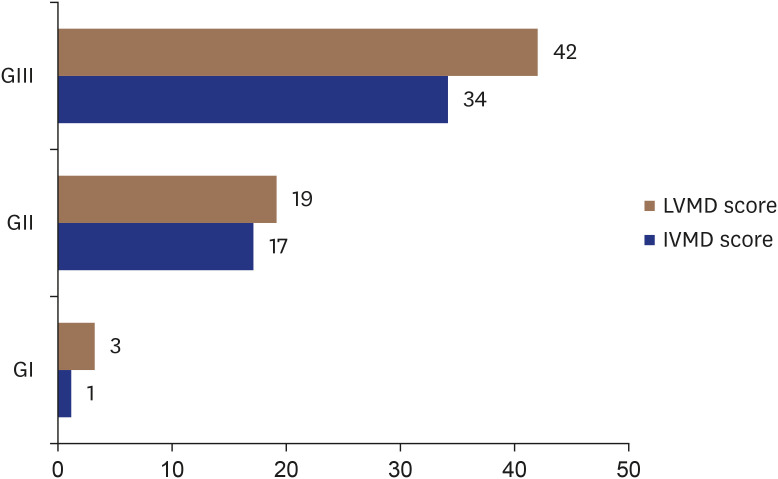
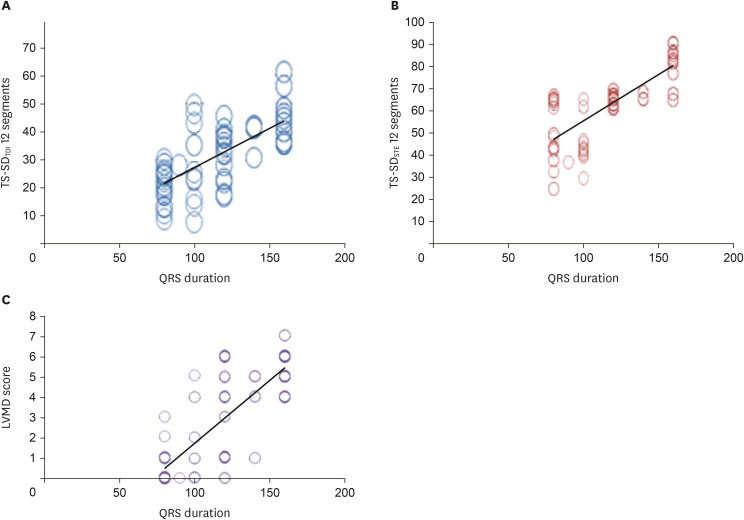
Results: Patients were classified according to QRS duration: group I with QRS < 120 ms, group II with QRS 120-149 ms, and group III with QRS ≥ 150 ms. Group III had significantly higher IVMD, LVMD indices, TS-SD speckle-tracking echocardiography (STE) 12 segments (standard deviation of time to peak longitudinal strain speckle tracking echocardiography in 12 LV-segments), and LVMD score compared with group I and group II. Group II and group III were classified according to QRS morphology into left bundle branch block (LBBB) and non-LBBB subgroups. LVMD score, TS-SD 12 TDI, and TS-SD 12 STE had good correlations with QRS duration.
Conclusions: HFrEF patients with wide QRS duration (> 150 ms) had more evident LVMD compared with patients with narrow or intermediate QRS. Those patients with intermediate QRS duration (120-150 ms) had substantial LVMD assessed by both TDI and 2D STE, regardless of QRS morphology. Subsequently, we suggest that LVMD indices might be employed as additive criteria to predict CRT response in that patient subgroup. Electrical and mechanical dyssynchrony were strongly correlated in HFrEF patients.
Keywords: Heart failure; Interventricuar mechanical delay; Left ventricular mechanical dyssynchrony score; Speckle tracking echocardiography.
Copyright © 2022 Korean Society of Echocardiography.
Conflict of interest statement
The authors have no financial conflicts of interest.
Figures
References
-
- Glikson M, Nielsen JC, Kronborg MB, et al. 2021 ESC Guidelines on cardiac pacing and cardiac resynchronization therapy. Eur Heart J. 2021;42:3427–3520. - PubMed
-
- Bank AJ, Burns KV, Gage RM. Echocardiographic measurement of mechanical dyssynchrony in heart failure and cardiac resynchronization therapy. US Cardiol Rev. 2010;7:24–32.
-
- Kleijn SA, Aly MF, Knol DL, et al. A meta-analysis of left ventricular dyssynchrony assessment and prediction of response to cardiac resynchronization therapy by three-dimensional echocardiography. Eur Heart J Cardiovasc Imaging. 2012;13:763–775. - PubMed
-
- Mor-Avi V, Lang RM, Badano LP, et al. Current and evolving echocardiographic techniques for the quantitative evaluation of cardiac mechanics: ASE/EAE consensus statement on methodology and indications endorsed by the Japanese Society of Echocardiography. J Am Soc Echocardiogr. 2011;24:277–313. - PubMed
-
- Dillikar MV, Venkateshvaran A, Barooah B, Varyani R, Kini P. Three-dimensional versus two - dimensional strain for the assessment of myocardial function: a case series. J Ind Acad Echocardiogr Cardiovasc Imaging. 2017;1:18–23.
LinkOut - more resources
Full Text Sources
Research Materials