


Using narratives to inform the development of a digital health intervention related to COVID-19 vaccination in Black young adults in Georgia, North Carolina and Alabama
- PMID: 36280559
- PMCID: PMC9581799
- DOI: 10.1016/j.vaccine.2022.10.027
Using narratives to inform the development of a digital health intervention related to COVID-19 vaccination in Black young adults in Georgia, North Carolina and Alabama
Abstract
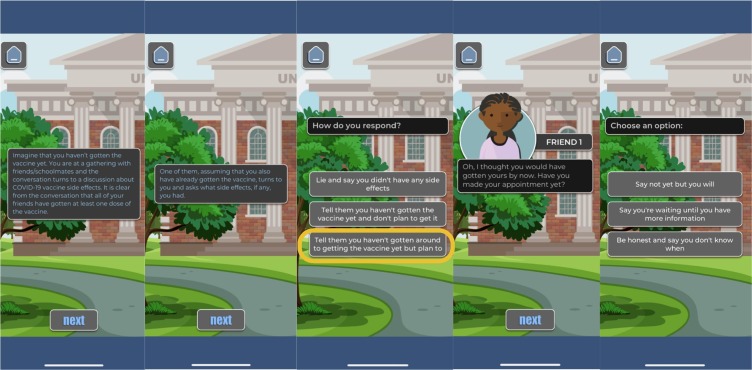
Interactive stories are a relatively newer form of storytelling with great potential to correct misinformation while increasing self-efficacy, which is crucial to vaccine acceptance. To address COVID-19 vaccine hesitancy and medical mistrust in young Black adults (BYA), we sought to adapt a pre-existing application ("app"; Tough Talks) designed to address HIV disclosure decision-making through choose-your-own adventure (CYOA) narratives and other activities. The adapted app (Tough Talks - COVID) uses a similar approach to situate COVID-19 vaccination decision-making within social contexts and to encourage greater deliberation about decisions. To inform content for the CYOA narratives, we conducted an online survey that was used to elicit the behavioral, cognitive, and environmental determinants influencing COVID-19 vaccine hesitancy among 150 BYA (ages 18-29) in Georgia, Alabama, and North Carolina. The survey included scenario questions that were developed with input from a youth advisory board to understand responses to peer and family influences. In two scenarios that involved discussions with family and friends about vaccination status, most respondents chose to be honest about their vaccination status. However, vaccinated individuals perceived more social pressure and stigma about not being vaccinated than unvaccinated respondents who were not as motivated by social pressure. Personal choice/agency in the face of perceived vaccine risks was a more common theme for unvaccinated respondents. Results suggest that relying on changing social norms alone may not impact barriers to vaccination in unvaccinated young adults without also addressing other barriers to vaccination such as concerns about autonomy and vaccine safety. Based on these findings, CYOA narratives in the app were adapted to include discussions with family and friends but also to touch on themes of personal choice as well as other topics that influence behaviors besides norms such as safety, side effects, and risk of COVID-19 in an evolving pandemic.
Keywords: COVID-19 vaccination; Digital Health Intervention; Mistrust; Narratives; Vaccine hesitancy.
Copyright © 2022 Elsevier Ltd. All rights reserved.
Conflict of interest statement
Declaration of Competing Interest The authors declare that they have no known competing financial interests or personal relationships that could have appeared to influence the work reported in this paper.
Figures
References
-
- CDC. COVID Data Tracker. https://covid.cdc.gov/covid-data-tracker/#national-lab. Published 2021, Accessed July 13, 2021.
-
- Lee J.J., Kang K.A., Wang M.P., et al. Associations Between COVID-19 Misinformation Exposure and Belief With COVID-19 Knowledge and Preventive Behaviors: Cross-Sectional Online Study. J Med Internet Res. 2020;22(11):e22205. https://www.jmir.org/2020/11/e22205 - PMC - PubMed
Publication types
MeSH terms
Substances
Grants and funding
LinkOut - more resources
Full Text Sources
Medical
