. 2023 Feb;28(2):564-578.
doi: 10.1038/s41380-022-01836-9. Epub 2022 Oct 24.

Long-COVID post-viral chronic fatigue and affective symptoms are associated with oxidative damage, lowered antioxidant defenses and inflammation: a proof of concept and mechanism study

Affiliations

Long-COVID post-viral chronic fatigue and affective symptoms are associated with oxidative damage, lowered antioxidant defenses and inflammation: a proof of concept and mechanism study

Hussein Kadhem Al-Hakeim et al. Mol Psychiatry. 2023 Feb.

Abstract

The immune-inflammatory response during the acute phase of COVID-19, as assessed using peak body temperature (PBT) and peripheral oxygen saturation (SpO2), predicts the severity of chronic fatigue, depression and anxiety symptoms 3-4 months later. The present study was performed to examine the effects of SpO2 and PBT during acute infection on immune, oxidative and nitrosative stress (IO&NS) pathways and neuropsychiatric symptoms of Long COVID. This study assayed SpO2 and PBT during acute COVID-19, and C-reactive protein (CRP), malondialdehyde (MDA), protein carbonyls (PCs), myeloperoxidase (MPO), nitric oxide (NO), zinc, and glutathione peroxidase (Gpx) in 120 Long COVID individuals and 36 controls. Cluster analysis showed that 31.7% of the Long COVID patients had severe abnormalities in SpO2, body temperature, increased oxidative toxicity (OSTOX) and lowered antioxidant defenses (ANTIOX), and increased total Hamilton Depression (HAMD) and Anxiety (HAMA) and Fibromylagia-Fatigue (FF) scores. Around 60% of the variance in the neuropsychiatric symptoms of Long COVID (a factor extracted from HAMD, HAMA and FF scores) was explained by OSTOX/ANTIOX ratio, PBT and SpO2. Increased PBT predicted increased CRP and lowered ANTIOX and zinc levels, while lowered SpO2 predicted lowered Gpx and increased NO production. Lowered SpO2 strongly predicts OSTOX/ANTIOX during Long COVID. In conclusion, the impact of acute COVID-19 on the symptoms of Long COVID is partly mediated by OSTOX/ANTIOX, especially lowered Gpx and zinc, increased MPO and NO production and lipid peroxidation-associated aldehyde formation. The results suggest that post-viral somatic and mental symptoms have a neuroimmune and neuro-oxidative origin.


Conflict of interest statement

The authors declare no competing interests.

Figures
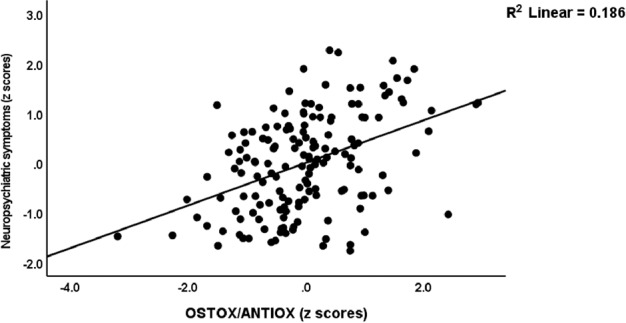
Fig. 1
Fig. 1. Correlation between Long COVID symptoms and oxidative stress.
Partial regression of the neuropsychiatric symptoms score on the oxidative stress toxicity/antioxidant (OSTOX/ANTIOX) ratio in patients with Long COVID and normal controls combined.
Fig. 2
Fig. 2. Correlation between oxidative stress and oxygen saturation in Long COVID.
Partial regression of the oxidative stress toxicity/antioxidant (OSTOX/ANTIOX) ratio in Long COVID patients on peripheral blood oxygen saturation (SpO2) during the acute phase of COVID-19. This regression is performed in Long COVID and control participants.
Fig. 3
Fig. 3. Correlation between CRP and body temperature during Long COVID.
Partial regression of serum C-reactive protein (CRP) in Long COVID patients on peak body temperature during the acute phase of COVID-19. This regression is performed in Long COVID and control participants.
Fig. 4
Fig. 4. Correlation between Long COVID symptoms and immune-oxidative pathways.
Partial regression of the neuropsychiatric symptoms score in Long COVID patients on a composite score based on increased oxidative stress toxicity and reduced antioxidant defences, peak body temperature and peripheral oxygen saturation (PBT + SpO2 + OSTOX). This regression is performed in Long COVID participants only.
Fig. 5
Fig. 5. Results or Partial Least Squares (PLS) analysis.
This model shows that the effects of reduced oxygen saturation (SpO2) and increased peak body temperature (PBT) during the acute phase of COVID-19 on the neuropsychiatric symptoms (NPS) of Long COVID are in part mediated by increased oxidative stress toxicity and lowered antioxidant defenses. The neuropsychiatric symptoms of Long COVID are entered as a latent vector extracted from subdomain scores on the Fibromylgia-Fatigue (FF), Hamilton Depression (HAMD) and Anxiety (HAMA) rating scales. sFF somatic FF symptoms, sHAMD and sHAMD somatic HAMD and HAMA scores, respectively, dHAMD depression HAMD scores, aHAMD anxiety HAMA scores, CRP C-reactive protein, Gpx glutathione peroxidase, TAC total antioxidant capacity, MPO myeloperoxidase, MDA malondialdehyde. Shown are path coefficients (with exact p values between brackets), loadings (with p values) of the latent vector and explained variance (white figures in blue circles).
Fig. 6
Fig. 6. Results of clustering analysis.
Results of cluster analysis with the formation of a new endophenotype class of patients with Long COVID (cluster 2) which is characterized by increased PBT (peak body temperature) and lowered peripheral oxygen saturation (SpO2) during acute COVID-19, and lowered zinc, Gpx (glutathione peroxidase) and TAC (total antioxidant capacity), and increased MDA (malondialdehyde), MPO (myeloperoxidase), NO (nitric oxide), PC (protein carbonyls), OSTOX/ANTIOX (oxidative stress toxicity/antioxidant defenses) ratio, CRP (C-reactive protein) and severity of the neuropsychiatric symptoms (NPS) 3–4 months after the acute phase (Long COVID).

References

    1. Dennis A, Wamil M, Alberts J, Oben J, Cuthbertson DJ, Wootton D, et al. Multiorgan impairment in low-risk individuals with post-COVID-19 syndrome: a prospective, community-based study. BMJ Open. 2021;11:e048391. doi: 10.1136/bmjopen-2020-048391. - DOI - PMC - PubMed
    1. Lu Y, Li X, Geng D, Mei N, Wu PY, Huang CC, et al. Cerebral Micro-Structural Changes in COVID-19 Patients - An MRI-based 3-month Follow-up Study. EClinicalMedicine. 2020;25:100484. doi: 10.1016/j.eclinm.2020.100484. - DOI - PMC - PubMed
    1. Miyazato Y, Morioka S, Tsuzuki S, Akashi M, Osanai Y, Tanaka K, et al. Prolonged and Late-Onset Symptoms of Coronavirus Disease 2019. Open Forum Infect Dis. 2020;7:ofaa507. doi: 10.1093/ofid/ofaa507. - DOI - PMC - PubMed
    1. van den Borst B, Peters JB, Brink M, Schoon Y, Bleeker-Rovers CP, Schers H, et al. Comprehensive Health Assessment 3 Months After Recovery From Acute Coronavirus Disease 2019 (COVID-19) Clin Infect Dis. 2021;73:e1089–98. doi: 10.1093/cid/ciaa1750. - DOI - PMC - PubMed
    1. Townsend L, Dowds J, O’Brien K, Sheill G, Dyer AH, O’Kelly B, et al. Persistent Poor Health after COVID-19 Is Not Associated with Respiratory Complications or Initial Disease Severity. Ann Am Thorac Soc. 2021;18:997–1003. doi: 10.1513/AnnalsATS.202009-1175OC. - DOI - PMC - PubMed
