


Oral Tau Aggregation Inhibitor for Alzheimer's Disease: Design, Progress and Basis for Selection of the 16 mg/day Dose in a Phase 3, Randomized, Placebo-Controlled Trial of Hydromethylthionine Mesylate
- PMID: 36281683
- PMCID: PMC9226274
- DOI: 10.14283/jpad.2022.63
Oral Tau Aggregation Inhibitor for Alzheimer's Disease: Design, Progress and Basis for Selection of the 16 mg/day Dose in a Phase 3, Randomized, Placebo-Controlled Trial of Hydromethylthionine Mesylate
Abstract
Background: Hydromethylthionine mesylate is a tau aggregation inhibitor shown to have exposure-dependent pharmacological activity on cognitive decline and brain atrophy in two completed Phase 3 trials in mild/moderate Alzheimer's disease (AD).
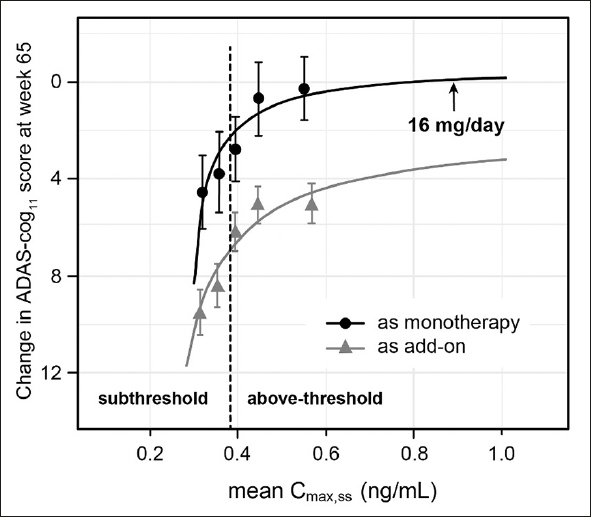
Objectives: The present report summarises the basis for selection of 16 mg/day as monotherapy as the optimal treatment regime and the design rationale of a confirmatory Phase 3 trial (LUCIDITY).
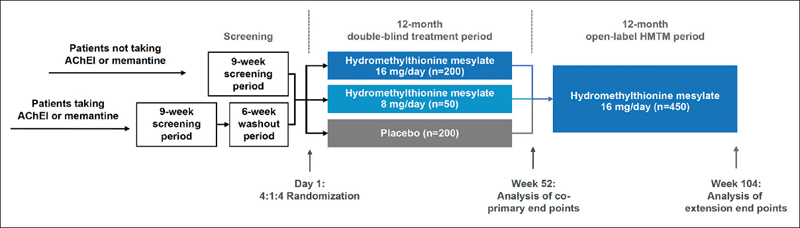
Design: The trial comprises a 12-month double-blind, placebo-controlled phase followed by a 12-month modified delayed-start open-label treatment phase.
Setting: 76 clinical research sites in North America and Europe.
Participants: 545 patients with probable AD or MCI-AD in the final version of the protocol.
Intervention: Participants were assigned randomly to receive hydromethylthione mesylate at doses of 16 mg/day, 8 mg/day or placebo at a 4:1:4 ratio during the double-blind phase. All participants in the open-label phase receive the 16 mg/day dose.
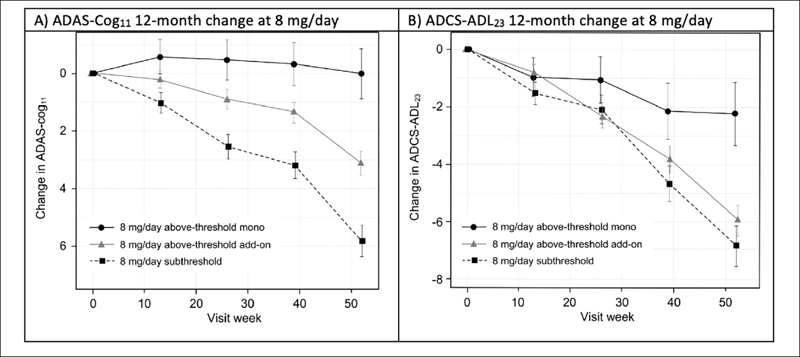
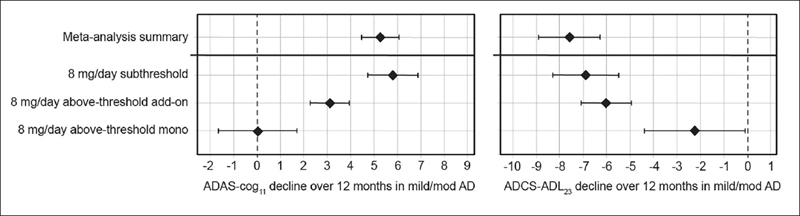
Measurements: Co-primary clinical outcomes are the 11-item Alzheimer's Disease Assessment Scale (ADAS-cog11) and the 23-item Alzheimer's Disease Cooperative Study - Activities of Daily Living (ADCS-ADL23). Secondary biomarker measures include whole-brain atrophy and temporal lobe 18F-fluorodeoxyglucose positron emission tomography.
Results: 446 participants are expected to complete the 12-month placebo-controlled phase in March 2022.
Conclusions: If the primary end points are met, the data will provide confirmatory evidence of the clinical and biomarker benefits of hydromethylthionine mesylate in minimal to moderate AD. As low-dose oral hydromethylthionine mesylate is simple to use clinically, does not cause amyloid-related imaging abnormalities and has a benign safety profile, it would likely improve AD management.
Keywords: Alzheimer’s disease; LMTM; Leuco-methylthioninium bis(hydromethanesulphonate); hydromethylthionine mesylate; tau aggregation inhibitor.
Conflict of interest statement
C.M.W. is an employee and officer of TauRx Therapeutics Ltd. S.M, B.S and P.B are employees of TauRx Therapeutics Ltd. S.G and K.K have received consulting fees from TauRx Therapeutics Ltd. C.M.W and B.S. are inventors on patents relating to neurodegenerative diseases that are owned by WisTa Laboratories Ltd, an affiliate of TauRx Therapeutics Ltd.
Figures
References
-
- Gauthier S, Rosa-Neto P, Morais J, Webster C. World Alzheimer Report 2021: Journey through the diagnosis of dementia. Alzheimer’s Disease International 2021. https://www.alzint.org/u/World-Alzheimer-Report-2021.pdf. Accessed 21 February 2022.
-
- Food and Drug Administration. FDA Grants Accelerated Approval for Alzheimer’s Drug. https://www.fda.gov/news-events/press-announcements/fda-grants-accelerat.... Accessed 25 January 2022.
Publication types
MeSH terms
Substances
LinkOut - more resources
Full Text Sources
Other Literature Sources
Medical
Research Materials
Miscellaneous