Clinical Trial
. 2022 Nov 21;145(11):3776-3786.
doi: 10.1093/brain/awac285.

Precuneus magnetic stimulation for Alzheimer's disease: a randomized, sham-controlled trial

Affiliations
Clinical Trial

Precuneus magnetic stimulation for Alzheimer's disease: a randomized, sham-controlled trial

Giacomo Koch et al. Brain. .

Abstract

Repetitive transcranial magnetic stimulation (rTMS) is emerging as a non-invasive therapeutic strategy in the battle against Alzheimer's disease. Alzheimer's disease patients primarily show alterations of the default mode network for which the precuneus is a key node. Here, we hypothesized that targeting the precuneus with TMS represents a promising strategy to slow down cognitive and functional decline in Alzheimer's disease patients. We performed a randomized, double-blind, sham-controlled, phase 2, 24-week trial to determine the safety and efficacy of precuneus stimulation in patients with mild-to-moderate Alzheimer's disease. Fifty Alzheimer's disease patients were randomly assigned in a 1:1 ratio to either receive precuneus or sham rTMS (mean age 73.7 years; 52% female). The trial included a 24-week treatment, with a 2-week intensive course in which rTMS (or sham) was applied daily five times per week, followed by a 22-week maintenance phase in which stimulation was applied once weekly. The Clinical Dementia Rating Scale-Sum of Boxes was selected as the primary outcome measure, in which post-treatment scores were compared to baseline. Secondary outcomes included score changes in the Alzheimer's Disease Assessment Scale-Cognitive Subscale, Mini-Mental State Examination and Alzheimer's Disease Cooperative Study-Activities of Daily Living scale. Moreover, single-pulse TMS in combination with EEG was used to assess neurophysiological changes in precuneus cortical excitability and oscillatory activity. Our findings show that patients that received precuneus repetitive magnetic stimulation presented a stable performance of the Clinical Dementia Rating Scale-Sum of Boxes score, whereas patients treated with sham showed a worsening of their score. Compared with the sham stimulation, patients in the precuneus stimulation group also showed also significantly better performances for the secondary outcome measures, including the Alzheimer's Disease Assessment Scale-Cognitive Subscale, Mini-Mental State Examination and Alzheimer's Disease Cooperative Study-Activities of Daily Living scale. Neurophysiological results showed that precuneus cortical excitability remained unchanged after 24 weeks in the precuneus stimulation group, whereas it was significantly reduced in the sham group. Finally, we found an enhancement of local gamma oscillations in the group treated with precuneus stimulation but not in patients treated with sham. We conclude that 24 weeks of precuneus rTMS may slow down cognitive and functional decline in Alzheimer's disease. Repetitive TMS targeting the default mode network could represent a novel therapeutic approach in Alzheimer's disease patients.

Keywords: Alzheimer’s disease; default mode network; plasticity; precuneus; transcranial magnetic stimulation.


Figures

Figure 1
Figure 1
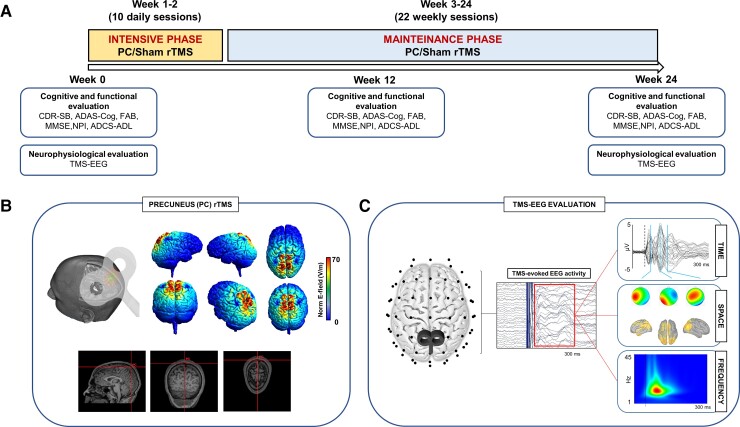
Schematic representation of the trial. (A) The trial consisted of a 24-week treatment that included a 2-week intensive course, in which PC-rTMS or sham-rTMS was applied daily (five times per week, Monday to Friday), followed by a maintenance phase in which the same stimulation was applied weekly for 22 weeks. (B) Location of the TMS coil on the scalp using neuronavigation, as visualized on a template head (top left), as well as the specific location in MRI space (bottom). Biophysical modelling based on simulated induced electric field are also shown for a representative subject (top right). (C) Cortical activity was evaluated with concurrent TMS and EEG applied over the PC and analysed in the temporal and oscillatory domain.
Figure 2
Figure 2
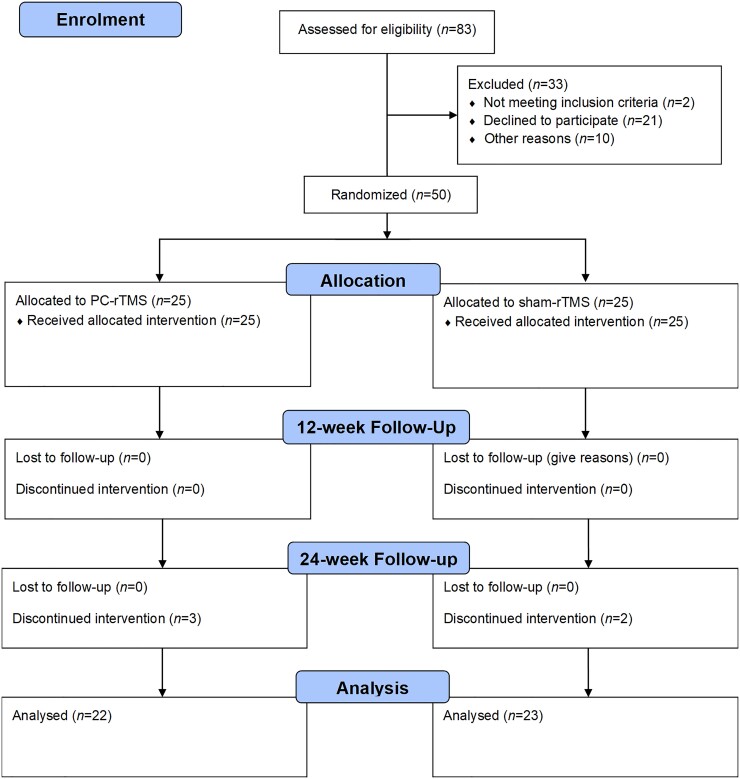
Flow diagram of the trial. Randomization, trial-group assignment, and follow-up in the trial.
Figure 3
Figure 3
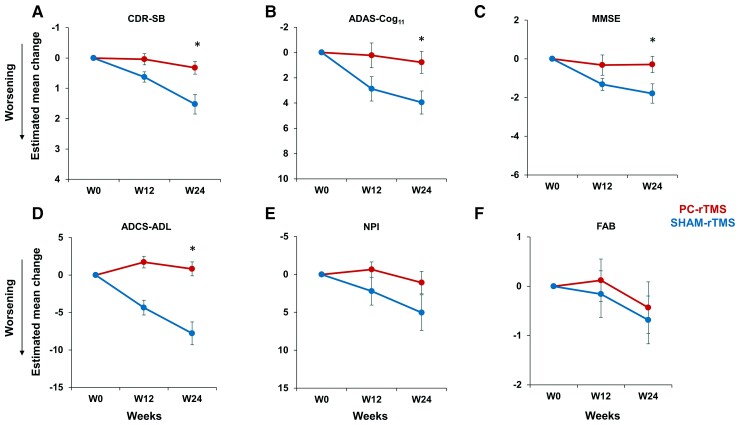
Estimated mean group changes for clinical scores. Estimated mean group changes from baseline (W0) in the CDR-SB, ADAS-Cog11, MMSE, ADCS-ADL, NPI, and FAB following 12 weeks (W12) and 24 weeks (W24) of PC-rTMS and sham-rTMS. Y-axis of each outcome was adapted in order to considering all depicted descending trend as a worsening. (A) GLMM estimated mean score change from baseline on the CDR-SB scale; scores are obtained by summing each of the domain box scores, with scores ranging from 0 to 18, with higher scores indicating worse cognition. (B) GLMM estimated mean score change from baseline for the ADAS-Cog11; scores range from 0 to 70, with higher scores indicating worse cognition. (C) GLMM estimated mean score change from baseline on the MMSE; scores range from 0 to 30, with lower scores indicating worse cognition. (D) GLMM estimated mean score change from baseline for the ADCS-ADL; scores range from 0 to 78, with lower scores indicating worse function. (E) GLMM mean score change from baseline on the NPI; scores range from 0 to 144, with higher scores indicating worse behavioural symptoms. (F) GLMM mean score change from baseline for the FAB; score ranges from 0 to 18, with higher scores indicating better frontal cognitive functions. Baseline is plotted at Week 0, which is the baseline measurement before the first rTMS session. Error bars indicate standard errors.
Figure 4
Figure 4
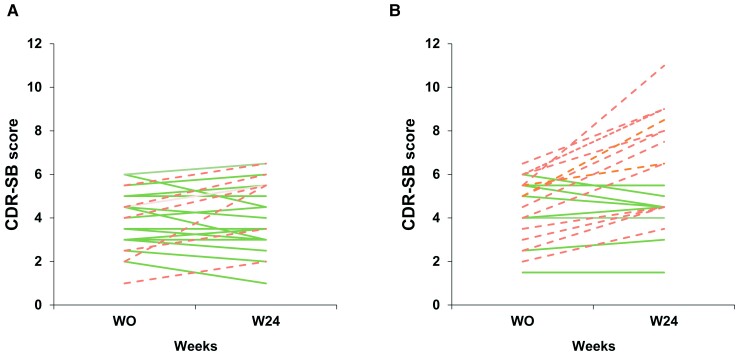
Individual changes in the CDR-SB scale. Line plot representing the individual CDR-SB scores before (W0) and at the end of the trial (W24) for the PC-rTMS group (A) and for the sham-rTMS group (B). Within each group, the solid lines indicate the responders, while the dashed lines represent the non-responders.
Figure 5
Figure 5
Changes in precuneus cortical activity. (A) TEPs before (W0) and after 24 weeks (W24) of PC-rTMS (light and dark lines, top) and sham-rTMS (light and dark lines, bottom). TEPs did not change in patients treated with PC-rTMS, while decreased TEP amplitudes were found in the sham-rTMS group. (B) Correlation analysis performed between the CDR-SB individual score change from baseline (W0) to 24 weeks (W24) in both PC-rTMS (top) or sham-rTMS (bottom) groups with individual TEP amplitude at baseline (W0) and with the TEP amplitude change from W0 to W24. Correlations were significant in the PC-rTMS but not in the sham-rTMS group. (C) TRSP before (W0) and after 24 weeks (W24) of PC-rTMS (top) and sham-rTMS (bottom), representing the power of oscillatory activity after single-pulse TMS over the precuneus. An increase of gamma activity was evident in the PC-rTMS, but not in the sham-rTMS group.

Comment in

References

    1. Scheltens P, De Strooper B, Kivipelto M, et al. . Alzheimer’s disease. Lancet. 2021; 397:1577–1590. - PMC - PubMed
    1. Kuller LH, Lopez OL. ENGAGE And EMERGE: truth and consequences? Alzheimers Dement. 2021;17:692–695. - PMC - PubMed
    1. Canter RG, Penney J, Tsai LH. The road to restoring neural circuits for the treatment of Alzheimer’s disease. Nature. 2016; 539:187–196. - PubMed
    1. Weiler M, Stieger KC, Long JM, Rapp PR. Transcranial magnetic stimulation in Alzheimer’s disease: are we ready? eNeuro. 2020;7:ENEURO.0235–19.2019. - PMC - PubMed
    1. Francesco DL, Koch G. Synaptic impairment: the new battlefield of Alzheimer’s disease. Alzheimers Dement. 2021;17:314–315. - PubMed

Publication types