


Heart rate variability and the risk of heart failure and its subtypes in post-menopausal women: The Women's Health Initiative study
- PMID: 36282885
- PMCID: PMC9595519
- DOI: 10.1371/journal.pone.0276585
Heart rate variability and the risk of heart failure and its subtypes in post-menopausal women: The Women's Health Initiative study
Abstract
Background: Low heart rate variability (HRV), a measure of autonomic imbalance, is associated with increased risk of coronary heart disease (CHD) and heart failure (HF). However, its relationship with HF subtypes; heart failure with preserved ejection fraction (HFpEF) and heart failure with reduced ejection fraction (HFrEF) has not been studied prior.
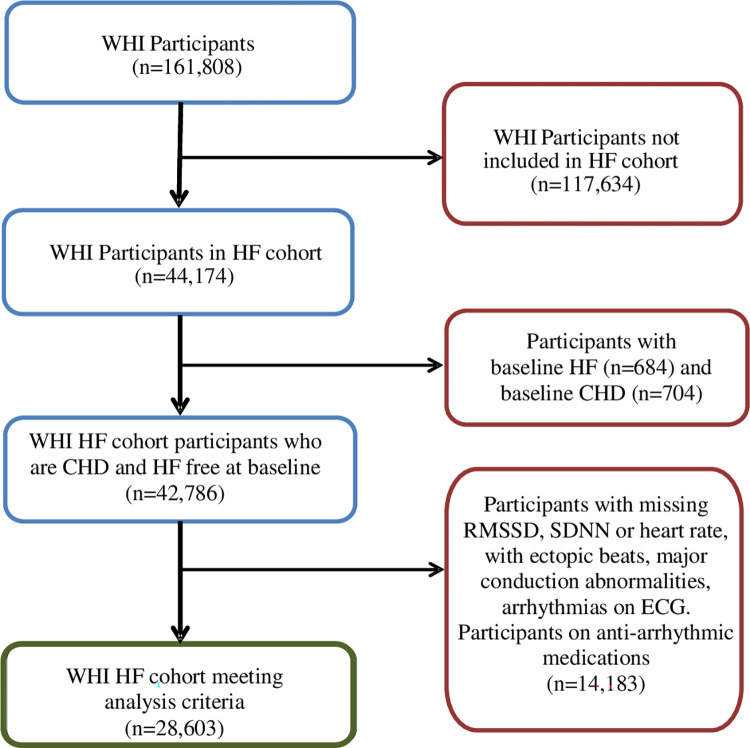
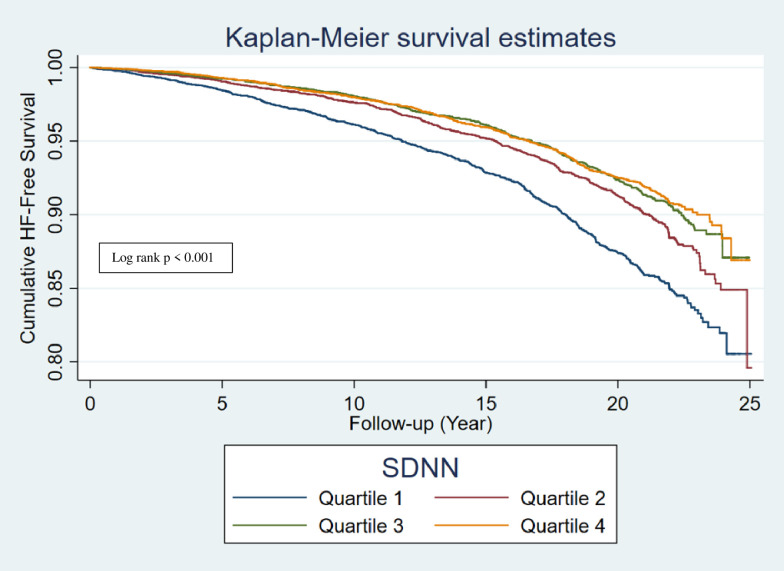
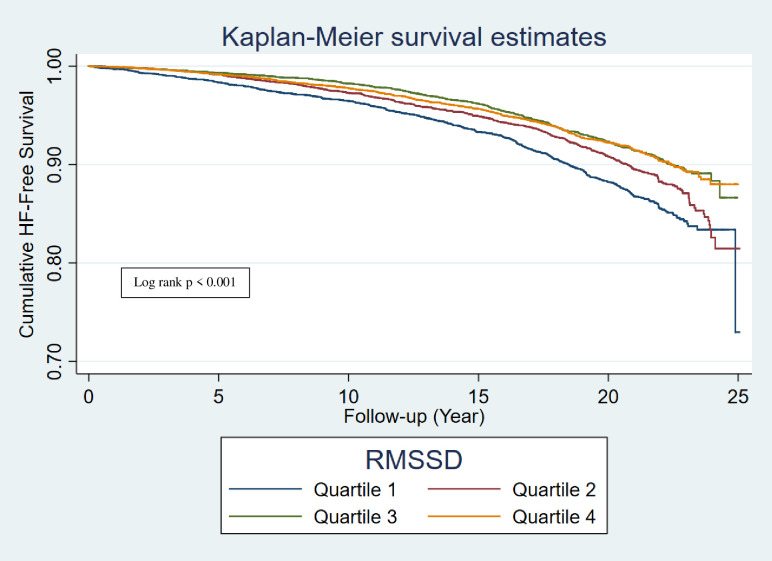
Methods and findings: We conducted a longitudinal study in Women's Health Initiative study cohort to investigate the association of baseline quartiles of resting heart rate (rHR) and HRV measures; SDNN (SD of normal-to-normal RR interval) and RMSSD (root mean square of successive difference of RR interval) measured by twelve-lead electrocardiogram (ECG) on enrollment, with the risk of hospitalized HF and its subtypes. Total of 28,603 post-menopausal women, predominantly non-Hispanic whites (69%), with a mean (SD) age of 62.6 (7.1) years, free of baseline CHD and HF were included. In a fully adjusted cox-proportional hazards regression model which adjusted for age, race, BMI, alcohol intake, education, physical activity, hyperlipidemia, hypertension, left ventricular hypertrophy, use of beta-blocker, calcium-channel blocker, hormone therapy, and time-varying incident CHD, the hazard ratios of lowest quartile of HRV (Q1) with HF risk were significant (Q1 SDNN compared to Q4 SDNN: 1.22, 95% CI 1.07, 1.39; Q1 RMSSD compared to Q4 RMSSD: 1.17, 95% CI 1.02, 1.33). On subgroup analysis of HF subtypes, low HRV was associated with elevated HFpEF risk (Q1 vs Q4 SDNN: 1.22, 95% CI 1.02, 1.47) but not with HFrEF (Q1 vs Q4 SDNN: 1.19, 95% CI 0.95, 1.50; Q1 RMSSD: 1.13, 95% CI 0.90, 1.43).
Conclusion: Low HRV is associated with elevated overall hospitalized HF risk and HFpEF risk in post-menopausal women. Whether interventions to increase HRV through healthy lifestyle changes will decrease HF risk warrants further investigation.
Conflict of interest statement
The authors have declared that no competing interests exist.
Figures
References
-
- National Heart, Lung, and Blood Institute, National Institutes of Health: Incidence and Prevalence: 2006 Chart Book on Cardiovascular and Lung Diseases. Bethesda, MD: National Heart, Lung, and Blood Institute; 2006.
-
- Shusterman V, Aysin B, Gottipaty V, Weiss R, Brode S, Schwartzman D, et al. Autonomic nervous system activity and the spontaneous initiation of ventricular tachycardia. ESVEM Investigators. Electrophysiologic Study Versus Electrocardiographic Monitoring Trial. J Am Coll Cardiol. 1998;32(7):1891–9. doi: 10.1016/s0735-1097(98)00468-9 - DOI - PubMed
-
- Tsuji H, Larson MG, Venditti FJ Jr, Manders ES, Evans JC, Feldman CL, et al. Impact of reduced heart rate variability on risk for cardiac events. The Framingham Heart Study. Circulation. 1996;94(11):2850–5. - PubMed
MeSH terms
Substances
LinkOut - more resources
Full Text Sources
Medical
Research Materials
Miscellaneous
